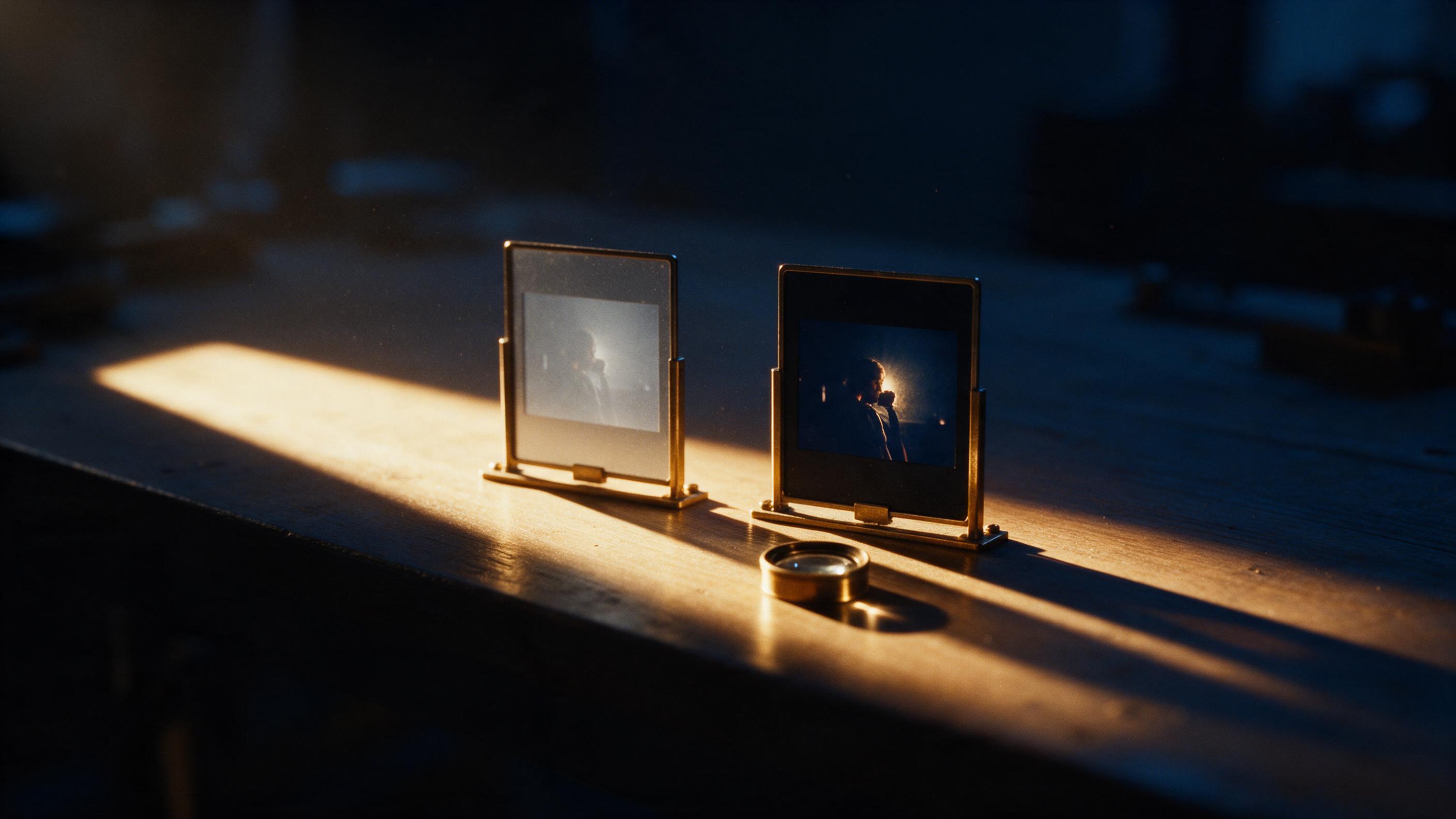
The Grade Is The Last Decision
Contrast, shadows and highlights baked into the render are 3 decisions that can never be revisited. Keep the capture flat and the grade stays the last move in the sequence, where the emotion is still editable.
Three Things You Cannot Get Back
Contrast, shadows and highlights. 3 things, and all 3 of them are gone the moment they are printed into the pixels. Embed them in the render and there is nothing left to work with afterwards. The footage is finished before the edit starts, and every cut after that is a cut through a decision that was made too early to know what the film needed. Baked into the render, a look is a fact. Held flat, it is still a decision. Only 1 of those 2 things can change when a scene turns out to want something else. A shadow graded into the file is not a shadow any more. It is a value, and the only tool that can still move it is a reshoot. 3 things. Count them before the first render and that number is the whole margin on the piece.
Flat Is Not A Look
Flat capture is not a style and it is not a compromise. It is a data decision. The file that comes out of a flat capture carries the full range. The highlights still have room above them, the shadows still have room below them, and the contrast curve has not been drawn yet. Someone watching the raw file would call it washed out. That is the point. It is an unfinished decision rather than an unfinished shot. 2 stages exist in the pipeline, capture and post, and the mistake is moving the look work into the 1st stage, where it cannot be undone. 2 stages, 3 channels, 1 order. Get the order wrong and there is no tool downstream that can put the choice back. Baked-in looks are unmanageable precisely because they are no longer looks. They are the picture.
The Grade Is The Last Move
The sequence runs 1 way. Shoot flat, then grade, and grade last. Not the last step of the edit because it is the least important 1, but because it is the 1 that decides what the audience feels about everything already in front of them. Decide the grade 1st, at the front of the pipeline, and the emotion is locked before the shape of the film is even known. Decide it last and every earlier choice is still open while the film is being assembled. Grade once, at the end, so the film is held together by 1 signature colour instead of 40 corrections chasing each other around 40 shots. 1 pass at the end beats 40 adjustments in the middle, and it beats them on cost as well as on coherence.
A LoRA Can Grade
Grading in post does not require a colour suite and a room with a calibrated monitor. A LoRA can carry the grade, applied to finished footage instead of burned into the render. The difference is not quality. It is reversibility. A preset built into the render is decided before the render exists. A LoRA in post is applied after, which means it can be swapped, softened or removed on the day the film comes together. 4 formats, 3 stocks, and the grade sits on top of all of them, applied once the images are already on disk. The 500 tungsten stock, the 50 and 250 daylight stocks, the 5222 for a black and white sequence: those are capture decisions and they stay in capture. The look is a post decision and it stays in post. Keep the grade editable to the end and the film can still be saved. Burn it in early and the film shipped its mistakes before anyone had seen the whole thing.
Baked into the render, a look is a fact. Held flat, it is still a decision.
The Grade Sells The Realism
There is a reason graded footage reads as more real than the raw render, and it is not saturation. An ungraded image reads as a file. A graded image reads as a frame of film, because the eye is matching it against everything it has ever seen projected, and that comparison happens in the first half of a second. The grade is what sells the realism, which is exactly why it is the last move rather than the 1st. If the realism were baked in during capture, there would be nothing left for the grade to do and nothing left for the audience to accept. Same footage, 2 endings. Grade last and the realism arrives with the final pass. Bake it early and the realism is a side effect nobody chose.
Shoot For Data, Decide The Emotion In Post
The principle underneath everything above it is 1 sentence long: shoot for data, decide the emotion in post. That is the whole method. Capture the widest range the sensor will give, hold the look back, and let the grade be the last decision the film receives rather than the 1st. Built companies across twelve countries. Restructured a EUR 75 million industrial group. Deployed 210 energy systems across Africa and Asia. Took a company through a Frankfurt IPO. Entrade built 200 wood-gasification machines across the UK and Europe. 16 years of field work from rural Nigeria to Fukushima. 393 pages in paperback and Kindle, published 8 April 2026. The probability that a look locked at capture time still fits the film at delivery is close to 0, and the probability that a look decided in post still fits is close to 1. It is the difference between a film that can still be saved and a film that shipped its mistakes. Same footage, same budget, 1 decision about when the look is allowed to happen.
Flat capture is not a style. It is the only thing that keeps every ending available.
The map is dead. Nobody told you.
Bali State of Mind is the survival guide for the collapse of everything you were taught to believe.
Beyond this book
Building the same thing somewhere else.
Julien Uhlig is available for advisory work, board seats and media appearances. Write to media@exventure.co.
The academy that trains the operators, across every company in the group, is EX Epic Academy - 25,000 applications, 25 seats per cohort, 210 alumni across 19 countries. academy.epicsolutiongroup.com
18-20 November. Online, Las Palmas, Bali.
Three days on what happens to work, capital and institutions when the map stops matching the ground. Seats are limited by cohort.
ex-aisummit.com →