The Finger That Borrowed A Camera
The best touch sensor of the last twenty years was built by a man who studied eyes. In 2009 Edward Adelson's group at MIT pressed a block of clear gel against a surface and photographed what happened underneath. Nothing about that is a tactile sensor except the answer it produced - and the answer was the whole field's problem.
The Man Who Studied Eyes
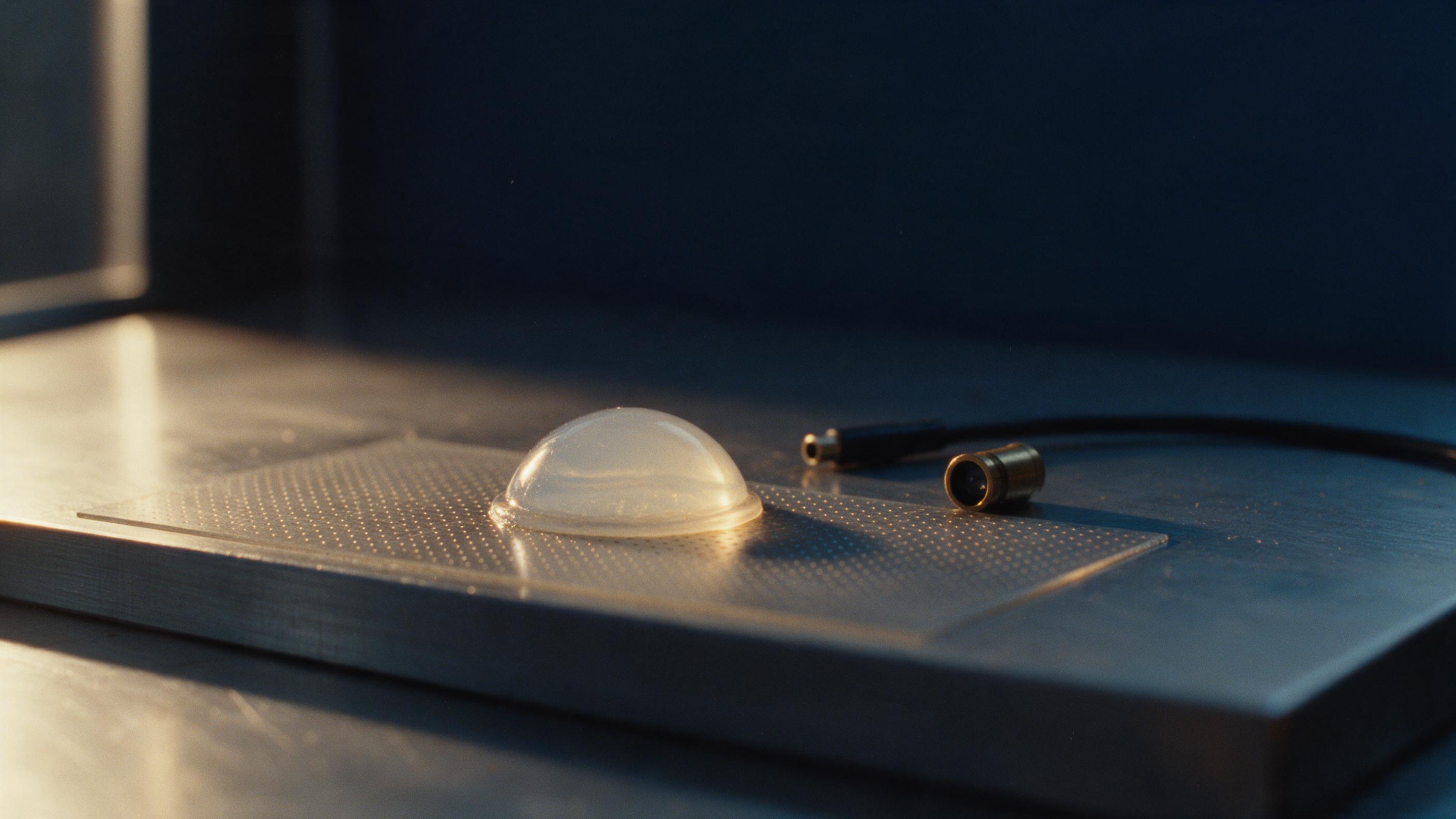
Edward Adelson did not set out to build a tactile sensor. He studied vision: how a retina turns light into an image, how a mind reads shape out of shading, how roughness reads off a still photograph. Texture was his subject long before touch was. In 2009 his group at MIT's Computer Science and Artificial Intelligence Laboratory, at 32 Vassar Street in Cambridge, Massachusetts, put a camera inside a block of clear gel and pressed the gel against things. The 2009 paper that introduced it was called Retrographic sensing for the measurement of surface texture and shape. That is the device. A camera, a gel, a light, and a lens aimed at the back of the gel. The first implementation was Micah Johnson's doctoral work. It was not a sensor in the way the field used the word. There was no resistance to measure and no capacitance to read. There was a photograph of a surface under load. A man who spent his career on photographs built the best touch sensor of its decade, and he built it by refusing to build a touch sensor.
Ten Micrometres Through A Sheet Of Gel
The number that made people look was resolution. GelSight resolved surface features as small as 10 micrometres. That is 0.01 millimetres, and it was an order of magnitude finer than any electrical tactile sensor of the day. The gap could not close on the electrical side, and the reason is structural. An electrical skin needs a sensing element at every point it can feel, so resolution and wiring density are the same question asked twice. Push the pitch down and you buy crosstalk, drift and a ribbon of copper you cannot route. A camera-based sensor needs one camera and one deformable medium. Its resolution is a property of optics, and optics had been improving for centuries before this problem existed. Nothing about the trade was hidden. The design bought resolution with bulk: a focal distance, a rigid camera body, and a sensor that could not be wrapped around a fingertip. Every advantage in sensing is paid for somewhere. This one was paid for in geometry.
The Output Changed, Not The Sensor
The honest description of GelSight is that it did not solve tactile sensing. It changed what tactile sensing outputs. An electrical taxel reports a number. A camera-based sensor reports an image, and an image was something machine vision already knew how to consume in 2009. That reclassification is why the work travelled. Between 2014 and 2020 the same group showed that objects can be identified, materials told apart and surface texture detected from touch alone - all of it read off images. So the hard problem was restated. It had been posed as a sensing problem for the better part of thirty years. It came back as an interpretation problem, and interpretation is a much larger field with a much deeper bench. The probability that a single number per contact point carries the next decade of robot hands is not zero. Most roadmaps price it at zero, and that is the mistake the field kept making before the gel. When the answer to a sensing problem is an image, you have not solved sensing. You have changed who is qualified to work on it.
The Fingertip Was The Hard Part
Resolution was easy. A fingertip was not. GelSight as first built was a bench instrument: a camera pointed down at a slab of gel. Putting that on a robot finger meant folding the optical path in half and bending it sideways. GelSlim, published in 2014 and detailed in a 2019 paper, did exactly that with mirrors and waveguides, and produced a finger compact enough to mount, robust enough to keep using, and calibrated enough to trust. The people who carried it are a short and specific list. Daolin Ma built the fingertip form factor. Wenzhen Yuan worked out geometry calibration and texture reconstruction. Shaoxiong Wang took edge detection and material recognition. Daniel Seita took reinforcement learning with tactile feedback. A bench instrument that resolves 10 micrometres is a paper. A finger that resolves 10 micrometres is a product, and the distance between those two sentences was five years, from 2009 to 2014. The optics were never the hard part. The mounting was.
A vision scientist built the best touch sensor of its decade by refusing to build a touch sensor.
Markers Inside The Gel Give You Three Axes
Two things travelled with the design, and only one of them was intended. The unintended one was openness. The group published its designs, and they were replicated and modified in dozens of labs worldwide. In 2020 two other groups, working independently and openly inspired by GelSight, released DIGIT and OmniTact, and the camera-behind-gel pattern became the default starting point for anyone building a finger. The intended one was markers. Print a tracking pattern on the inside of the gel and the deformation reads as a field of moving dots. That gives force reconstruction in all three axes rather than pressure alone, which is the difference between a picture and a signal. A sensor that measures pressure tells you a hand is closed. A sensor that resolves three axes tells you how the hand is slipping. Ten micrometres of resolution sounds like the achievement. Three axes of force is what a robot actually needs.
The Spinout Went To The Factory Floor
Follow the money and the story gets honest. The commercial spinout from this work went after industrial surface inspection rather than robotics. Panels, turbine blades, painted bodywork: flat, expensive, stationary surfaces with a defect tolerance measured in micrometres. That is not a failure of the technology. It is a reading of where the buyer stood. A factory line has a budget line for inspection, a fixed station, and a hard number attached to a missed flaw. A robot hand has a research grant and an integration problem. Anyone who has built companies across twelve countries will recognise it. The technology went where the invoice already existed. Seventeen years after the gel block in Cambridge, no one has put this sensor on every finger. The probability that the winning design for artificial touch is the one with a camera inside it is not zero. The factories have been pricing that above zero since 2009, and the robots have not. The sensor borrowed a camera to see. The market borrowed the sensor to inspect, and left the hands waiting.
The resolution you get from a camera is a property of optics. The resolution you get from an array is a property of your wiring budget.
The map is dead. Nobody told you.
Bali State of Mind is the survival guide for the collapse of everything you were taught to believe.
Beyond this book
Building the same thing somewhere else.
Julien Uhlig is available for advisory work, board seats and media appearances. Write to media@exventure.co.
The academy that trains the operators, across every company in the group, is EX Epic Academy - 25,000 applications, 25 seats per cohort, 210 alumni across 19 countries. academy.epicsolutiongroup.com
18-20 November. Online, Las Palmas, Bali.
Three days on what happens to work, capital and institutions when the map stops matching the ground. Seats are limited by cohort.
ex-aisummit.com →