The Filter Before The Nerve
Ask what a touch receptor actually receives and the honest answer is not the contact. It is what survived the tissue. Skin filters, amplifies and reshapes a contact before a single nerve fires, and the numbers behind that pre-processing read as a specification sheet for anyone building a sensing stack. The transducer is the easy half. The layer in front of it decides whether the rest works.
The Layer That Does The Arithmetic
The outer epidermis of human skin runs from 0.05 millimetres to about 1.5 millimetres thick, and the outermost 10 to 20 micrometres of it is dead keratinised tissue. Under that sits the living epidermis, then the dermis at 1 to 4 millimetres, then a fat layer doing the cushioning. Read as a stack of materials, it looks like packaging around a sensor bed. Read as a signal path, it looks like something else. Every contact passes through those layers before it reaches a single receptor, and the tissue changes the shape of the signal on the way: it removes one part, boosts another, and spreads a point load over a wider patch of surface. The distinction matters because it is the cheapest answer to a problem that engineered stacks keep handing to software. A bare transducer sees everything, including the parts nobody wants, and then a filter has to be written to throw those parts away. Skin does the removal in the material, once, for nothing.
What The Ridges Do To A Vibration
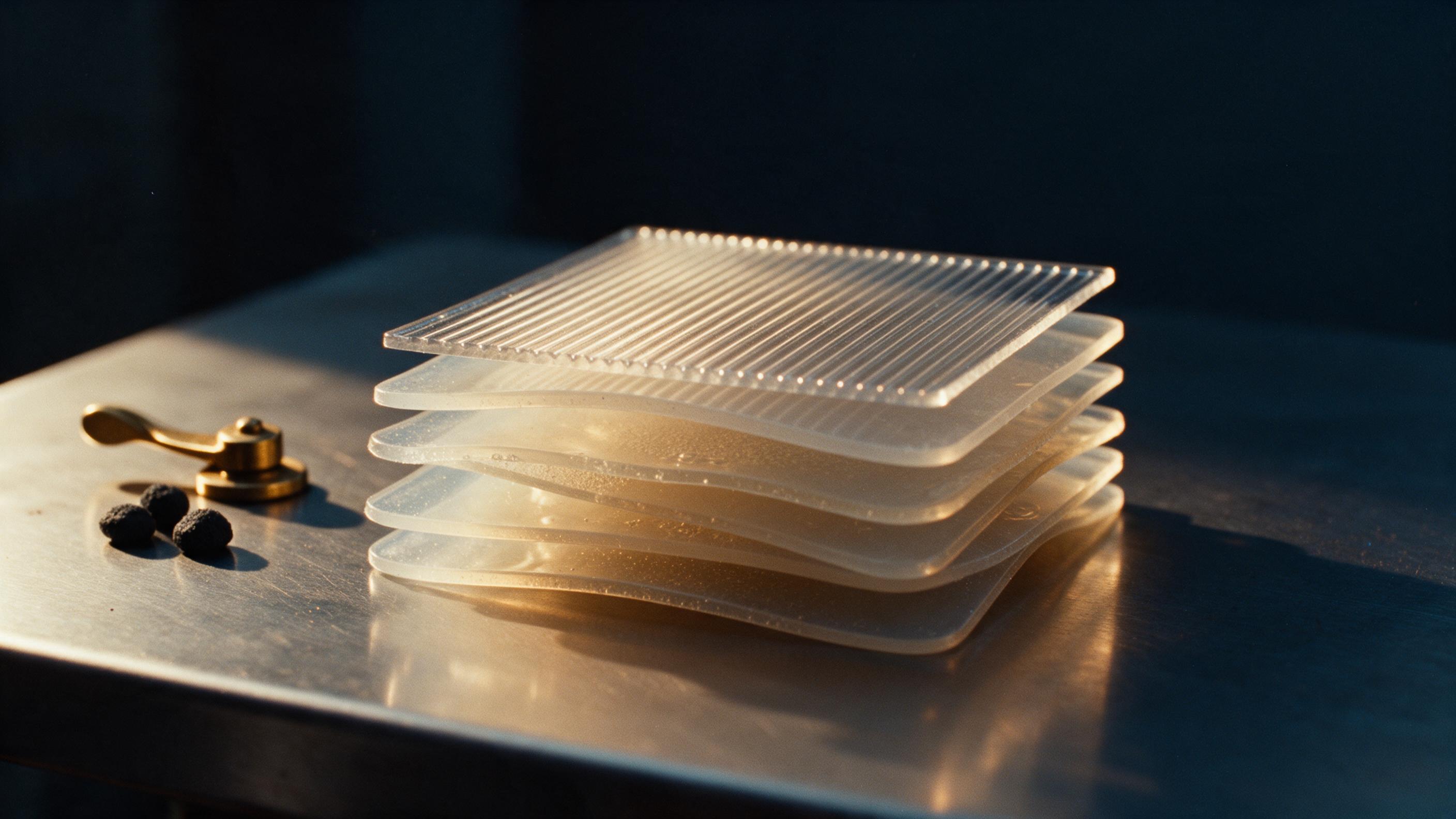
Fingerprint ridges sit at a pitch of 200 to 400 micrometres. They are not decoration and they are not grip texture alone. They behave as a mechanical bandpass filter: they amplify the 50 to 500 hertz band where texture and the onset of slip show up, and they attenuate the slow component beneath it. The consequence is easy to miss. The channel that reports vibration never has to deal with drift, because the drift was removed upstream by shape. In an engineered pad, adding ridges measurably improves slip detection and texture discrimination, and the mechanism is the same one: the pattern does arithmetic on the waveform before anything electronic sees it. That is worth stating as a design rule rather than a curiosity. If a mechanical feature can delete a failure mode from the signal, the algorithm downstream gets simpler, the power budget gets smaller and the recalibration schedule gets longer.
The Stack Separates Fast From Slow
Layered viscoelastic tissue carries a frequency-dependent mechanical impedance, and that is the second filter in the chain. It splits a single contact into a fast channel and a slow channel before the nerve endings do anything about it. The slow side is handled by Merkel cells at the base of the epidermis, which hold a sustained pressure and report how hard the grip is, and by Ruffini endings that read lateral stretch. The fast side is handled by Meissner corpuscles and Pacinian corpuscles, which report change and go quiet when the world stops moving; the Pacinian endings sit deep in the dermis and in the fat beneath it, where the tissue has already filtered what reaches them. The epidermal-dermal junction is not flat. It is folded into dermal papillae, which increases the coupling area and forms a mechanical lever arm that amplifies lateral shear at the Merkel cell interface. Shear is the hardest component of touch to read with a flat element. Here it arrives already amplified, delivered by the shape of the boundary rather than by an amplifier.
Compliance Is Control Work Done By Shape
A fingertip indents 1 to 2 millimetres under a firm press, and while it does that it conforms to whatever rough surface it is touching. Conformal contact means the soft layer has already worked out the geometry of the contact mechanically, so the controller above it has less to correct and fewer ways to be wrong. This is why the mechanical layer keeps turning up in places that look unrelated to sensing. Grip depends on friction, and dry skin runs at a coefficient of 0.4 to 0.8, which makes friction a design target rather than a footnote. Heat is handled in the same layer: skin conducts at only 0.2 to 0.5 watts per metre kelvin, so the fat underneath cushions and insulates at the same time, and the surface stays comfortable while it measures. There is an older way to say this. A robot with no touch is a disembodied eye. A robot with touch has a boundary it can feel, and the softness and shape of that boundary is the difference between registering a contact and understanding one.
By the time a nerve fires, the contact has already been edited.
The Numbers A Wearable Has To Match
Young's modulus is the headline figure. Skin sits at 10 to 100 kilopascals. Silicon sits near 150 gigapascals. The gap between them is six orders of magnitude, and it is the reason a stiff element bonded to a soft body fails at the joint long before it fails in the die. The rest of the specification is quoted less often. Tensile strength of 5 to 30 megapascals, which is tough for something that soft. Elongation at break of 30 to 70 per cent if the skin is meant to move with a joint or a finger. Thermal conductivity of 0.2 to 0.5 watts per metre kelvin. Water vapour transmission of roughly 200 to 400 grams per square metre per day, which is the breathability figure that decides whether a wearable is worn or abandoned. Then the compromise no datasheet resolves. The outermost protective layer has to be thin enough for sensitivity and thick enough to survive abrasion, and those two requirements push in opposite directions. Self-healing materials are the current answer, and they are an answer about the layer, not about the sensor.
Specify The Filter First
The rule that follows is a sequencing rule. The mechanical layer is stage one of the pipeline rather than packaging in front of it, so its modulus, its thickness, its ridge pitch and its viscoelastic behaviour belong in the specification before a transducer is chosen. Companies that have built a sensing product will recognise the pattern: the part that looked like housing turned out to be the part that set the limits. Morphology can be made to do work. A soft pad that conforms to an object has already computed the contact geometry, which leaves the algorithm less to compute and less to get wrong. Layered designs that copy the protection-sensing-isolation stack of skin hold up better than monolithic ones for the same reason, and artificial ridges earn their place in the same way. The probability that one material stack covers every contact regime well is small, and pricing it above 20 per cent asks a lot of a single layer. Skin resolved this at the bottom of the stack, in material, before anything expensive was allowed to see the signal. That is still the cheapest place to put a filter, and it is usually the last place a project looks.
The tissue is not packaging. It is the first stage of the pipeline.
The map is dead. Nobody told you.
Bali State of Mind is the survival guide for the collapse of everything you were taught to believe.
Beyond this book
Building the same thing somewhere else.
Julien Uhlig is available for advisory work, board seats and media appearances. Write to media@exventure.co.
The academy that trains the operators, across every company in the group, is EX Epic Academy - 25,000 applications, 25 seats per cohort, 210 alumni across 19 countries. academy.epicsolutiongroup.com
18-20 November. Online, Las Palmas, Bali.
Three days on what happens to work, capital and institutions when the map stops matching the ground. Seats are limited by cohort.
ex-aisummit.com →