The Field Does The Measuring
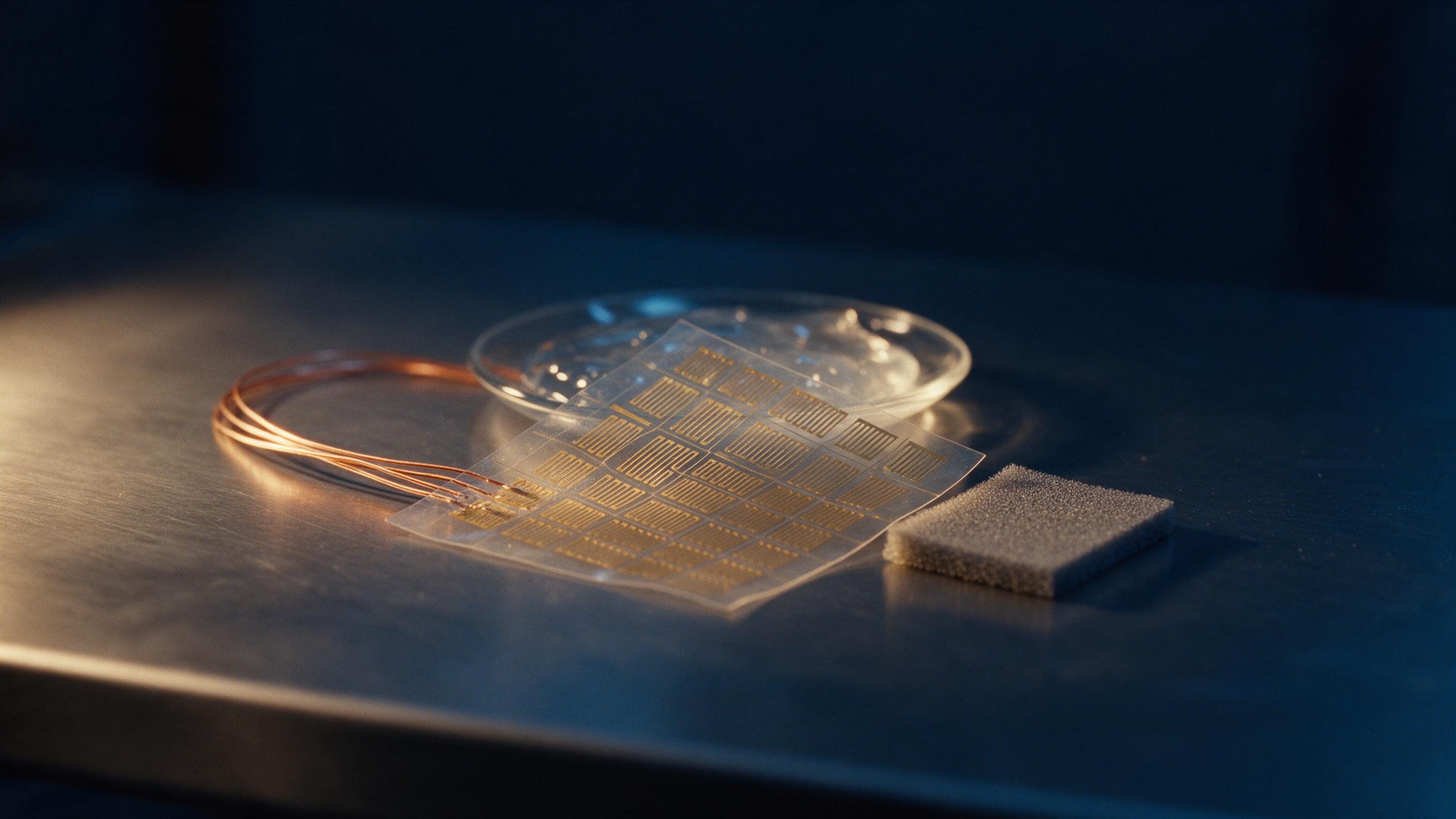
Capacitive sensing is the most commercially successful touch technology in history, and it works by watching a gap close. Two electrodes are separated by a compressible dielectric; pressure squeezes the plates together and the capacitance rises. It reads 0.01 to 100 kilopascals across a 0.5 to 5 millimetre taxel pitch in under 1 millisecond, it draws under 1 microwatt per taxel, and every phone on the planet already paid for the factory that makes it.
The Sensor That Already Won
The screen you are reading this on is a capacitive sensor. So is the phone in your pocket and the trackpad on 200 million laptops. Projected capacitance is the most commercially successful touch technology in history, shipped in billions of devices. That matters to anyone building electronic skin, and not for the reason it sounds like. It matters because a phone company already paid for the hard part. The electrode deposition lines, the low-cost readout chips, the standard scanning protocols, the shielding practice: all of it was funded by consumer volume over 20 years of iteration, at a unit cost no robotics programme could have underwritten on its own. A tactile array that chooses capacitance starts on a supply chain it did not have to build.
A Gap That Closes
Two conductive electrodes, one compressible dielectric between them, and the device is a parallel-plate capacitor. Pressure squeezes the plates closer, the gap shrinks, the capacitance rises. The relation is the dielectric constant times the permittivity of free space times overlap area, divided by the distance between the plates, and the only term the outside world gets to move is the distance. Read that twice, because it tells you what the sensor can and cannot do. It reports load, not change. Hold a stone against a capacitive pad for an hour and the reading holds steady, because the plates are still that far apart. Put a piezoelectric film in the same place and you get the moment of contact, followed by a slow drift back toward zero while the stone is still sitting there. That difference decides the product. Grip force needs sustained load. Slip detection needs a fast edge. Capacitive sensing gives you the first in steady state and the second in under 1 millisecond, which is 1,000 reads a second, and it does it while drawing under 1 microwatt per taxel, which is how the arrays get dense and battery powered at once. Choose interdigitated electrodes and you get shear as well, because a sideways push makes the fringe field between the combs asymmetric, and the asymmetry is the reading.
The Dielectric Is The Design
Take the dielectric out of the parts list and the sensor has no specification at all. How soft, how sensitive, how stable: all of it lives in the layer between the electrodes. PDMS sits at a dielectric constant of 2.7 to 3.0 with a modulus near 1 megapascal. It is the standard choice because it is predictable and it survives being handled. Ecoflex drops the modulus to about 100 kilopascals at a dielectric constant of 2.5 to 2.8. The sensor gets more sensitive and easier to squeeze. An aerogel composite goes further: 1.1 to 2.0, about 10 kilopascals of modulus, the most sensitive option on the table and the most fragile one in the room. Silicone foam sits near 50 kilopascals at 1.5 to 2.0, and the porosity is the mechanism. The air inside the foam is what compresses. Then there is PVDF, the outlier at 8 to 12 with a modulus near 1 gigapascal. It is stiff, it is also piezoelectric, and it will run both modes at once if the readout chain can keep up. Across the table, stiffness falls from about 1 megapascal to 10 kilopascals, a 100-fold spread in how hard the thing is to press.\n\nThe trade does not resolve. Soft dielectric, high sensitivity, poor durability, permanent set under load. That is one column, not three choices.
Everything On The Table
Here is the whole specification, and it is short. Sensitivity runs from 0.01 to 100 kilopascals, which is the span from a fingertip brushing a surface to a foot landing on a floor. Pressure resolution lands near 1 pascal with an optimised dielectric. Taxel pitch runs 0.5 to 5 millimetres, so a dense array can put 20 separate contacts under a single fingertip, and a palm-sized patch carries 30,000 of them. Response time is under 1 millisecond. Hysteresis is 1 to 5 per cent with a good dielectric, and that number is the difference between a sensor you can calibrate once and one you cannot. Power draw is under 1 microwatt per taxel. Four electrode geometries cover the field. Parallel plate for normal force only. Interdigitated comb for normal plus shear. Fringe field for single-sided fabrication. Matched differential pairs to cancel common-mode noise. Forty of those numbers came out of other people's production lines, not out of robotics money.
It does not measure touch. It measures a gap closing.
Three Bills It Sends You
The costs are known, and they are not small. The first is that a hand near the sensor changes the reading. Fringe fields extend into the space above the electrodes, so a hovering object shifts the baseline before contact ever happens. That is a calibration problem and a shielding problem, in that order. The second is crosstalk. Adjacent taxels couple capacitively, and the tighter you pack them the more they talk to each other. A dense array stops being a manufacturing project and becomes a signal-processing project. The third is creep. A soft dielectric under sustained load takes a permanent set, so the thickness you characterised on day one is not the thickness you have in month six. The baseline walks, and every calibration built on top of it walks with it. There is more. EMI susceptibility high enough to require shielding. A dielectric constant that drifts with temperature. A readout chain that wants precision capacitance-to-digital converters or an AC bridge, not a voltmeter. None of that is a reason to avoid the technology. All of it is a reason to design the calibration before the array.
Paid For By Phones
I have built companies across twelve countries and restructured a 75 million euro industrial group, and the pattern in hardware has not moved in 30 years. The part with the mature supply chain and the cheap chip wins, and the part that photographs well stays in the lab a while longer. Capacitance is the boring answer with the funded supply chain. Billions of touchscreens paid for the electrode processes, the readout ICs and the standard protocols, and electronic skin inherits all of it at consumer prices. That is a rare position to be in. Most new sensor categories have to invent the transducer, the readout and the factory at the same time, and most of them die between the second and the third. The probability that the tactile standard for the next decade is capacitive is not zero. Most road maps price it at zero, because a sensor that already works in your pocket is a harder thing to write a grant around than a material that has never shipped. In hardware, the boring sensor with the cheap chip usually wins. Ask the phone in your pocket.
Softer dielectric, more sensitivity, more fragility. One column, not three choices.
The map is dead. Nobody told you.
Bali State of Mind is the survival guide for the collapse of everything you were taught to believe.
Beyond this book
Building the same thing somewhere else.
Julien Uhlig is available for advisory work, board seats and media appearances. Write to media@exventure.co.
The academy that trains the operators, across every company in the group, is EX Epic Academy - 25,000 applications, 25 seats per cohort, 210 alumni across 19 countries. academy.epicsolutiongroup.com
18-20 November. Online, Las Palmas, Bali.
Three days on what happens to work, capital and institutions when the map stops matching the ground. Seats are limited by cohort.
ex-aisummit.com →