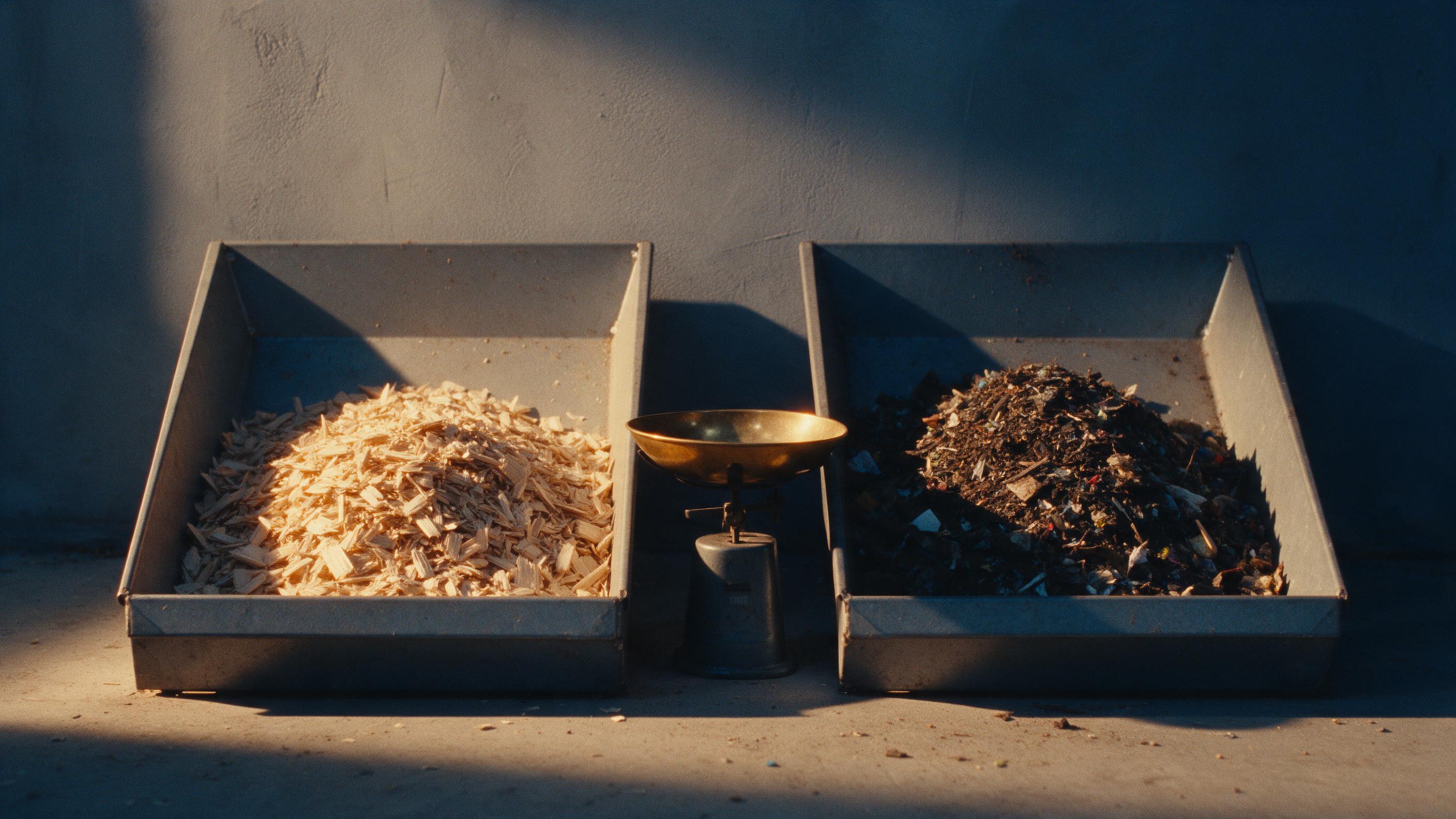
The Feedstock Split Decides The Subsidy
Spanish incentive law reads what a plant consumes before it reads how the plant was built. One threshold of biomass energy content moves an installation between two categories, two tax treatments and two decades of regulated return.
The Rule Reads The Fuel First
Spanish law sorts a generating installation by what it consumes before it looks at how the plant is built. Royal Decree 413/2014 puts a unit drawing 90 per cent or more of its energy from biomass into category b.6 or b.8. The non-recyclable fraction left after metals, glass, paper and organics have been pulled out falls to category c.2. Incineration of unsorted municipal waste sits in c.1. The line between b and c is not cosmetic. Categories b.6 and b.8 reach the regulated remuneration regime, carry a 20-year regulatory life, and open the renewable tax benefits. Category c.2 keeps limited access to that regime and takes no renewable tax benefit at all. The measurement is energy content, not mass. A tonne of dry wood chips and a tonne of refuse-derived fuel are not the same tonne, and the register reads them differently on the same scale. Ninety per cent. One number decides which law the machine lives under for two decades.
The Auction Sits Behind The Category
The regulated regime for high-efficiency cogeneration is being auctioned. The plan on the table is 1,200 MW of capacity across three rounds of 400 MW a year, proposed in February 2025 and expected across 2025, 2026 and 2027. Three conditions are read at the gate. At least 30 per cent of the electricity produced has to go to self-consumption. The unit has to be ready for at least 10 per cent hydrogen blending. A guarantee of EUR 20 per kW of installed capacity is posted. The remuneration is set on 7.09 per cent reasonable profitability, a figure under revision for the 2026 to 2031 period. The 20-year regulatory life attached to a category-b unit is the part that compounds. Twenty years of a defined return beats a project that reprices every time the framework is reviewed. An installation sorted into c.2 does not collect that. Same machine. Same output. Different category. Different decade.
The Tax Stack Sits On The Same Switch
Free amortisation allows up to EUR 500,000 of investment to be depreciated in the year it is made. It applies only where the installation qualifies as renewable. Category b again. The municipal layer runs on the same logic. A 50 per cent reduction on property tax, held for five years, for properties carrying renewable installations. A 95 per cent reduction on the construction tax for works that incorporate renewable energy systems, extended by RDL 7/2025 to energy ambient systems, and requested before works begin. An application filed after the first trench is open is an application for nothing. RDL 7/2025 also changed the business tax base to leave electric furnaces and boilers out of installed capacity. One feedstock decision reaches four bills: the auction, the depreciation schedule, the property tax and the construction tax.
What Still Passes Through The Meter
Self-consumption has its own framework under RD 244/2019. Simplified net billing credits surplus electricity exported to the grid at the hourly spot price of the reference market, for installations up to 100 kW, with registration in the national register of self-consumption installations. The national energy efficiency fund pays 30 per cent of eligible investment up to EUR 15 million per project, against equipment replacement, waste heat recovery and energy management certified to ISO 50001, on periodic calls. The capacity market is not open yet. Public consultation ran from December 2024 to January 2025. The design carries an emissions limit of 550 g CO2 per kWh, and new investment is admitted only in renewable generation, storage or demand-side response. Read that threshold as the last filter on the row.
The subsidy is decided before the engineering is reviewed.
The Region Adds Its Own Layer
Asturias holds a just-transition allocation of EUR 263 million for 2021 to 2027, with an extension to 30 June 2028 approved. The regional programmes reward employment as hard as they reward capital. Business projects that generate jobs reach EUR 24 million with a minimum investment of EUR 100,000 and three jobs created. The small-investment line covers EUR 30,000 to EUR 500,000 with a single job required. Large-company diversification runs to EUR 8 million at 15 to 20 per cent on investments from EUR 150,000 to EUR 10 million and five jobs. A circular economy line holds EUR 12 million at up to 45 per cent for large applicants, 55 per cent for medium and 65 per cent for small. Regional incentives under the economic promotion law apply above EUR 900,000 of investment, at 15 per cent for large companies, 25 per cent for medium and 35 per cent for small, with the employment condition attached. One line does not exist. A free-trade zone at the port was requested by a Senate motion in June 2024 and remains a political proposal. Build the plan against what is open.
Sort The Plant Before You Site It
Permitting reads the same way. Above 10 tonnes a day, or 3 MW of thermal input, an installation needs an integrated environmental authorisation from the regional environment ministry, alongside an environmental impact declaration, a municipal building permit and a waste treatment licence. The waste hierarchy in Ley 7/2022 supports energy recovery from non-recyclable fractions. Gasification is recognised as a process distinct from incineration, which keeps the machines in a different permitting lane from a furnace. The probability that a project is engineered, financed and permitted before anyone reads the 90 per cent is close to zero, and a missing category read is the ordinary failure rather than the exception. Read the fuel first. Then the category. Then the auction round. Then the tax stack, the regional layer and the meter. The engineering comes last, because the engineering is the only part that can still be changed cheaply.
Same machine. Same output. Different category. Different decade.
The map is dead. Nobody told you.
Bali State of Mind is the survival guide for the collapse of everything you were taught to believe.
Beyond this book
Building the same thing somewhere else.
Julien Uhlig is available for advisory work, board seats and media appearances. Write to media@exventure.co.
The academy that trains the operators, across every company in the group, is EX Epic Academy - 25,000 applications, 25 seats per cohort, 210 alumni across 19 countries. academy.epicsolutiongroup.com
18-20 November. Online, Las Palmas, Bali.
Three days on what happens to work, capital and institutions when the map stops matching the ground. Seats are limited by cohort.
ex-aisummit.com →