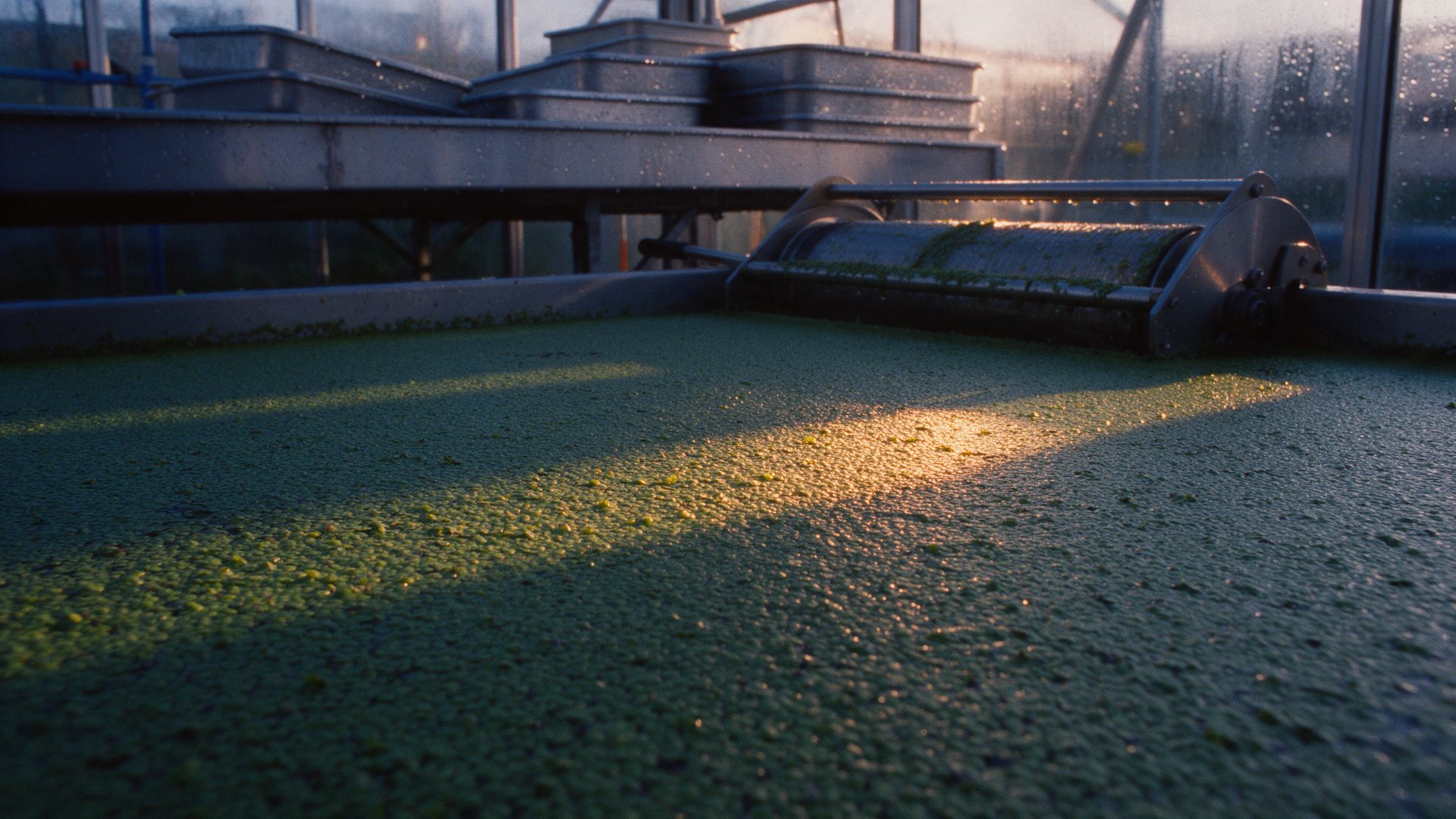
The Farm That Runs On Waste Water
Ten to twenty grams of dry matter a square metre a day, forty per cent protein, grown on the nitrogen a sewage works is already paying to remove. The highest-yielding crop per hectare is not planted.
The Crop Nobody Plants
Four genera: Lemna, Wolffia, Spirodela and Landoltia. The smallest flowering plants on earth, floating on every slow ditch in every temperate country, doubling every 24 to 72 hours when light, nutrients and temperature line up. Protein runs 35 to 45 per cent of dry weight in Lemna minor, and Wolffia reaches 50. The amino acid profile is comparable to soy, complete for feed and for food. The water requirement is roughly a tenfold saving on soy, and no arable land is involved at all. Ujong and colleagues compiled the production numbers in Sustainable Food Technology in 2025, volume 3, pages 54 to 80. The plant is not new. The industry built around it is new.
Two Systems, Two Numbers
An open pond is cheap and seasonal. Raceways of 0.1 to 1 hectare, sunlight, no climate control, 10 to 20 grams of dry matter per square metre per day in a warm climate. Contamination risk is real, evaporation is a cost, and this is what most of the fleet still is. A controlled greenhouse is the opposite trade. Multi-tiered trays with recirculating nutrient solution and LED light return 150 to 400 grams of fresh weight per square metre per day, which is 15 to 40 grams dry. One bioreactor study reported 392.8 grams fresh per square metre at 20 per cent inoculation density, with 1.20 grams per square metre per day of starch at that density and 2.24 grams of protein at 60 per cent. The reference design is four stainless steel tiers, gravity flow, a 500 litre sump, 1.5 litres a minute and 50 millimetres of water depth. Controlled systems sit at readiness 6 to 8. The gap between the two systems is the building.
The Water Nobody Wants
Lemna grows fastest on a nutrient load that is somebody else's disposal problem. Total nitrogen of 20 to 100 milligrams per litre is optimal, and municipal secondary effluent sits inside that band. Phosphorus of 5 to 20 milligrams per litre is enough for the plant and barely enough to matter downstream. Removal runs 60 to 95 per cent of total nitrogen and 50 to 85 per cent of total phosphorus. Ammonia above 30 milligrams per litre is toxic, which is why a swine lagoon has to be diluted first and a municipal works does not. A fog-o-ponic trial measured nitrogen removal at 500 milligrams of total nitrogen per square metre per day. Nitrate removal of 86.2 per cent was reported at 20 per cent inoculation density. Heavy metals are the wall. Lemna minor bioaccumulates cadmium, chromium and lead, and a 2022 paper in Chemosphere recorded cadmium uptake rising 106 to 422 per cent with acid enhancement. The plant is a good pump and a bad place to store the metals.
The Yield Nobody Prices
Protein per hectare per year is where the argument lands: 10 to 40 tonnes from duckweed against 2 to 4 tonnes from soy, on a tenth of the water and no arable land. In a wastewater pond the yield falls back to 10 to 20 grams of dry matter per square metre per day, and the nutrients are free. That is the trade. You give up the top of the yield curve and you stop buying fertiliser, because the nitrogen is arriving as a liability somebody has to remove anyway. Plantible screened more than 400 duckweed strains looking for RuBisCO, the soluble protein fraction. In that business the strain is the asset. The highest-yielding crop per hectare grows in water nobody else wants.
The highest-yielding crop per hectare grows in water nobody else wants.
The Harvest Is The Cost
Harvesting is solved engineering. A rotary drum skimmer collects 70 to 90 per cent of the surface mat. A floating conveyor belt takes 80 to 95 per cent. An aquatic vacuum takes 60 to 80 per cent and costs more than either. Small systems use nets and people. The bill arrives after the mat is out. A screw press or a belt filter takes moisture from about 95 per cent down to 75 or 80. Drying on to 10 per cent takes roughly 5 megajoules per kilogram of dry matter, and that single line decides whether the crop is a product or a liability. Plantible's answer was proprietary filtration hardware, and the company says the equipment change cut production costs significantly. No cheap drying route has been published by anyone.
The Two Commercial Routes
Plantible Foods is the reference. Headquartered in San Diego, operating from Eldorado, Texas, where it raised a 30 million dollar Series B in November 2024 with Piva Capital, Siddhi Capital, Chipotle Ventures, Astanor and Griffith Foods. The protein sells as Rubi Protein. The company received a no-questions FDA GRAS letter in February 2026, the first acknowledgement of RuBisCO protein for food use, and holds a long-term partnership with ICL. Ranchito came online in August 2025 at thousands of tonnes of biomass a year and hundreds of tonnes of protein, with financing being raised to triple capacity. The company's own figure is 8,000 tonnes of carbon dioxide equivalent avoided a year by displacing animal protein. LemnaPro in Flanders took the other route. It bought the IP of Lemnature Aquafarms, formerly Parabel, out of Chapter 11, including 95 patents and 17 trademarks, with the US federal court approving the transfer in May 2025. It is funded through the Flemish VLAIO-LA agricultural research programme alongside FlandersFood, Inagro, Ghent University and VIVES. The market then splits by price. Food protein sells at food prices. A fuel feedstock competes with wood chips.
The Part That Is Not Finished
Continuous cultivation without contamination is the unsolved problem. Algae and pathogens take a pond, and the closed environment is the answer that costs money. Fog-o-ponic cultivation suspends the plant on fabric and delivers nutrients as fog, with no standing water and therefore far less structural load. Lemna minor grew at a relative growth rate of 0.24 per day in that trial, comparable to liquid medium, at a healthy Fv/Fm near 0.8. Readiness is 3 to 4. The research base is deep. The University of Jena holds a sixty-year duckweed collection behind Appenroth and Sree. Teagasc and TU Dublin published the 2025 biorefinery review. The Chinese Academy of Sciences works the starch route and Nagoya works genomics. The EU LIFE LEMNERGY project stacked vertical Lemna above fish farming on a 350 square metre culture area in Kalkar.
The Decision Rule
A duckweed farm is a wastewater asset that produces protein, or it is a protein farm that pays for water. The order you build it in decides which one you get. Measure the nutrient load first, because that number is either free money or nothing at all. Measure the drying energy second, because it is the only line in the plant that can eat the margin. Argue about strains last, because a better strain improves a business that already works and rescues nothing. I have built companies across twelve countries and deployed 210 energy systems across Africa and Asia, and the projects that failed were the ones where the input was assumed rather than measured. Entrade built 200 wood-gasification machines across the UK and Europe. The machines ran. The question was always what went into them. The probability that the water under a sewage works becomes a feedstock is not zero, and most people are pricing it at zero. The pond is already there. The crop is already growing on it.
You give up the top of the yield curve and you stop buying fertiliser.
The map is dead. Nobody told you.
Bali State of Mind is the survival guide for the collapse of everything you were taught to believe.
Beyond this book
Building the same thing somewhere else.
Julien Uhlig is available for advisory work, board seats and media appearances. Write to media@exventure.co.
The academy that trains the operators, across every company in the group, is EX Epic Academy - 25,000 applications, 25 seats per cohort, 210 alumni across 19 countries. academy.epicsolutiongroup.com
18-20 November. Online, Las Palmas, Bali.
Three days on what happens to work, capital and institutions when the map stops matching the ground. Seats are limited by cohort.
ex-aisummit.com →