The Fabric Was Already Flexible
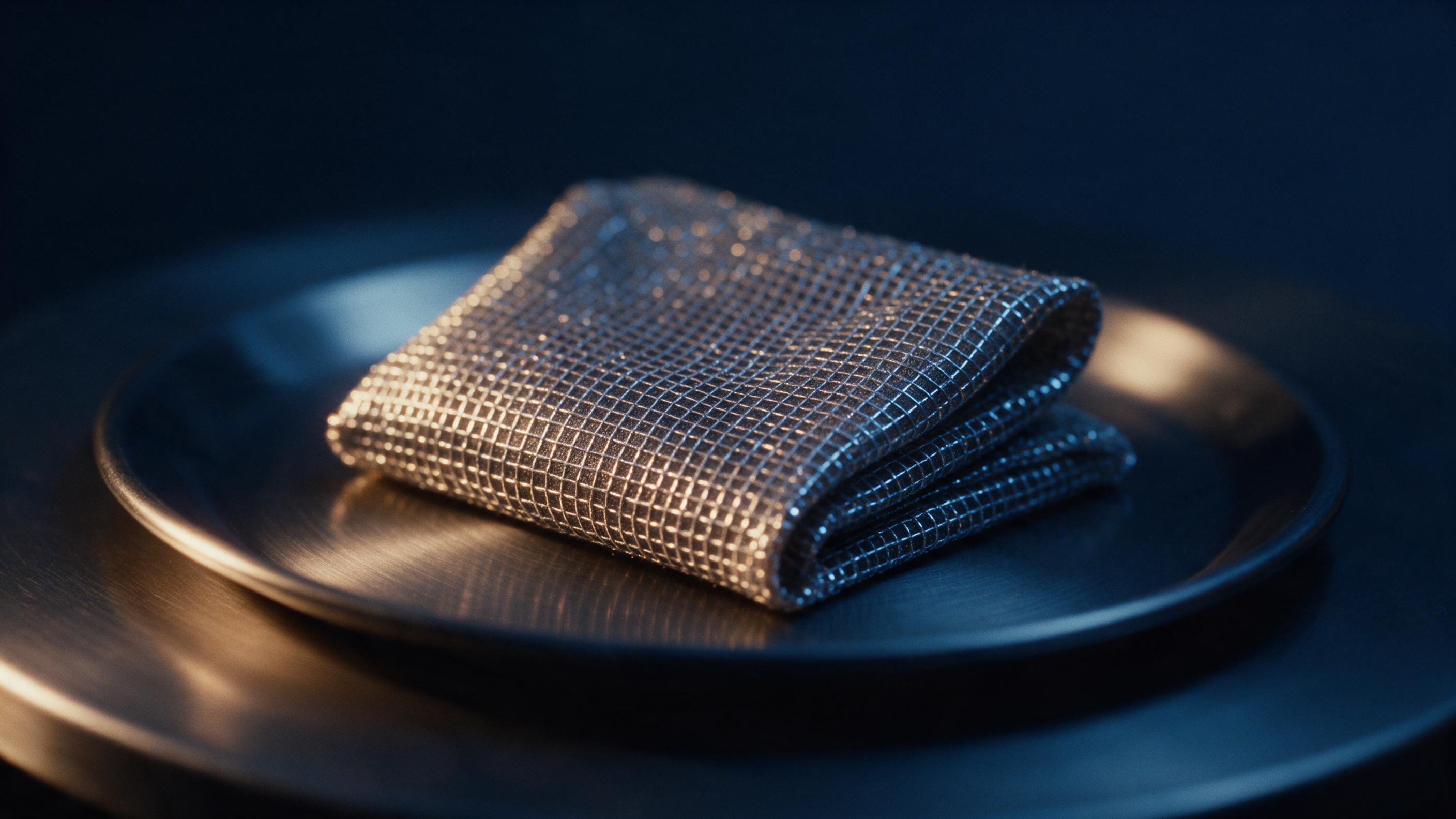
Silver-coated nylon conducts at 1 to 10 ohms per centimetre and an EGaIn-filled hollow fibre runs 0.1 to 1. Woven as warp and weft, the crossing points of the threads become the sensing elements, so the cloth is the array. The substrate arrives already breathable above 200 grams per square metre per day, already stretchable to 200 per cent when knitted and already washable for 20 to 100 cycles. The hard part was never the fabric.
The Inversion
The usual route to an electronic skin starts with rigid electronics and then tries to bend them, stretch them and perforate them for airflow. Each step fights the one before it. The textile route runs the other way. Start with the cloth, which is already flexible, already stretchable to 50 to 200 per cent when knitted rather than woven, and already breathable above 200 grams per square metre per day, then add the sensing function without giving any of that up. That inversion changes the question. It stops being how to make electronics conform like fabric and becomes how to make fabric report like electronics. Conformability is not a feature to be engineered into the substrate. It is the substrate. Whole-body coverage is where the difference shows. A robot sleeve, a seat, a floor and a chest band are the same problem on four different surfaces, and all four are cloth problems before they are sensor problems.
What Each Yarn Costs In Ohms
Five yarns carry the category and their resistances span four orders of magnitude. An EGaIn-filled hollow fibre runs 0.1 to 1 ohm per centimetre. Silver-coated nylon runs 1 to 10. Stainless steel runs 10 to 100 and work-hardens as it bends, which is why it keeps its washability and loses its stretch. Carbon-loaded polymer runs 100 to 1,000 and costs least. PEDOT:PSS coated yarn runs 1,000 to 10,000, a thousand times the silver, and it washes worst of the five. No single row of that table wins. Silver-coated nylon stretches beautifully and tarnishes. Carbon-loaded polymer takes the laundry at 100 to 1,000 ohms. A carbon-loaded yarn is the cheapest metre in the table and an EGaIn-filled fibre is the most expensive. The choice is which compromise the application can carry, not which yarn is best. What has not shipped is a spool that is as conductive as silver and as washable as carbon. Until it does, every design picks its own loss.
The Grid Is The Sensor
Warp one way, weft the other, and the fabric is the array. Every crossing point of a row and a column is a taxel, and nothing is laminated to the cloth because the cloth is the sensing element. A grid like that reads resistance or capacitance at each crossing, so a square metre of woven fabric holds more measurement points than a circuit board holds soldered parts. The resolution is set by the loom. Woven fabric resolves 1 to 10 millimetres because the yarn spacing is the limit. Knitted fabric resolves 2 to 20 millimetres, where the loop is the unit. Nonwoven fabric resolves 5 to 50. Sensitivity lands between 0.1 and 10 kilopascals for the resistive woven grid and between 0.1 and 5 kilopascals for the capacitive knitted one. A millimetre of thread spacing is three orders of magnitude coarser than a silicon array. For a fingertip that is a disqualification. For an arm, a mattress or a floor it is the correct resolution, and it arrives in metres rather than wafers.
Twenty To A Hundred Washes
Washability decides what ships. A knitted sensor fabric survives 20 to 100 machine cycles, a woven one 10 to 50, a nonwoven one 10 to 20, and every one of those numbers assumes the encapsulation holds. Each wash, each stretch and each wear event moves the fabric's geometry, and with it the sensor baseline. Recalibration is the hard unsolved problem in the category, and it is hard because the reference is moving with the thing being measured. A dense grid also talks to itself. The conductors are long, unshielded and spaced a millimetre apart, so capacitive and inductive crosstalk is worse than between traces on a board. Knitted fabric maps stretch to pressure through a hysteresis curve rather than a straight line. The edges fray, which puts the weakest mechanical point exactly where the electrical connection has to be made. The readings are still usable. They need a reference sensor or a model to hold them in place, and neither is standard yet.
The problem was never the fabric. It was the connector.
The Connector Is The Failure Point
The electronics end of an e-textile is rigid silicon: amplifiers, converters, radios and a battery. The textile end is soft, wet and machine-washable. The joint between them is where these devices fail, and no amount of fabric engineering closes a gap that sits outside the fabric. It is a mechanical problem with a predictable shape. Movement is largest at the boundary, and the material changes there, so the connector is the weakest point by construction. A sleeve that bends ten thousand times at the shoulder concentrates stress where the yarn meets a crimp. A prosthetic socket concentrates load where the cloth meets a wire. The same pattern shows up at the edge of every panel. Cut a sensor fabric and the weave loses its integrity along the cut. A textile that survives its own fabric and dies at its own plug has solved nothing.
Where It Already Earns Its Place
The applications do not need lithographic resolution and they do not need a clean room. A woven sleeve over a robot arm gives the whole arm touch sensing for human interaction without a single sensor mounted to the arm, and the sleeve is replaceable when it wears. A floor or a seat covered in pressure fabric reads gait, occupancy and a fall, and the manufacturing speed that makes it viable is 10 to 50 metres per minute for nonwoven, 1 to 10 for woven and 0.5 to 5 for knitted. A chest band reads heart rate from the movement of the chest and respiration from stretch. Pressure mapping inside a prosthetic socket is a cloth question rather than a chip question. The frontier is five problems closing rather than one. Self-calibrating fabrics that track their own drift. Encapsulation that survives 100 wash cycles instead of 20. Whole-garment 3D knitting that turns out a sensing shirt in a single manufacturing step with no cutting and no sewing. Triboelectric weaves that harvest the movement they are measuring. Reference standards that turn a resistance reading into a calibrated number. The looms and the knitting machines that would build these fabrics are already installed, already built to hold a yarn spacing across kilometre runs, and already cheaper than any semiconductor line. The probability that a fabric sensor array and a silicon array ever become interchangeable on arbitrary, curved and moving surfaces is not zero, and the field prices it as if it were.
Warp one way, weft the other: the fabric is the array.
The map is dead. Nobody told you.
Bali State of Mind is the survival guide for the collapse of everything you were taught to believe.
Beyond this book
Building the same thing somewhere else.
Julien Uhlig is available for advisory work, board seats and media appearances. Write to media@exventure.co.
The academy that trains the operators, across every company in the group, is EX Epic Academy - 25,000 applications, 12 per cohort, 200+ alumni across 19 countries. academy.epicsolutiongroup.com
18-20 November. Online, Las Palmas, Bali.
Three days on what happens to work, capital and institutions when the map stops matching the ground. Seats are limited by cohort.
ex-aisummit.com →