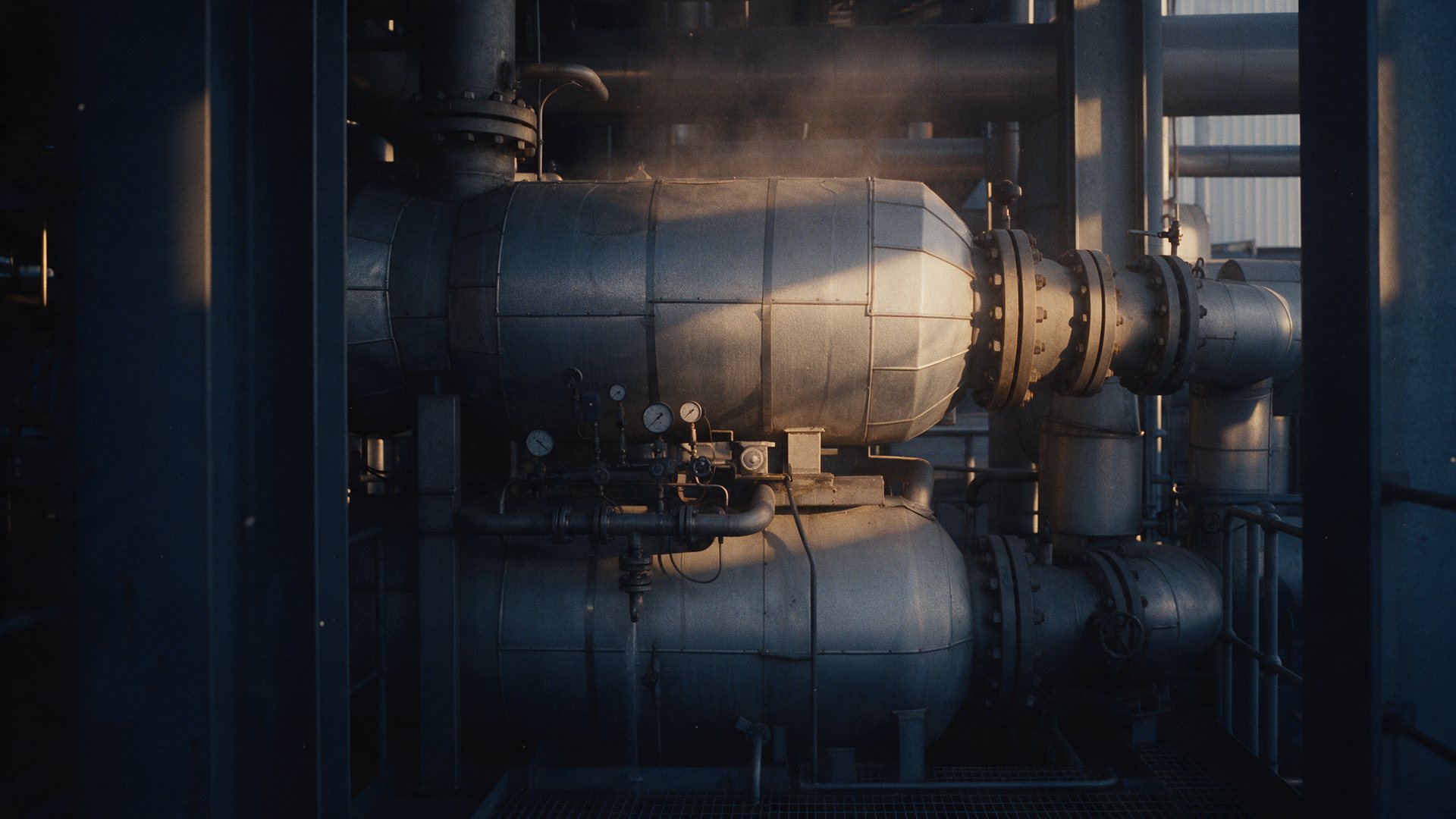
The Equilibrium Tax
One reversible reaction sets the price of every hydrogen route, and the constants were published long before anyone wanted to build the plant. You pay the tax in temperature, in capital or in purity.
The Reaction That Sets The Price
Hydrogen is made by one reaction more than any other, and it runs backwards as easily as forwards. Carbon monoxide plus water goes to carbon dioxide plus hydrogen, with an enthalpy change of minus 41.2 kilojoules per mole. Moderately exothermic, so cold favours the products. Equilibrium limited, so the temperature you choose decides how far it gets. The numbers are not new. The equilibrium constant sits near 200 at 200 degrees Celsius, falls to roughly 12 at 400, to about 1 at 800 and 0.25 at 1,000. More than 95 per cent of industrial hydrogen passes through this step, grey and blue alike. Every ammonia plant. Every methanol plant. Every Fischer-Tropsch line. The price of hydrogen is set by a reaction with a published answer, and the industry has had the answer for sixty years.
Two Beds And A Tax
Industry splits the shift in two. High temperature first, magnetite on an iron-chromium oxide carrier, 310 to 450 degrees, taking carbon monoxide from 10 to 15 per cent down to 2 to 4. Then low temperature, copper on zinc oxide on alumina, 190 to 250 degrees at the inlet and up to 280 at the outlet, taking the last 2 to 3 per cent down to about 1,000 parts per million. An industrial pellet from Johnson Matthey holds 87 per cent conversion at 400 degrees. A proton exchange membrane fuel cell needs carbon monoxide below 10 parts per million, because the platinum electrode is poisoned by it. So the second bed exists to buy two decimal places. That is the equilibrium tax. The reaction refuses to finish, and you pay a second reactor, extra steam and pressure drop to force the last of it.
The Chromium Bill
The standard high temperature catalyst is 88 per cent iron oxide, 9 per cent chromium oxide and 3 per cent copper oxide, and the chromium is the problem. Hexavalent chromium is a carcinogen, and REACH in Europe and OSHA in the United States have been squeezing it out of the catalogue. Topsoe shipped SK-501 Flex, the first commercial chromium-free high temperature catalyst, zinc spinel based, and the company claims about 11 million dollars a year of revenue improvement on a large ammonia plant. Clariant offers ShiftMax 120 HCF at ultra-low hexavalent chromium with a stated 85 per cent conversion. The best published chromium-free research result is a cerium promoted iron copper aluminium oxide at roughly 90 per cent at 400 degrees, from Sourav and Wachs in ACS Catalysis in 2023. The patent record tracks the same direction. The foundational iron-chromium pellet, US5656566, expired years ago. The 2015 Johnson Matthey filing, US10807866B2, claims a pore controlled iron oxide with hexavalent chromium below 0.1 per cent by weight. A chromium-free hydrothermal route, EP2237882B1, has been granted since 2007. The tax moved off the reactor and onto the regulator.
Where The Bed Dies
Catalyst is the consumable, and the failure modes are documented. Copper sinters above 405 degrees, the Tammann temperature, and Walter and colleagues in the Journal of Catalysis in 2024 named water as the agent that does it inside a copper zinc alumina bed. Sulfur poisons copper at parts per billion. Chlorides chemisorb onto the active sites and stay. Noble metal systems tolerate more. Platinum on ceria holds stable for 100 hours at 100 parts per million of hydrogen sulfide and regenerates through the oxygen storage capacity of the support. This is where the tax gets paid twice. You buy the low temperature bed for the rate, then you pay for guard beds, tight temperature control and a replacement schedule to keep it alive.
The second bed exists to buy two decimal places.
The Record Moves Down The Temperature Scale
The published record keeps dragging the reaction to lower temperatures. A molybdenum carbide nanorod reported in the Chemical Engineering Journal in 2024 reaches near total conversion at 175 degrees. A copper cobalt oxide, Cu1Co9Ox, holds 100 per cent at 250 degrees at a gas hourly space velocity of 84,000 per hour, and 204 micromoles per gram per second at 300 degrees. A single atom platinum system on molybdenum carbide is active at 40 degrees, with 4.3 million moles of hydrogen per mole of platinum. Platinum on defective titanium dioxide, 0.15 per cent by weight, reports a turnover frequency of 11.59 per second at 80 degrees. Every one of those figures is a reduction in the heat bill. Run the bed cold enough and a different heat source can drive it, which is where the electrochemical routes start. The reactor is a box. The catalyst is the asset.
Running It Backwards
Reverse the reaction and carbon dioxide becomes the feedstock. Carbon dioxide plus hydrogen goes to carbon monoxide plus water, and the enthalpy flips to plus 41.2 kilojoules per mole. Now heat is a cost instead of a product, and the competing reaction is methanation, which eats the hydrogen to make methane. A potassium carbonate on gamma alumina catalyst holds equilibrium conversion at 550 degrees with 100 per cent selectivity to carbon monoxide and hundreds of hours of stability at 10 bar, published in JACS Au in 2025. A platinum on magnetite system carrying 0.017 per cent by weight of platinum reports 99.7 per cent selectivity at 500 degrees. The patent record is crowded here. Infinium holds a granted reactor system, US12071351B2, a high temperature adiabatic design with group 1 and 2 metals on an alumina spinel. BP filed in 2023. Osaka Gas filed in 2020. Stanford filed in 2021. Reverse shift is the bridge from captured carbon to liquid fuel, and the toll on that bridge is hydrogen.
The Version That Needs No Heat
Biology runs the same reaction at ambient temperature and pressure. Two enzymes split the work: a nickel iron carbon monoxide dehydrogenase turns carbon monoxide and water into carbon dioxide, protons and electrons, and a nickel iron hydrogenase turns the electrons and protons into hydrogen. Carboxydothermus hydrogenoformans is one of the organisms that carries both. The limits are kinetics and oxygen. The enzymes are slow next to a heated bed, and the dehydrogenase is oxygen sensitive. Electrochemistry gets closer to a product. A room temperature cell with a platinum copper catalyst reported hydrogen above 99.99 per cent pure, faradaic efficiency near 100 per cent, 475 hours of stability and 70 milliamps per square centimetre at 0.6 volts. Palladium copper then reported 19.9 milliamps per milligram of palladium, which is 330 times the figure for pure palladium. Plasma assist is the compromise. A dielectric barrier discharge over a copper cerium oxide catalyst lifted carbon monoxide conversion from 6 per cent to 96 per cent at 150 degrees, and the activation energy fell from 69.6 to 15 kilojoules per mole. Photocatalysis is still under 9 per cent solar to hydrogen. The pump that needs no heat does not yet beat the heat.
The Decision Rule
The equilibrium tax is paid in one of three currencies: temperature, capital or purity. Decide which one you are buying before you buy a reactor. The catalyst market inside the reaction runs between 1.2 and 2.1 billion dollars, growing 5 to 7.5 per cent a year, and three suppliers hold 60 to 70 per cent of it. Honeywell, after the Johnson Matthey catalyst acquisition announced in 2025 for 1.8 billion pounds, then Topsoe and Clariant. The hydrogen market around it is 225 billion dollars in 2025 heading for 312 billion by 2030 at 6.8 per cent a year. The United States pays 3 dollars per kilogram of clean hydrogen under section 45V. European policy wants 10 million tonnes of domestic renewable hydrogen and 10 million tonnes of imports by 2030. I have built companies across twelve countries and deployed 210 energy systems across Africa and Asia. Entrade built 200 wood gasification machines across Britain and Europe, and those machines ran. The catalyst in front of them decided the economics, every time. The probability that the cheapest hydrogen route in 2035 is the one nobody is building today is not zero, and most people are pricing it at zero. The reaction does not care which route you prefer. It only cares what temperature you can afford.
The tax moved off the reactor and onto the regulator.
The map is dead. Nobody told you.
Bali State of Mind is the survival guide for the collapse of everything you were taught to believe.
Beyond this book
Building the same thing somewhere else.
Julien Uhlig is available for advisory work, board seats and media appearances. Write to media@exventure.co.
The academy that trains the operators, across every company in the group, is EX Epic Academy - 25,000 applications, 12 per cohort, 200+ alumni across 19 countries. academy.epicsolutiongroup.com
18-20 November. Online, Las Palmas, Bali.
Three days on what happens to work, capital and institutions when the map stops matching the ground. Seats are limited by cohort.
ex-aisummit.com →