The Middle Is The Dangerous Part
In 1450 a press in Mainz could print 3,600 pages in a working day. A scribe, working by hand, produced 40. Nobody in that trade was lazy, badly educated or wrong about anything. The technology simply stopped needing them. I have now read this same story nine times across 1,600 years, and it always has the same middle. The middle is where people lose everything they saved.
1450: The Scribes Did Nothing Wrong
I have a habit I cannot break. I read old disruption stories the way other people read crime novels, looking for the moment the victim could have moved. 1450 is the one I keep coming back to. Gutenberg's press arrived in Mainz and within decades it had reached more than 200 European cities and produced over 20 million volumes. A press could put out 3,600 pages in a working day. A monastic scribe, working by hand, produced 40. Put those two numbers next to each other and the entire story is there. Not 20% better. Ninety times faster. There is no negotiation available inside a ratio like that. The scribes were not lazy and they were not stupid. Copying was a craft refined over centuries and they were among the most literate people in Europe. What happened to them was structural. Many tried copying the new printed books, which is a strange way to fight a technology, and by the late 1400s they had surrendered. Now watch where the next turn comes from, because this is the part people forget. The Church welcomed the press at first. Cheaper Bibles. Indulgences printed by the thousand. Then a monk in Wittenberg put up 95 theses in 1517, they were printed and distributed across the continent in weeks, and a monopoly on interpretation that had held for a thousand years was gone. Fifty years from press to Reformation. The scribes who survived did not survive by defending the scriptorium. They moved into binding and distribution, or they learned the machine. The ones who disappeared had exactly one skill, and it was the skill the machine had.
1347: The Plague Repriced Every Hour Of Work
Between 1347 and 1353 the Black Death killed between 17 and 28 million people in Europe. In the worst regions, up to 80% mortality. Across the continent as a whole, 25 to 50% of everybody, inside a five-year window. What happens to wages when half the workers are gone? Nominal pay went up two and three times, which sounds like good news if you were the one who survived. For a few years it was not. The money supply per surviving head had risen too, and inflation ate the raise. Real wages stayed flat or fell through the 1350s and 1370s. Prices only settled in the mid-1370s and the equilibrium arrived around 1393. Researchers who studied 15 European pandemics found the same pattern each time: for roughly 40 years after a plague ends, real wages rise and returns on capital fall. Forty years. One working life. Not a bad winter you sit out. Whoever owned food did well. Whoever had surplus to sell while clearing debts in inflated coin did very well. Whoever owned land with rents fixed in currency watched the value drain straight out of it. Serfdom ended across Western Europe in the aftermath, not because anyone became enlightened, but because labour had become scarce enough to bargain with. One event. Opposite outcomes. The difference was what each person was standing on.
1800: A Quarter Of A Million Weavers, Then Seven Thousand
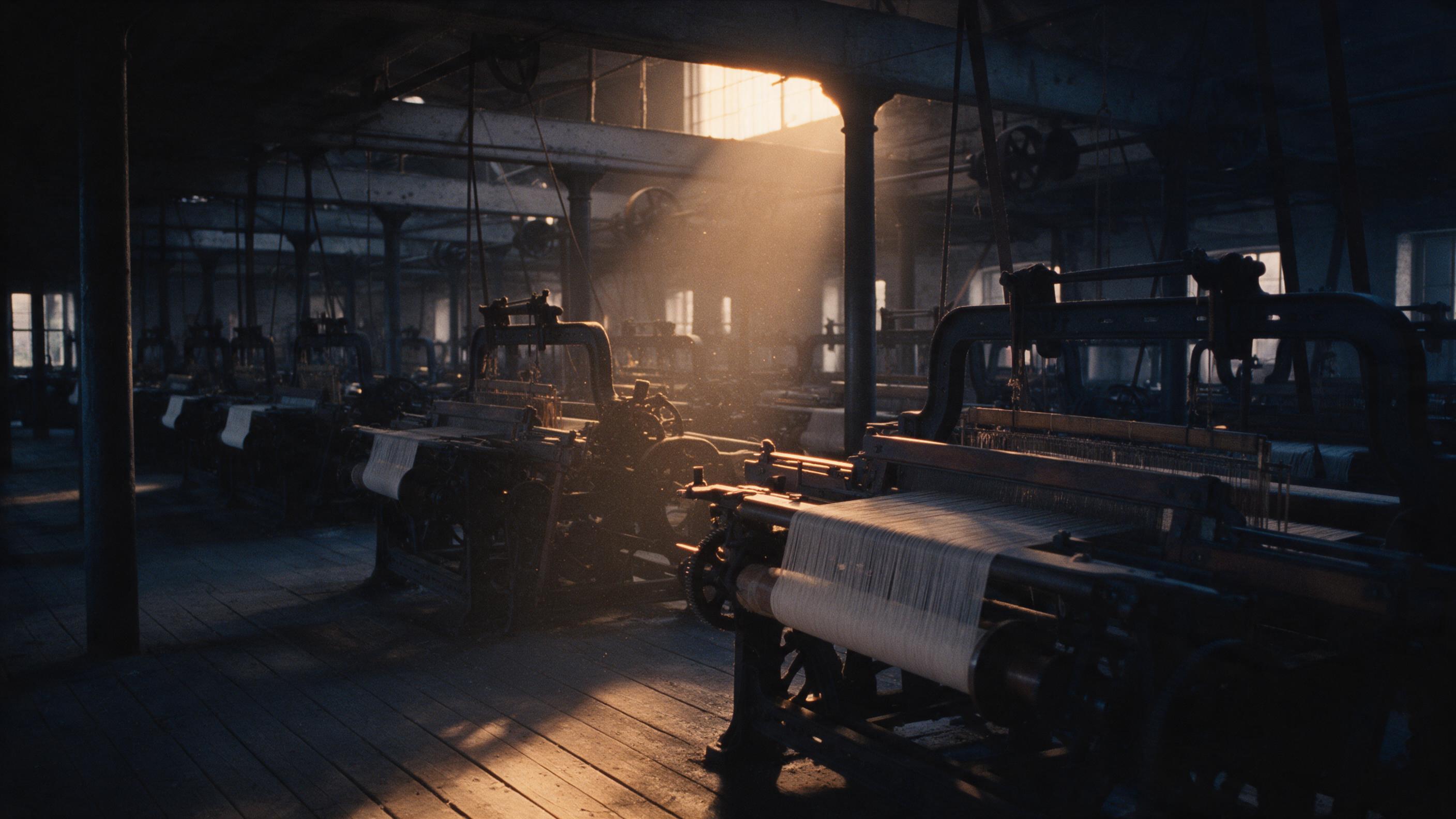
Hand weavers in Britain: 250,000 around 1800. By 1860, 7,000. A 97% collapse in sixty years. The machines arrived in a sequence anyone could have read as a countdown. Spinning jenny 1764. Water frame 1769. Spinning mule 1779. Power loom 1785. One factory outproduced hundreds of households, textile prices fell through the floor, and work that had earned a week's income started paying a day's. Then came the Luddites, and I want to defend them for a moment, because they get used as a punchline and they deserve better. From 1811 in Nottinghamshire, spreading to Yorkshire in 1812 and Lancashire in 1813, they did not break machines because they hated progress. They asked for minimum wages. They asked for labour standards. They proposed a levy to fund worker pensions. That is a serious negotiating position from people watching their trade be deleted. By 1816 the movement had been suppressed militarily and no framework was ever built. The transition stayed unmanaged and took 80 years, with disruption running past 120. The children adapted faster than the master craftsmen, and the reason is not talent. The children had less invested in being right about the old world. I have watched a specialism that took a decade to build get commoditised in 18 months. The ratio is not 90 times yet. It is moving.
1923: A Hundred Thousand Marks Could Not Buy Coffee
June 1921: 60 German marks to the US dollar. November 1923: 4.2 trillion. A 99.9999% loss of value in under 30 months. The German middle class were the people who did everything the system told them to do. They saved. They bought war bonds and government securities, they paid into pensions, they held the paper. A family with 100,000 marks in savings in 1921 could not buy a cup of coffee by 1923. Pensions became worthless. Government bonds became wallpaper. The moral order inverted. Debtors got rich because their debts evaporated. Savers were wiped out for the crime of being careful. Landlords with rents fixed by law were ruined, which is the counter-intuitive part, because everyone assumes property is the hedge. It was not. Farmers selling at rising prices and clearing debt with worthless notes did fine. So did anyone holding gold, dollars or pounds, and anyone who borrowed early and repaid late. The end came in weeks rather than years. The Rentenmark arrived in August 1924 and it was over. None of this was a secret in advance. The warning signs sat in the open for five years. That is the part that repeats: the information is available, and the pricing stays at zero.
Ninety times faster is not a competitive threat. It is a different world arriving without asking.
1971: The Good Thirty Years Were The Exception
In 1944, at a hotel in New Hampshire, the world agreed the dollar would be convertible to gold at $35 an ounce. America held 70% of the world's gold reserves by 1947, which made the promise credible. For nearly 30 years it held, and it produced something the historical record barely contains: ordinary people getting steadily richer. Real wages nearly doubled between 1945 and 1975. Private pension coverage went from 3.7 million American workers in 1940 to 23 million by 1960. One income carried a household. Retirement was a thing you could count on. Then the Federal Reserve turned inflationary in 1965. Foreign dollar holdings outgrew the gold that was supposed to back them. In August 1971 Nixon closed the gold window. The Smithsonian Agreement that December wrote the formal ending, and by spring 1973 currencies were floating. What never came back was the wage. Since 1980 productivity is up around 70% and compensation has been flat. Pensions became 401(k)s, which means the risk moved off the employer's balance sheet and onto yours. The financial crisis of 2008 finished the job and the covid years buried it. So the deal your parents were handed was not normal. It was a 30-year exception built on one power holding most of the gold, competitors in rubble, capital controls and a Cold War bidding war for workers. Every one of those conditions is gone. Look at the clock across the whole record. Rome took 200 to 365 years to settle into feudalism. Sterling handing over to the dollar took 50 years and two world wars compressed it to 30. The press took 100. The plague took 40.
The Middle: Where To Stand
Read all of it together and the structure repeats. A system is certain. Then it is strained. Then there is a middle, where the old institutions have lost the capacity to do anything and nothing has replaced them, and that middle is where most of the damage lands. In severe disruptions it runs 5 to 20 years. Unmanaged, past 40. I have been through three of these middles at small scale, and they felt identical from the inside. In 2003 I was in the Lehman Brothers building when the power failed and lower Manhattan went dark. In 2008 I was carrying a EUR 20 million personal guarantee and the company folded on Christmas Day. In 2013 I lost savings in the Cyprus bail-in when an account stopped being an account overnight. Every time the mechanics were obvious in hindsight and priced at permanent beforehand. The people who came through the earlier ones were not smarter. They held the same things. More than one income. Assets in more than one place and more than one currency. The physical ability to move. A community that actually turns up when it is inconvenient. Patience, because the forty-year payout rewards whoever is still solvent in year twelve. And literacy, because the printing press specifically rewarded the people who could read what was suddenly available. The people who failed did the same few things too. One specialism with no alternative. Loyalty to an institution that was already hollow. Savings in a single currency. Immobility, geographic or mental. I am not theorising about the building part. 210 energy systems standing in places that had none. Companies built in twelve countries. A EUR 75 million industrial group restructured. 220 interns a year, drawn from 25,000 applications for 25 seats, 210 alumni working in 19 countries. A book of 393 pages published on 8 April 2026, because I could not watch another generation walk into this blind, holding a map that was already wrong when it was handed to them. The probability that the next 20 years look like the last 20 is not zero. Almost everyone is pricing it at zero, and that is the most expensive assumption currently available to a person with savings. Understand what I am not saying. I am not saying the world ends. Every one of the disruptions above ended with a new system, and most of them ended with more people able to read, earn and move than before. What I am saying is that the middle is where the losses happen, and the middle does not announce itself. It arrives as a normal Tuesday. You cannot predict it. You can price it, you can diversify, and you can be mobile when the moment comes. Those are different jobs, and only one of them pays. So do the arithmetic on your own position. How many places can you earn from. How many currencies are you holding. How many people would take your call at 2am. If the honest answer to any of those is one, you are not positioned. You are exposed. Position before the crash, not after. Build the second and third leg now, while it still looks like overkill, because in every one of the nine cases above, the people who moved early looked paranoid right up until the morning they looked prescient.
Every disruption has a middle: the old institutions have failed and the replacements have not arrived.
The map is dead. Nobody told you.
Bali State of Mind is the survival guide for the collapse of everything you were taught to believe.
Beyond this book
Building the same thing somewhere else.
Julien Uhlig is available for advisory work, board seats and media appearances. Write to media@exventure.co.
The academy that trains the operators, across every company in the group, is EX Epic Academy - 25,000 applications, 25 seats per cohort, 210 alumni across 19 countries. academy.epicsolutiongroup.com
18-20 November. Online, Las Palmas, Bali.
Three days on what happens to work, capital and institutions when the map stops matching the ground. Seats are limited by cohort.
ex-aisummit.com →