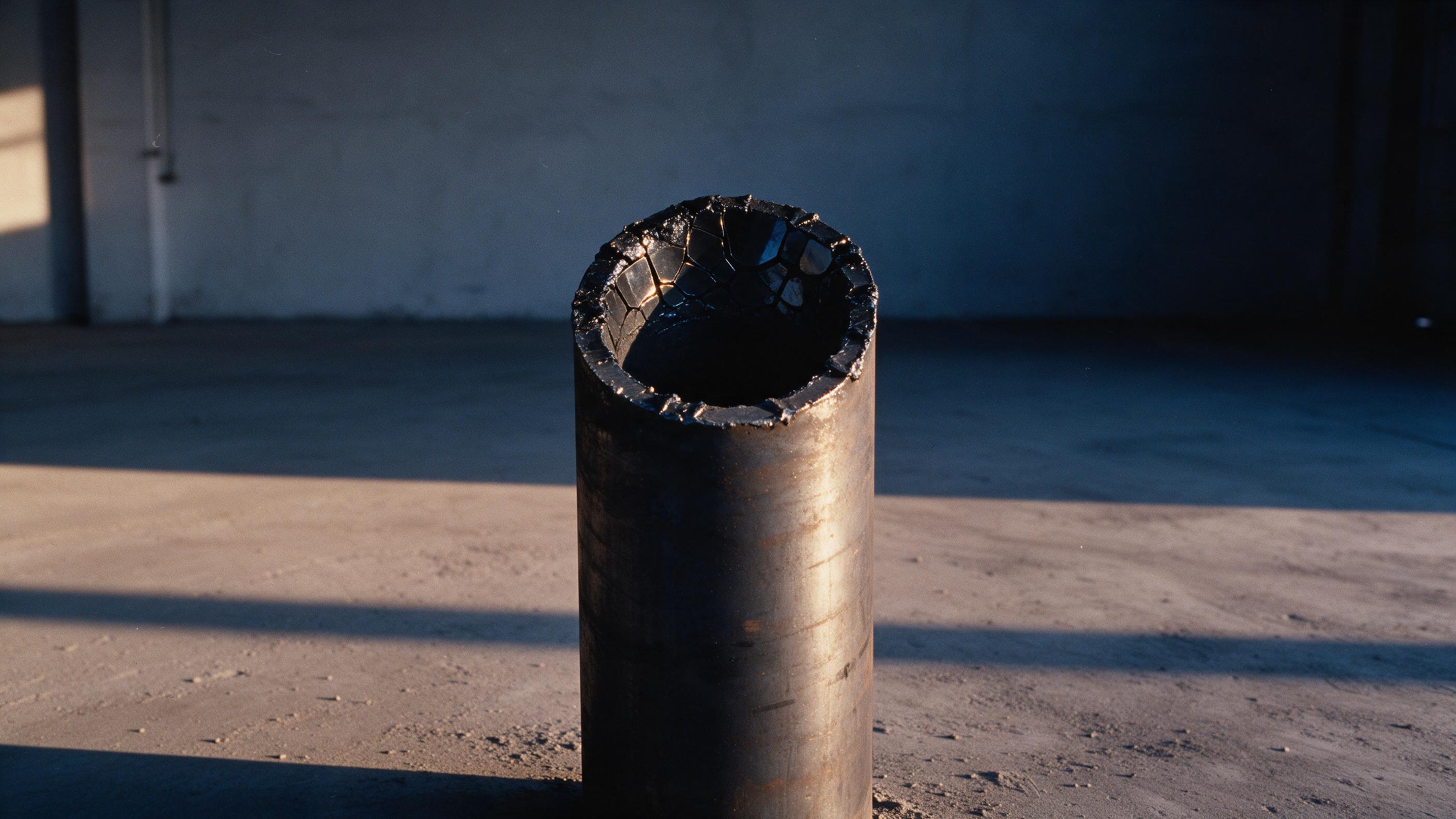
The Deposit That Ends The Run
Catalytic depolymerisation has been built for twenty years and no plant has survived it. Alphakat ran from 2003 to 2010 with plants in five countries and was dissolved. Clyvia filed insolvency in 2009. The chemistry works; the run ends at the wall.
Twenty Years Of Pilots, No Survivor
Alphakat GmbH ran from 2003 to 2010 and built plants in Mexico, Canada, Spain, Germany and Cyprus. Not one of them reached sustained commercial operation. The company was afterwards dissolved. Clyvia Technology went the other way. Its pilot plant shut down on clogging, and the company filed for insolvency in 2009. Two companies. Two country lists. One ending. The process was never the problem. Catalytic depolymerisation heats plastic and organic residue to 250 to 350 degrees in a thermal oil bath at close to atmospheric pressure and cracks the long chains down into diesel-range oil. Operators produced fuel. Several of them sold it. None of them kept producing it.
The Deposit Chooses The Coldest Surface
Solids come out of the oil and land on whatever metal is cooler than the bath. Char, coke, tar, spent catalyst, ash. The layer that forms is a poor conductor. Published figures put its thermal conductivity at 0.1 to 2.0 W/mK against 15 to 40 W/mK for the steel underneath. The deposit insulates 10 to 100 times better than the surface it sits on. Heat transfer drops. Surface temperature drops with it. Cooler surfaces collect more deposit. The favourite site is the hot to cold transition, where the coil leaves the hot zone. That is where the gradient is steepest and the deposit sets first. Then the shutdown arrives. As the reactor cools, the deposit hardens into a glassy mass that has to be cut out of the vessel by hand. The maintenance bill is not the failure. The outage is.
The Published Record Concedes It
This failure is not a secret kept by the industry. It is written into the field's own patent record. Coke sticking to the heating and cooling coils appears there as a known operating problem (EP3177698B1), and the mitigation offered is improved agitation of the bath. Agitation moves the oil. It does not clean a surface. That is the gap in one sentence. The problem is stated accurately, and the answer does not touch it.
The Analogue Stops Fifty Degrees Short
Continuous mechanical scraping of heat transfer surfaces is old, proven industrial practice. Scraped surface heat exchangers run in fouling service where nothing else survives, with a blade travelling the surface and taking the layer off before it sets. Published operating experience puts the runtime gain at 3 to 10 times a clean-and-restart cycle. The class has a ceiling. The established equipment is rated to about 250 degrees. The depolymerisation bath runs at 300 to 350. That band is where a proven analogue stops being an answer. Fifty degrees of extra temperature changes the material, the clearances and the wear rate. Nothing about the principle is in doubt. Everything about the duty is.
Two companies. Two country lists. One ending.
The Demand Is Priced, Not Promised
Waste-to-fuel is put at EUR 2.4 billion to EUR 12.8 billion by 2030 to 2034, compounding at 9 to 31 per cent a year depending on the scenario. The policy pull is explicit. RED III asks for 14 per cent renewable energy in transport by 2030, with 3.5 per cent of it from advanced biofuels, and fuel made from waste qualifies. The money is real. The EU Innovation Fund's IF25 call carries EUR 5.2 billion. OMV ReOil drew EUR 81.6 million from it for a 200,000 tonne plant. Operators already run commercially. Plastic Energy runs plants alongside SABIC and TotalEnergies. Agilyx holds 22 or more patents in the category. The capital arrived. It went to the plants that could stay switched on.
The Run Ends At The Wall
Look at the pattern across twenty years of this field. The idea is sound. The feedstock is cheap. The permit is obtainable. The funding is winnable. The plant still stops. The probability of sustained operation is set by one surface, not by the chemistry. A better catalyst does not move that number. A cleaner coil does. That is the whole argument, and it is not a technical one. I have built companies across twelve countries and deployed 210 energy systems. I restructured a industrial group and signed a personal guarantee on a business that failed on Christmas Day 2008. In every case the idea was not what decided the outcome. The part that had to keep running did. Throughput is the product. The process is the entry ticket. A technology that only works between cleanings is not a plant. It is a pilot with a longer name.
Agitation moves the oil. It does not clean a surface.
The map is dead. Nobody told you.
Bali State of Mind is the survival guide for the collapse of everything you were taught to believe.
Beyond this book
Building the same thing somewhere else.
Julien Uhlig is available for advisory work, board seats and media appearances. Write to media@exventure.co.
The academy that trains the operators, across every company in the group, is EX Epic Academy - 25,000 applications, 12 per cohort, 200+ alumni across 19 countries. academy.epicsolutiongroup.com
18-20 November. Online, Las Palmas, Bali.
Three days on what happens to work, capital and institutions when the map stops matching the ground. Seats are limited by cohort.
ex-aisummit.com →