The Claim Nobody Filed
There are more than 125,000 published drone patents and the airframe that changed the economics of the field is not among them. The empty classes are the honest part of the map.
The Map Is Already Written
A patent application is a document you publish so that you can own something. Google Patents returns more than 125,048 results for drone, UAV or unmanned aerial vehicle, and the defense subclass alone carries more than 100,000 of them. Filings grew at 16 per cent a year, from 16,800 in 2022 to 19,700 in 2023. The Mathys and Squire 2024 filing report puts the 2023 split at China 87 per cent, which is 17,285 filings, the United States 4.3 per cent at 858, Russia 1.7 per cent at 333, and the rest of the world the remaining 7 per cent. No other industry hands you that. Every claim is public. Every assignee is named. Every empty class is visible as an absence. I have sat in rooms where a competitive position was described as too sensitive to write down. The filing record says otherwise. Somebody wrote it down. Usually in Chinese.
Where The Money Stands
Connectivity carries the heaviest portfolios: Huawei at 10,513, Qualcomm at 7,896, Samsung at 7,585. Consumer and commercial airframes follow, with DJI at 4,628 and XAG at 2,413. Counter-drone interception runs past 25,000 documents and holds Anduril, Elta and IAI, Securus and Boeing. Swarm coordination sits at medium density with ETRI in Korea, NaviGate in Israel, Thales and Hanwha. Now read the bottom of the same table. Low-cost and expendable airframes: SYPAQ, DZYNE, Air Kamuy, Kratos. Patent strength, very low. Cardboard and paper airframes: SYPAQ, Air Kamuy, Skykrafts, PapyDrone. Patent strength, near zero. Two rows, one page, and one of them is empty. Density is a decision. Twenty-five thousand counter-drone patents is not enthusiasm. It is a crowd.
The Fleets With No File
Search ZALA Aero, the Kalashnikov subsidiary behind Lancet-1, Lancet-3, KUB-BLA and Italmas. Nothing. Search Kronshtadt, which builds Orion, Sirius and Grom. Nothing. Search STC, which builds Orlan-10 and Orlan-30. Nothing. Then search Iran: HESA, Shahed Aviation Industries, the IRGC Aerospace Force, Qods Aviation Industries, IAIO. No published drone patent in English or in Farsi. The Shahed-136 airframe is unpatented. The MADO MD-550 engine is an unlicensed copy of the Limbach L550E. The Shahed 171 is a copy of the RQ-170. You cannot patent a copy of something you have already copied. Sanctions close the international filing routes on top of that. The exception is the defensive layer. Almaz-Antey holds patents for a shotgun-armed counter-drone aircraft, a flying wing interceptor with twin guns and an X-shaped convertiplane anti-drone missile. KBM filed RU2853544C1 in May 2025 for a tank protection system adapted to detect FPV drones. Yakovlev filed RU228578U1 in 2024 for a stratospheric UAV on a hydrogen fuel cell. Rusdronoport filed RU2843876C1 in 2025 for an automated hangar. They file for what defends the fleet. They leave the fleet itself unclaimed.
The Airframe Nobody Claimed
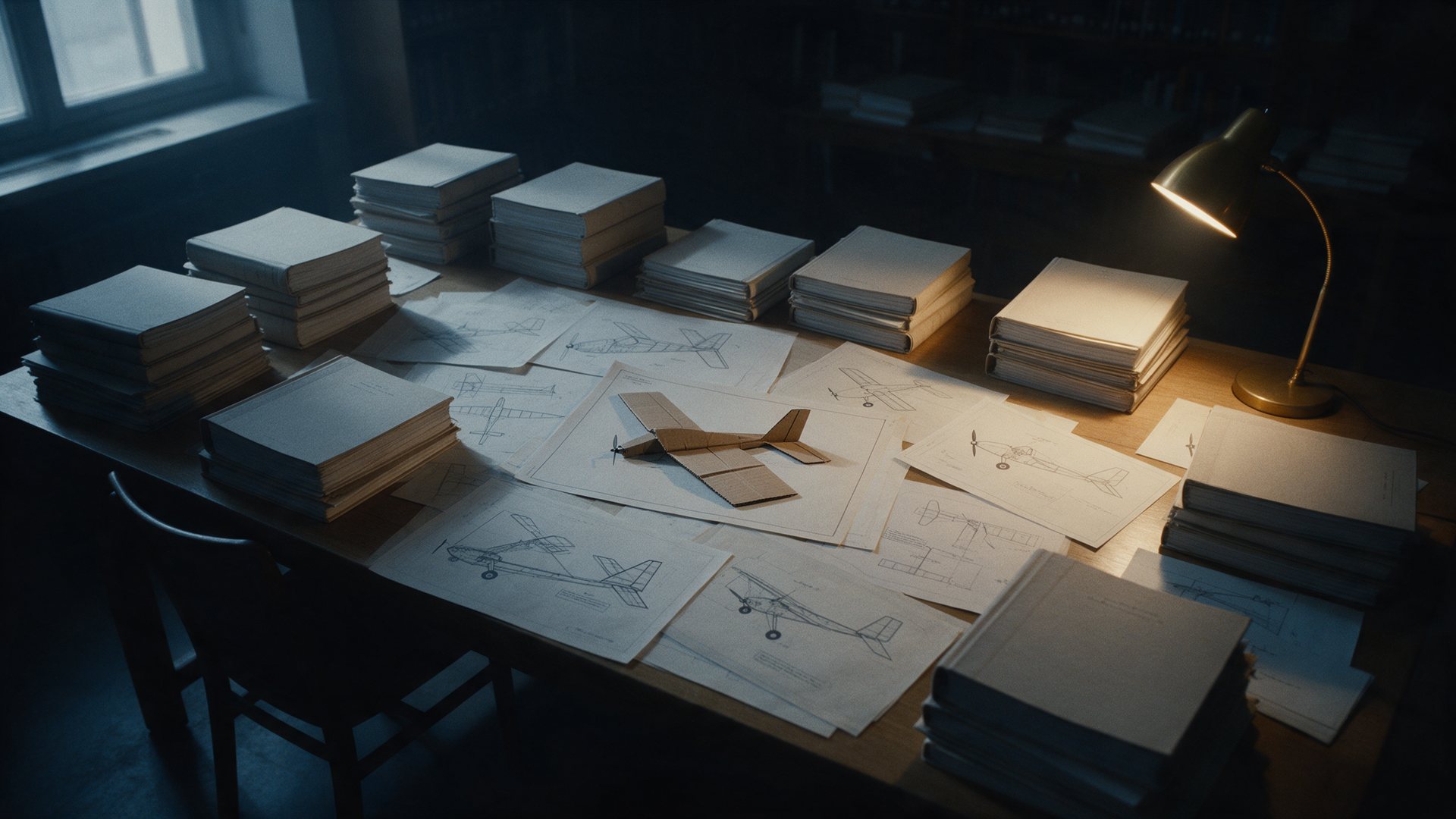
SYPAQ builds the Corvo PPDS in Australia for 1,000 to 5,000 US dollars a unit. No filings found. Air Kamuy builds the 150 in Japan for 2,000 to 3,000. PapyDrone-800 in South Korea lands near 1,000. Skykrafts in India claims about 500 for the ahaDRONE and says a filing is in progress, with the status unclear. The single relevant patent is US10589858B2, held by Mirko Kovac at Imperial College: foam and composite deposition to build web-like airframe structures. It covers a robot that sprays a frame into existence. It does not cover a flat sheet of waxed corrugated board, cut to a pattern, folded and tabbed. So the die-cutting patterns are open. The waterproofing treatments are open. The bio-resin and paper laminates are open. The production method that turns an ordinary cardboard factory into a line is open, and Air Kamuy has said as much in public. The cheapest airframe in the world is the one with the thinnest file.
A patent file is a written confession of where somebody thought the money was.
The Ratio
A 3,000 dollar airframe against a 1 million dollar interceptor is the arithmetic that ends procurement arguments. The source material behind this piece flags one figure as an estimate rather than a measurement: drone-on-drone interceptor cost running near 1 to 10 against the reconnaissance aircraft it hunts, built on interceptors at 3,000 to 5,000 dollars against UAVs above 50,000. Read it as an estimate. The rest is on the record. The United States reverse-engineered the Shahed-136 into the LUCAS and FLM-136 at 35,000 dollars a unit, and no patent barrier stood in the way, per reporting through 2026. The Pentagon Replicator effort and the DAWG program named software for orchestrating more than 100 expendable aircraft as a critical gap, across defense reporting from July 2025 to August 2026. The swarm patents that exist target something else. ETRI, Hanwha, NaviGate and Thales patent the coordination of complex, heterogeneous fleets. Nobody has filed on the coordination of a hundred disposables. The probability that a hundred cheap aircraft do the job of one expensive one is not zero. The probability that anybody has priced it is close to it.
The Empty Classes
Ukraine filed four drone patents across 2022 and 2023, according to WIPO and PatentScope analysis. Four. In a war that rewrote small-aircraft tactics in real time. Fiber optic control is the widest hole. Russia deployed the Knyaz Vandal Novgorodsky on fibre guidance in August 2024, with spools bought commercially from China and 3 to 30 kilometres of glass behind the aircraft. No patent appears in any accessible database for tether deployment, spool payout, drag compensation, turn coordination, or switching between radio and fibre in flight. Counter-fibre detection is empty too. A surface drone shot down a Su-30. Unprecedented. Zero patents. Learning that updates a model in the field without a cloud connection: empty. DJI holds no significant machine-learning sensing patents after 2021. PatSnap 2026 reports agricultural coverage as thin at DJI and aggressive at XAG, and neither covers a cheap expendable airframe doing precision spraying. These counts are a snapshot of a filing record at the dates named. A filing record moves.
What An Empty Class Is Worth
An empty class is not a bargain. It is one of three things, and only one of them is an opportunity. First, the value is in the factory. SYPAQ protects nothing and sells cardboard aircraft, because the process is the asset and a process is hard to copy at 1,000 dollars a unit. Second, the value is in the people. A trade secret held by twenty engineers is a wall until the twentieth of them walks out; the zero-patent fleets are built on that arrangement. Third, the value is not defensible at all, and the class is empty because everyone who tried it reached the same conclusion. Twenty-five thousand counter-drone patents did not make counter-drone cheap. Density is not victory. It is a crowd standing in a room, and the crowd is evidence of what buyers were afraid of. The book was published on 8 April 2026 and runs 393 pages on this exact failure of inherited maps. The chapter you are reading is shorter. A document nobody filed is a question nobody answered.
The Rule
If you want to know what a field believes, read its filing record and not its marketing. Companies file when they think an advantage can be held inside a document, and they publish when they file, so the map appears years before the outcome does. I have built companies in twelve countries and spent sixteen years in the field, from rural Nigeria to Silicon Valley. The most useful habit I ever formed was reading what other people had already claimed, and then looking at what they had left out. The omissions were never accidents. They were the places where nobody wanted to be first. Here is the rule. Ask what has no file. Ask what is published, unprotected and running anyway. Ask who is selling something a competitor could copy next quarter, and why they are not worried. The empty space is not the opportunity. The empty space is the question nobody has answered yet, and the answer is the business.
Every empty class is visible as an absence.
The map is dead. Nobody told you.
Bali State of Mind is the survival guide for the collapse of everything you were taught to believe.
Beyond this book
Building the same thing somewhere else.
Julien Uhlig is available for advisory work, board seats and media appearances. Write to media@exventure.co.
The academy that trains the operators, across every company in the group, is EX Epic Academy - 25,000 applications, 25 seats per cohort, 210 alumni across 19 countries. academy.epicsolutiongroup.com
18-20 November. Online, Las Palmas, Bali.
Three days on what happens to work, capital and institutions when the map stops matching the ground. Seats are limited by cohort.
ex-aisummit.com →