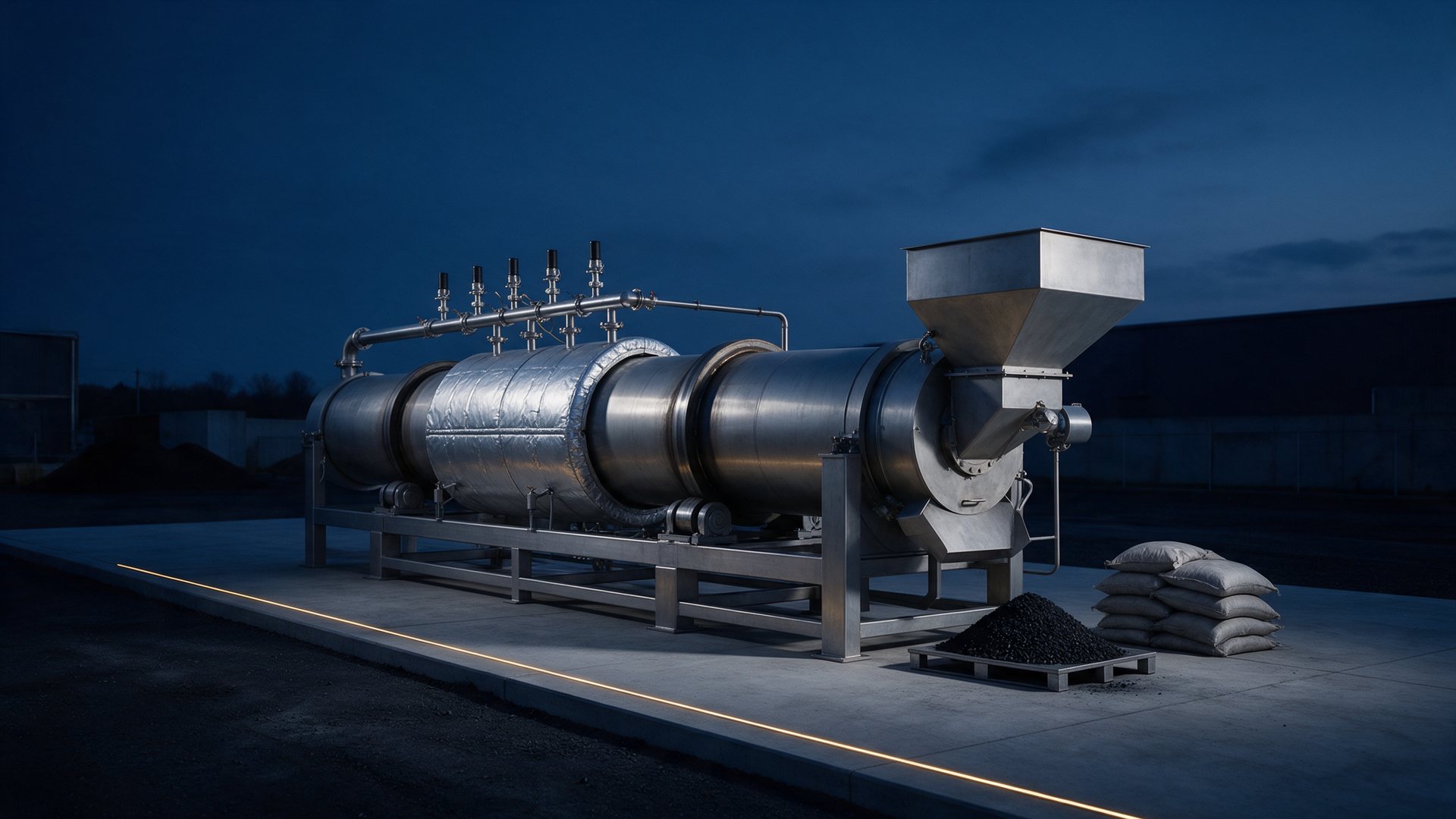
The Char That Is Worth More Than The Burn
Raw char leaves the kiln at USD 200 to 500 a tonne. Activate it and the price moves to the kilogram. The gap between those two numbers is a pore, and the cost of that pore is a kiln schedule someone has to choose.
The Same Tonne, Twice
A tonne of raw biochar leaves the kiln with a surface area of 50 to 200 square metres per gram. It sells for USD 200 to 500 a tonne. Activate the same char and the surface area goes to 1,500 square metres per gram or higher. The price leaves the tonne and moves to the kilogram. Commodity activated carbon trades at USD 2,000 to 3,500 a tonne. The United States sat near USD 2,480 in November 2025. China sat near USD 1,780. Southeast Asia near USD 2,350. Europe runs USD 2,500 to 3,500. American prices moved up 23 per cent in a year. The global activated carbon market was put near USD 9.6 billion in 2023. Nothing was added to the carbon. Holes were added to it. The tonne does not change. The pore does.
Two Ways To Buy A Pore
Chemical activation uses a reagent. Physical activation uses gas and heat. KOH runs 600 to 900 degrees Celsius in an inert atmosphere, at a KOH to char ratio of 1 to 1 up to 4 to 1, with 2 to 1 to 3 to 1 as the working range. It reaches 1,500 to 3,500 square metres per gram. Rice husk reached 755. A polyacrylonitrile precursor reached 1,884. Corncob reached 2,500. Pine bark reached 3,505. Rice husk char took up 3.13 millimoles of carbon dioxide per gram at zero degrees and 1.55 at 50 degrees, at a selectivity over nitrogen of up to 131. H3PO4 runs cooler, at 400 to 600 degrees, and reaches 500 to 1,500 square metres per gram. Date pits went from 3 square metres per gram untreated to 383. ZnCl2 works, and it is being retired. Zinc toxicity ends the argument on its own. Steam runs at 800 to 950 degrees and reaches 300 to 800 square metres per gram. Carbon dioxide runs at 800 to 1,000 degrees on the Boudouard reaction and reaches 200 to 600.
The Multiplier
The reagent is where the margin lives. KOH costs USD 1,000 to 1,500 a tonne. Consumables and recovery push energy to 5 to 9 gigajoules per tonne of product, and the washing train takes water and acid. H3PO4 costs USD 500 to 800 a tonne. Up to 85 per cent of it can be recovered. Steam costs nothing but the heat. Energy runs 8 to 12 gigajoules per tonne and there is no washing stage at all. The reaction is endothermic: carbon plus water makes carbon monoxide and hydrogen. Carbon dioxide activation is slower and takes the same heat. Per kilogram of product: steam-activated char at USD 1 to 3. H3PO4 at 2 to 5. KOH at 3 to 8. Plasma at 5 to 8. Commodity activated carbon at 2 to 3.50. KOH char for carbon capture has to reach parity with commodity carbon at USD 2 to 3 a kilogram. Every price above that line needs a buyer who is not buying on price.
The Buyer Buys A Number
Nobody buys char. Buyers buy a surface area with a pore size attached. Post-combustion carbon capture wants more than 1,000 square metres per gram in ultramicropores under 0.7 nanometres. Direct air capture wants more than 1,500 with amine groups added. Dye removal in water wants 500 to 1,000 in mesopores of 2 to 50 nanometres. Heavy metals want the same range with sulfur and nitrogen on the surface. Supercapacitors want more than 2,000 with mesopores and micropores together. Catalyst supports want 300 to 800. Soil amendment wants 50 to 200 and macropores. One kiln. Seven markets. Seven prices. The specification is written before the feedstock is chosen, and it decides which reagent gets bought.
The tonne does not change. The pore does.
Seven Dials
Seven levers move the pore. Raise the KOH ratio from 1 to 4 and micropores multiply. Raise the temperature from 600 to 900 degrees and pores widen, until the optimum passes and the walls collapse. Impregnate with H3PO4 and mesopores form. Use a silica or metal-organic template, then remove it, and the mesopores come out ordered. Treat with ammonia, or start from a nitrogen-rich feedstock, and the surface turns basic and carbon dioxide sticks better. Run the steam longer and burn-off widens the pores. Run carbon dioxide and the micropores come out narrow. The first cost table a plant builds is the feedstock. The second is the schedule. Move one dial and the reagent bill, the energy bill and the product grade all move together.
Who Is Already Selling
The incumbents are large and they run on fossil feedstock. Cabot Norit runs more than 100,000 tonnes a year from coal, peat and coconut. Calgon Carbon, under Kuraray, runs more than 100,000. Jacobi Carbons in Sweden and Germany runs about 80,000. MeadWestvaco runs about 50,000 from wood. Datong Coal Mining runs more than 100,000 at Chinese cost. The biochar side is small and mostly sells something else. Carbofex in Germany sells steam-activated biochar at small commercial scale. Carbon Gold in the UK sells soil blends. ArtiGras in the Netherlands runs a demonstration on sewage sludge. VTT in Finland runs pilot work. Bioforcetech sells biosolids char. Takachar works on low-cost units. Novocarbo and Exomad Green and CarbonFuture sell carbon removal credits with the char attached. Commercial activated biochar for carbon capture is close to empty as a market. Most producers sell the tonne. A few sell the pore.
The Carbon Market Underneath
Global biochar production reached 520,810 tonnes in 2025, against 180,150 tonnes in 2023. That is roughly 70 per cent a year. Carbon removal credits from biochar run USD 80 to 200 a tonne of carbon dioxide. Production cost sits at USD 500 to 1,000 a tonne at 1,000 tonnes a year, USD 200 to 500 above 5,000 tonnes a year, and as low as USD 116 to 197 in the Malaysian case where the char goes onto soil and the soil benefit is counted (Saharudin and colleagues, STOTEN 919, 170266). The University of Massachusetts work by Timmons put sequestration at USD 82 to 119 a tonne. The credit pays for the tonne. The activation has to pay for itself. That is the whole commercial argument, and it fits on one line.
What I Would Fund
Start with steam, because steam is the honest price. It needs no reagent, no washing train and no recovery loop, it sits at technology readiness level 9, and microwave-assisted continuous steam activation is already demonstrated on waste palm shells in an auger system (Springer, 2025). Then sell the tonne for the credit, and upgrade a fraction of it. I restructured a industrial group. Entrade built 200 wood-gasification machines across the UK and Europe. The first units never set the price and the tenth build did. I signed a personal guarantee on a company that folded on Christmas Day 2008, so I price cash flow before I price a forecast. The probability that a producer keeps selling raw char because activation looks complicated is not zero. Most of that market is pricing it at zero. Steam is the floor. Chemicals are a mortgage on a pore. Check which unit the price is quoted in before you believe the comparison.
Nobody buys char. Buyers buy a surface area with a pore size attached.
The map is dead. Nobody told you.
Bali State of Mind is the survival guide for the collapse of everything you were taught to believe.
Beyond this book
Building the same thing somewhere else.
Julien Uhlig is available for advisory work, board seats and media appearances. Write to media@exventure.co.
The academy that trains the operators, across every company in the group, is EX Epic Academy - 25,000 applications, 12 per cohort, 200+ alumni across 19 countries. academy.epicsolutiongroup.com
18-20 November. Online, Las Palmas, Bali.
Three days on what happens to work, capital and institutions when the map stops matching the ground. Seats are limited by cohort.
ex-aisummit.com →