The Catalyst That Decides The Reactor
The hydrogen to carbon monoxide ratio picks the metal, the metal picks the reactor, and the reactor decides whether the heat leaves before the methane takes the yield. Fischer-Tropsch in the order it actually gets built.
The Order Of Operations
The hydrogen to carbon monoxide ratio decides which metal you can use. The metal decides which reactor you can buy. That order does not reverse. Cobalt wants a ratio near 2. Iron tolerates anything below 1, and it carries a water gas shift reaction that turns carbon monoxide and steam into carbon dioxide and more hydrogen. Most gasified waste and most gasified biomass arrive below 1. Coal and natural gas arrive where cobalt is comfortable. So the feedstock picks the metal before anyone opens a supplier list, and the choice is settled in a ratio you cannot move without paying for it. The gas picks the catalyst. The catalyst picks the reactor. In that order.
Two Metals, One Trade
Cobalt costs more. It runs 2 to 5 years in commercial service, it makes long chain paraffins, and it makes very little methane. If the product is liquid fuel, that last property is the one that matters. Iron costs less and it will run on the dirty ratio. It also hands you more olefins and more oxygenates, which is a different product slate and a different buyer. Adding a small amount of ruthenium, platinum or rhenium improves the reduction step and lifts activity by a factor of 2 to 5. That is a published effect and it is also a price. On a mixed silica and alumina support, an iron and cobalt pair reached 80 per cent carbon monoxide conversion in a 3D printed stainless steel microchannel reactor at 20 bar and between 200 and 350 degrees Celsius. That is a bench result. The commercial answer is still one metal or the other. You are not buying a catalyst. You are buying the feedstock it will tolerate.
The Reactor Is A Cooling Problem
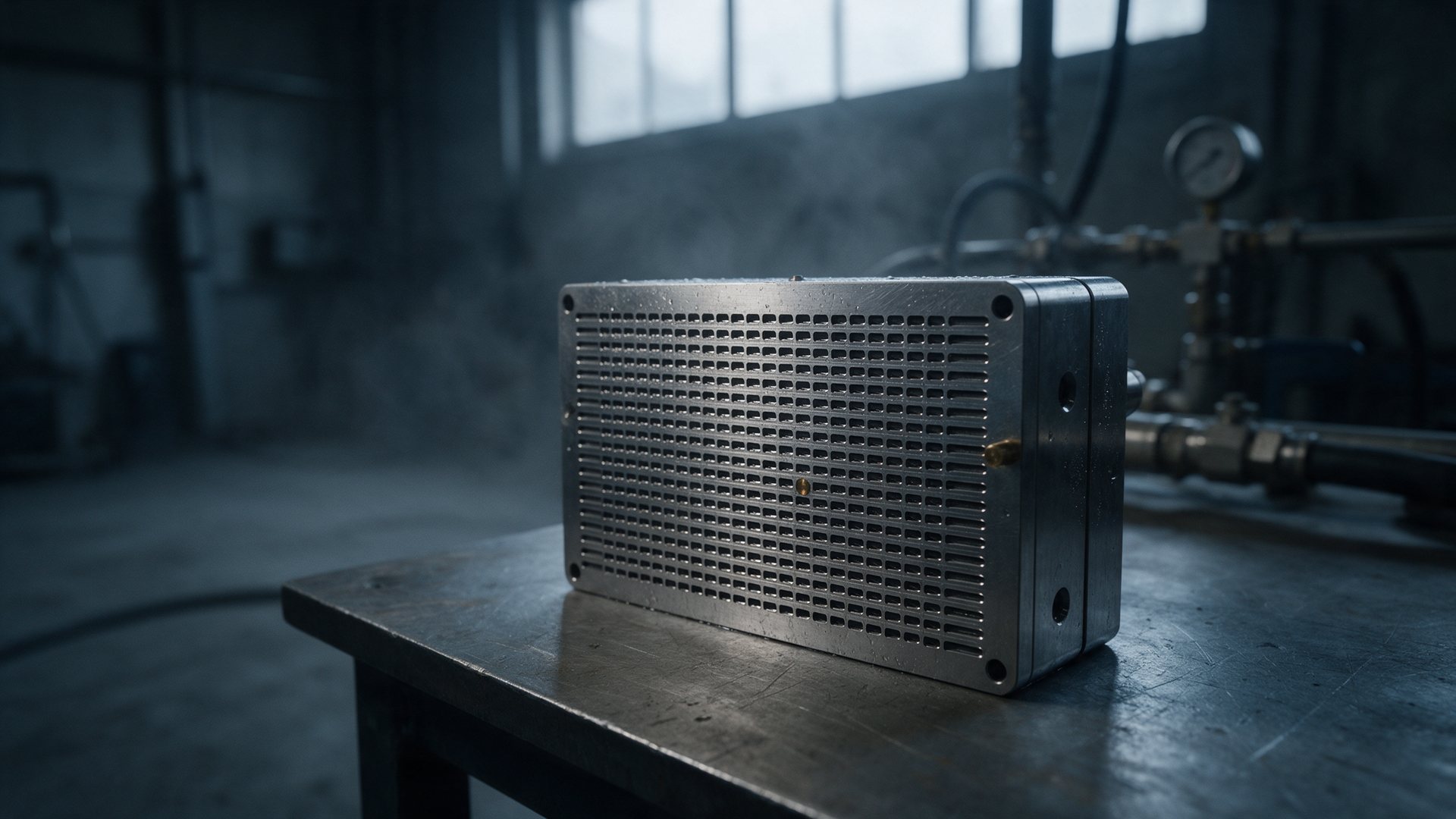
The reaction releases heat, and where that heat goes decides what leaves the pipe. A microchannel design moves about 5 kilowatts per square metre per kelvin and holds the temperature inside 1 to 2 degrees. Methane selectivity lands between 5 and 8 per cent. A slurry bed moves roughly 1. A multi-tubular fixed bed moves about half of that and swings 10 to 30 degrees across the tube. Methane selectivity climbs to 8 to 12 per cent and then to 10 to 15 per cent. Methane is the yield you paid for and did not sell. The microchannel itself is about 1 millimetre wide with catalyst coated on the wall, and the pressure drop across it is 3 to 5 pascals. A bed of packed pellets cannot match either number. The catalyst picks the reactor. The reactor is a cooling problem wearing chemistry.
The Size Floor
Capital puts a floor under each of those designs. Microchannel is quoted at roughly 30,000 to 50,000 dollars per barrel per day of capacity and works from about 20 barrels per day. Fixed bed is 60,000 to 100,000 dollars per barrel per day with a floor near 500. Slurry is 50,000 to 80,000 dollars with a floor near 1,000 barrels per day, which is why the operators of it have either a gas field or a coal mine attached. Sasol has made 50,000 barrels per day from coal since 1955. Shell Bintulu has made 12,500 barrels per day from gas since 1993. Pearl in Qatar makes 140,000 barrels per day. Scale was never a preference. It was the only arrangement in which the heat and the capital both worked. Below 500 barrels per day a fixed bed stops being a smaller version of a big plant and becomes a worse one.
The gas picks the catalyst. The catalyst picks the reactor. In that order.
What The Cheap Barrel Actually Costs
Read the production numbers and most of the argument ends. Large coal to liquids lands at 2.00 to 2.50 dollars per gallon of gasoline equivalent, which is 85 to 105 dollars a barrel, with coal at 50 dollars a tonne. Large gas to liquids lands at 1.50 to 2.00 dollars per gallon, 65 to 85 dollars a barrel, with gas at 3 dollars per million British thermal units. A small biomass to liquids plant at 200 barrels per day lands at 4.00 to 7.00 dollars per gallon, or 170 to 300 dollars a barrel. A small waste to liquids plant lands at 3.00 to 5.00 dollars, or 130 to 210 dollars a barrel, because the gate fee for taking the waste sits on the revenue line. Microchannel is quoted at 3.00 to 4.50 dollars per gallon, 130 to 190 dollars a barrel. The small plant does not compete with crude at 70 dollars a barrel. It competes with a disposal bill and a mandate.
Nobody Has Built The Small One Yet
Search the record for a commercial small scale biomass to liquids plant and the answer is that there is none. The closest is a project in the United Kingdom at 30 million litres a year of sustainable aviation fuel, about 23,000 tonnes, still in front end engineering design in 2026 with a final investment decision pencilled for the second quarter of 2027. A developer in the United States that promised municipal waste to fuel filed for bankruptcy in 2023 and the site in Indiana stopped. There is a pilot in Austria that has run about 1 barrel per day since 2014. There is a Swedish feasibility study on forest residue. There is a two stage fixed bed on peanut shell biochar that reached 94.9 per cent conversion in a laboratory. One microchannel developer reports 6,000 hours of continuous operation at up to 250 barrels per day, and announced a 30 per cent cost reduction in February 2026. 6,000 hours is about 8 months. Nobody has published a decade. Carbon dioxide in the syngas makes every version of this harder. It dilutes the feed, it consumes hydrogen through the reverse water gas shift, and it accelerates deactivation of the catalyst. The probability that a commercial small scale plant is running by 2030 is not zero. The synthetic fuels market was measured at 15.44 billion dollars in 2025 and projected at 32.70 billion by 2034, which is a price that assumes it happens.
The Regulation Is The Customer
Sustainable aviation fuel sells at 1,000 to 1,500 dollars a tonne. Fossil kerosene does not. The gap is closed by law rather than by chemistry. Aviation fuel rules in the European Union carry a mandate trajectory, and the United Kingdom runs a revenue certainty mechanism over offtake. A tonne of waste that costs money to dispose of is a feedstock with a negative price. That is the only reason the arithmetic on a 200 barrel per day plant closes at all. The mandate does not care which metal you chose. It buys the volume. When a regulation creates the market, the regulation is the customer.
The Part Nobody Prices
I restructured a industrial group and built companies across twelve countries. I have deployed 210 energy systems across Africa and Asia, and every one of them was a bet on a fuel price and a running hour. Entrade built 200 wood gasification machines across Britain and Europe. Those machines were sold on a feedstock number, and the feedstock number was the whole sale. This trade is the same trade. On one side, capital per barrel per day. On the other, a ratio in the gas, a metal that will tolerate it, and a reactor that carries the heat away before the methane takes the yield. Most of the market prices the catalyst as a line item. It is the decision that sets everything downstream of it. The gas picks the catalyst. The catalyst picks the reactor. Everything after that is procurement.
You are not buying a catalyst. You are buying the feedstock it will tolerate.
The map is dead. Nobody told you.
Bali State of Mind is the survival guide for the collapse of everything you were taught to believe.
Beyond this book
Building the same thing somewhere else.
Julien Uhlig is available for advisory work, board seats and media appearances. Write to media@exventure.co.
The academy that trains the operators, across every company in the group, is EX Epic Academy - 25,000 applications, 12 per cohort, 200+ alumni across 19 countries. academy.epicsolutiongroup.com
18-20 November. Online, Las Palmas, Bali.
Three days on what happens to work, capital and institutions when the map stops matching the ground. Seats are limited by cohort.
ex-aisummit.com →