The Catalyst Is The Business
The chemistry has been in the open literature for a century. The pellet nobody puts on the slide is the part that decides the economics.
The Reaction Nobody Owns
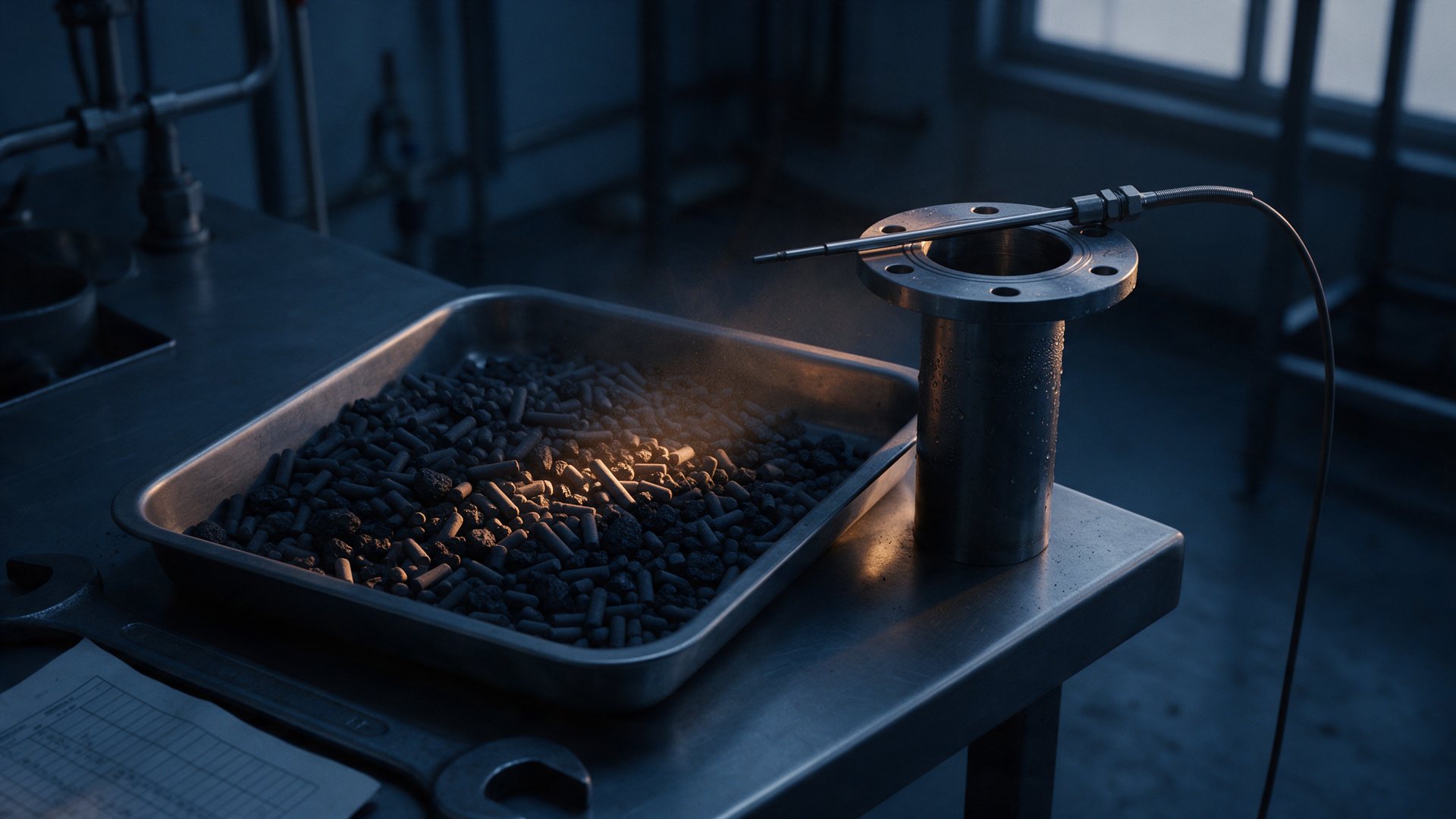
Every synthetic fuel plant on earth runs the same two steps. First a gasifier turns a solid or a waste into syngas, a blend of carbon monoxide and hydrogen. Then a reactor closes those carbon chains back up into liquids. The first step is engineering you can walk past on site. The second step has been in the open literature for a century. Sasol has run that second step in South Africa at more than 50,000 barrels a day since 1955. Shell Bintulu in Malaysia has run 12,500 barrels a day since 1993. Pearl GTL in Qatar opened at 140,000 barrels a day from gas in 2011. Entrade built 200 wood-gasification machines across the UK and Europe, and every one of them was judged on the gasifier. That is the error in miniature. The reaction is not the asset. The catalyst is, and it is a pellet the size of a fingernail that nobody puts on the slide.
Two Metals, Two Deals
Cobalt and iron do the same job and they are two different businesses. Cobalt wants a hydrogen-rich syngas, a hydrogen-to-carbon-monoxide ratio near 2, and it gives back long-chain paraffins at high selectivity with low water-gas shift activity. A commercial cobalt charge lasts 2 to 5 years in service. Iron costs less to buy, tolerates a ratio below 1, and runs the water-gas shift itself: carbon monoxide plus steam to carbon dioxide plus hydrogen. It produces more olefins and more oxygenates, and its promoters carry the trade. Potassium shifts selectivity toward the heavier olefins. Copper and manganese are still being tuned in published work. Then comes the layer that decides activity. Ruthenium, platinum and rhenium added to a cobalt charge improve reduction and lift activity by 2 to 5 times. That is not a rounding error. It is the difference between a reactor that pays for itself and one that runs on subsidy.
The Support Is The Product
The published work is not converging on a better metal. It is converging on a better cage for the metal. A cobalt-iron charge on a mixed silica-alumina support ran in a 3D-printed stainless steel microchannel microreactor at 20 bar and between 200 and 350 degrees Celsius, and reached up to 80 per cent carbon monoxide conversion (Molecules, volume 30, issue 17, page 3486, 2025). Cobalt confined in a three-dimensional hierarchical silica network improved stability and selectivity to C5-plus products (Zhou and colleagues, Chemical Communications, volume 60, issue 93, page 13762, 2024). Cobalt oxide sized on carbon spheres did the same job (Sun and colleagues, Nano Research, volume 17, issue 4, pages 2520 to 2527, 2024). Cobalt inside the mesopores of an MFI zeolite nanosponge lifted selectivity again (Jeong and colleagues, Fuel, volume 381, page 133673, 2025). On the iron side, a two-stage fixed bed with potassium ferrate promoted on biochar and fed on peanut shells converted 94.9 per cent (Kumar and colleagues, 2025). An iron-molybdenum catalyst on ZSM-5 was tested for direct syngas-to-aromatics, on syngas made from hardwood pellets at 850 to 950 degrees Celsius (a 2025 poster from North Carolina State University). The maturity gap is the whole story. Published technology-readiness levels sit at 4 to 5 for bimetallic charges, 3 to 5 for nanoconfined ones, 3 to 4 for bifunctional and core-shell designs, and 2 to 3 for single-atom and metal-organic-framework-derived work. A single-atom catalyst is a paper. A support that survives 6,000 hours is a product.
The Reactor Chooses The Economics
Three reactor families, three size floors, and the floor is set by heat. A microchannel reactor runs hundreds of parallel channels about a millimetre wide, with the catalyst coated on the wall. Per-pass carbon monoxide conversion is about 70 per cent, and 90 to 95 per cent with recycle. Productivity per unit of volume is 6 to 10 times a conventional reactor. The temperature spread across the reactor is 1 to 2 degrees Celsius, against 10 to 20 degrees in a fixed bed. A module runs at 20 to 30 bar and 210 to 240 degrees Celsius on cobalt, and produces about 30 barrels a day. Pressure drop is 3 to 5 pascals. A computational study of an iron charge in a microchannel at 340 degrees Celsius, 0.7 megapascals and a hydrogen-to-carbon-monoxide ratio of two thirds found a maximum temperature rise of 9.1 degrees Celsius with catalyst coated on both sides of the channel, and an 8.9 per cent improvement in conversion (Ren and Wang, RSC Advances, 2025). The comparison holds line by line. Heat transfer is about 5 kilowatts per square metre per kelvin in a microchannel, about 1 in a slurry bed, and about 0.5 in a multi-tubular fixed bed. Methane selectivity runs 5 to 8 per cent, then 8 to 12, then 10 to 15. The minimum economic size is roughly 20 barrels a day for microchannel, 1,000 for slurry, and 500 for fixed bed. Capital cost runs 30,000 to 50,000 dollars per barrel a day of capacity for microchannel, 50,000 to 80,000 for slurry, and 60,000 to 100,000 for fixed bed. The slurry reactor is the mature one and it does not scale down. Sasol runs more than 50,000 barrels a day through it. Its catalyst attrition and its wax separation problem both get worse as the reactor gets smaller.
The reaction is not the asset. The catalyst is, and it is a pellet the size of a fingernail that nobody puts on the slide.
Four Dollars Against Fifty Cents
The cost ladder is the argument. Large coal-to-liquids sits at about 2.00 to 2.50 dollars a gallon of gasoline equivalent, at 50 dollars a tonne of coal and no carbon capture. Gas-to-liquids sits at 1.50 to 2.00 dollars, at 3 dollars per million British thermal units of gas. A 200 barrel a day biomass-to-liquids plant sits at 4.00 to 7.00 dollars. A waste-fed plant of the same size, where a gate fee is being paid to take the feedstock, sits at 3.00 to 5.00. A microchannel plant is claimed at 3.00 to 4.50 after a 30 per cent cost reduction announced in February 2026. Capital cost per daily barrel inverts the same way. About 90,000 dollars at 50,000 barrels a day (NETL, 2007). 70,000 to 100,000 at 2,500 barrels a day (ETIP). 100,000 to 150,000 at 200 barrels a day, which is 20 to 30 million dollars for the plant. Then 30,000 to 50,000 dollars per daily barrel for a 30 barrel a day microchannel module at 0.9 to 1.5 million dollars each. Crude at 70 dollars a barrel makes the large gas and coal plants borderline. It leaves the small plants nowhere. Sustainable aviation fuel at 1,000 to 1,500 dollars a tonne, under the European Union mandate of 10 per cent by 2030, the United Kingdom revenue certainty mechanism for offtake, and a gate fee is the entire business case for small scale. The probability that a small plant is profitable without a mandate, a gate fee or a carbon credit is close to zero, and most project models are pricing it at zero.
Nothing Small Is Running
On the compilation date, 7 July 2026, there is no commercial small-scale biomass-to-liquids plant anywhere in the world. That sentence is worth reading twice. The most advanced project globally is Altalto at Immingham in the United Kingdom: 30 million litres a year of sustainable aviation fuel, 23,000 tonnes of it, from municipal solid waste, with front-end engineering design starting in early 2026, a final investment decision targeted for the second quarter of 2027, and planning permission already granted. A demonstration system at Wednesbury was commissioned in March 2026. The hardware has run more than 6,000 continuous hours at up to 250 barrels a day. A memorandum with Varhad Capital covering biomass-to-sustainable-aviation-fuel projects in India was signed in April 2026. A partnership with Sekisui Chemical pairs chemical looping that turns carbon dioxide into carbon monoxide at above 90 per cent yield with the same reactor running at 90 to 95 per cent conversion, to make a synthetic aviation fuel. Behind that, the field is thin. A one barrel a day pilot in Austria has run since about 2014. A three megawatt thermal pilot in Sweden runs on black liquor. A one barrel a day demonstration completed in Austria in 2017. A plant in the United States filed for bankruptcy in 2023 and its site stalled. An earlier attempt at gasification plus fermentation failed outright. The market forecast is not thin at all: 15.44 billion dollars in 2025 to 32.70 billion dollars by 2034, at 8.7 per cent a year (IMARC, 2026). The constraint named in the same report is the supply of carbon-dioxide-free hydrogen for power-to-liquids. A forecast with a bottleneck inside it is a forecast. It is not a pipeline.
The Pellet Is The Business
One failure mode belongs here, because it decides who gets paid. Carbon dioxide in the syngas is not a neutral passenger. It dilutes the feed, it consumes hydrogen through the reverse water-gas shift, and it accelerates deactivation of the charge. A gasifier that produces syngas at a hydrogen-to-carbon-monoxide ratio below 1 cannot feed a cobalt reactor without a shift step to raise the hydrogen, an iron charge that tolerates the ratio, or hydrogen recycled back around the loop. Each of those is capital, and each of those is priced late. That is the choice against the methanol route as well. Methanol synthesis runs at lower pressure, is simpler, and tolerates carbon dioxide far better. Fischer-Tropsch hands you drop-in hydrocarbons and then charges you again for the hydrocracking and isomerisation that finish them. I have built companies across twelve countries, restructured a 75 million euro industrial group, took a company through a Frankfurt IPO, and deployed 210 energy systems across Africa and Asia. In every one of those, what decided the outcome was the smallest line item in the budget and the hardest one for a competitor to copy. The chemistry is published. The catalyst is the asset. Read the pellet before the headline.
A single-atom catalyst is a paper. A support that survives 6,000 hours is a product.
The map is dead. Nobody told you.
Bali State of Mind is the survival guide for the collapse of everything you were taught to believe.
Beyond this book
Building the same thing somewhere else.
Julien Uhlig is available for advisory work, board seats and media appearances. Write to media@exventure.co.
The academy that trains the operators, across every company in the group, is EX Epic Academy - 25,000 applications, 25 seats per cohort, 210 alumni across 19 countries. academy.epicsolutiongroup.com
18-20 November. Online, Las Palmas, Bali.
Three days on what happens to work, capital and institutions when the map stops matching the ground. Seats are limited by cohort.
ex-aisummit.com →