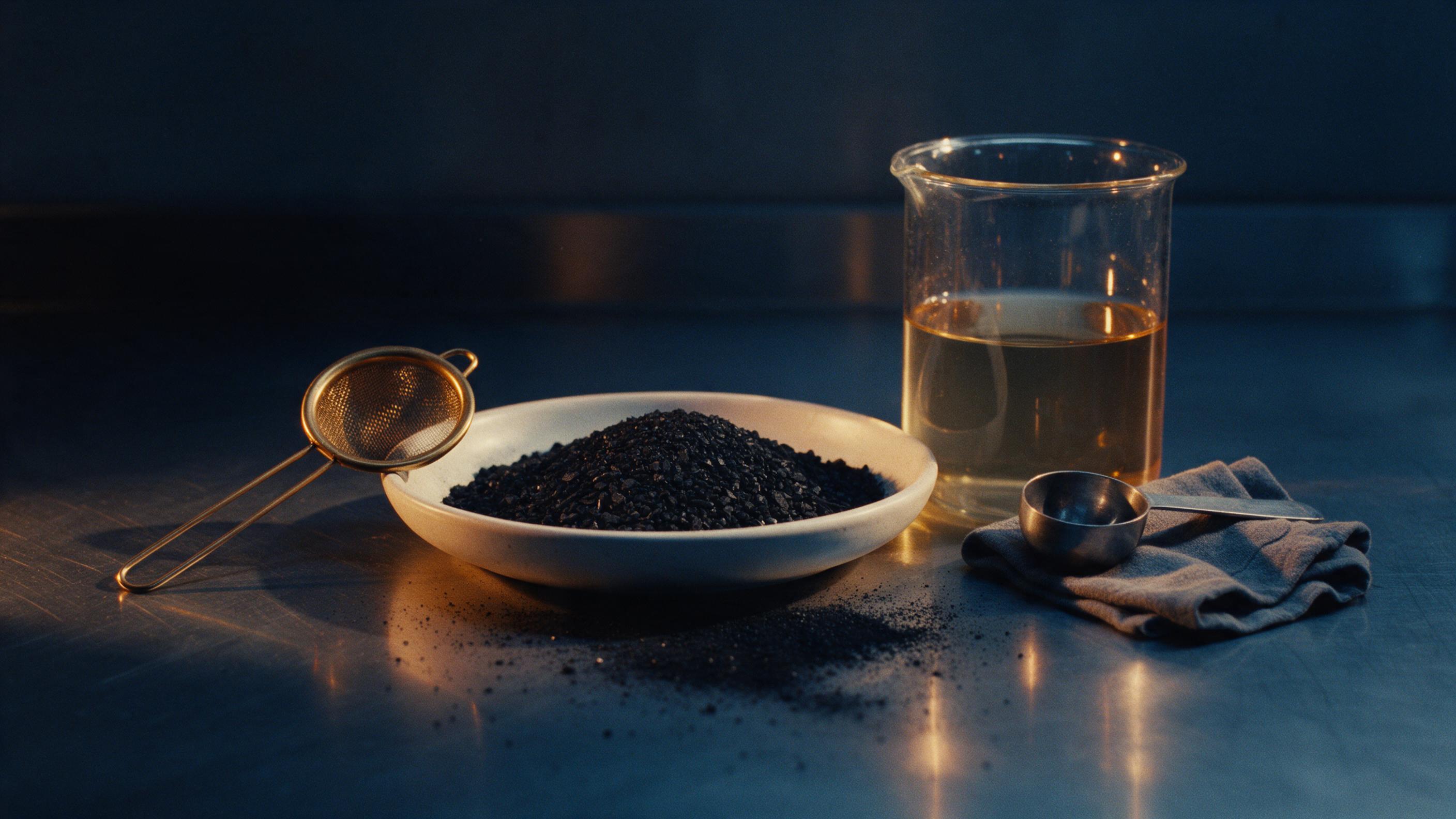
The Acid That Takes The Product With It
Citric acid lifts 60 to 75 per cent of the phosphorus out of a gasifier char and leaves more than 90 per cent of the carbon standing. A mineral acid does the same job faster and takes the carbon with it. One of those two outputs is the reason the plant exists.
Two Products In One Black Pile
Every tonne of sewage sludge through a gasifier leaves two things worth money in the same black pile. Phosphorus, which is a nutrient Europe imports, and the carbon skeleton itself, which is the actual product if the char is going to be sold as a carbon capture material. Phosphorus is the loud one. A liquid fertiliser a farmer can put straight on a field is a finished product rather than an intermediate, and the market for it is regional and price-stable. Carbon is the quiet one. Surface area, pore structure, oxygen functional groups. That is what binds CO2, and that is what a buyer is paying for. Take it out and you are left with a phosphate fertiliser and a pile of ash. So the question was never whether an acid lifts the phosphorus out of the char. Every acid does. The question is which of the two products is still standing when the acid is finished. The probability that a project team picks the fast route and only discovers the carbon loss at the CO2 uptake test is not zero. Most teams are pricing it at zero, which is exactly why it keeps happening.
What The Cheap Acid Does To The Carbon
The mineral route is hydrochloric, sulphuric or nitric acid at pH 0.5 to 3. It is fast, it is cheap per litre, and it is not selective, because a proton at that concentration does not distinguish between the phosphate it is freeing and the carbon matrix it is standing in. Carbon attack needs pH below 3 held for an extended period. The mineral route spends its entire working life inside that window, carrying a proton concentration 100 to 1,000 times higher than the organic route ever reaches. The published comparison is blunt. Wang et al. (2022) measured biochar surface area retention above 85 per cent after organic acid treatment, with CO2 capture capacity unaffected. That is the number to keep, because it is the difference between a material and a residue. The second bill is the one that never makes the slide. Strong acid needs corrosion-resistant alloys in the reactor, a disposal route for the spent liquor and a permit conversation with a regulator. The one-tonne-per-day plant priced at EUR 40,000 to 60,000 carries that price because the acid is mild enough to sit in 304L stainless or plain polypropylene. Change the acid and that assumption is the first thing to go.
The Citric Number
Semerci and Akkaya (2021) lifted 62 per cent of the phosphorus out of sewage sludge ash with citric acid at 30 millimolar, 80 degrees, 30 minutes of contact, and kept more than 90 per cent of the carbon. Biswas et al. (2020) ran citric, oxalic and gluconic acid against the same calcium-bound phosphorus chars and found citric acid ahead. So citric acid is the lead agent and the working window is pH 3 to 5. The published spread is 60 to 75 per cent phosphorus recovery with citric acid and 40 to 60 per cent with oxalic or gluconic. Acid consumption sits at 30 to 100 millimolar and 5 to 10 millilitres per gram of char. Contact time is 30 minutes at 80 degrees, or 2 to 4 hours at ambient. Three hours at room temperature, or 30 minutes hot. Same 60 per cent. The only difference between those two runs is whether the char arrives hot. That is not a laboratory detail. It is the process decision.
The Heat Is Already In The Char
Gasifier char discharges at 300 to 500 degrees. Even after air cooling to 80 or 100 degrees it is hotter than the reaction needs. Arrhenius puts the kinetics 3 to 5 times faster at 80 degrees than at ambient, and the protocol asks for 30 minutes at 80 degrees. That contact time is available from residual heat. No external energy, no steam, no boiler, no gas line. The one engineering decision that matters is the heat exchanger. Spent char and incoming acid run counter-current, or the acid arrives cold and every euro of thermal advantage handed to you for free gets bought back with a burner. I have deployed 210 energy systems across Africa and Asia, and the failure mode is always the same shape. The chemistry is proven, the arithmetic is proven, and the plant loses the margin in the plumbing between the two.
The question is never whether the acid works. It is which of the two products is still there when the acid is done.
The Acid Costs Nothing, The Product Costs Everything
Food-grade citric acid trades at EUR 1 to 2 per kilogram. Technical grade at EUR 0.80 to 1.20. At 30 millimolar and 10 millilitres per gram of char that is roughly EUR 6 to 18 of acid per tonne of char processed. Operating cost, all in, is EUR 20 to 40 per tonne. One tonne per day of capacity is built for EUR 40,000 to 60,000. Now set that against the thing the fast acid destroys. A carbon capture material is sold on surface area and CO2 capacity, and Wang et al. measured both retained above 85 per cent after organic acid treatment. An acid that lifts extraction to 90 per cent while eating the carbon matrix has improved the cheaper of the two outputs and written off the expensive one. The leach liquor is the third saving. P-citrate is accepted as a component under EU 2019/1009, so what comes off the filter is already a fertiliser: no precipitation, no concentration, no second plant. Mazumder et al. (2023) put bioavailability at 87 per cent in pot trials against 45 per cent for mineral phosphorus fertiliser. The acid is a rounding error. The carbon is the business.
The Patent Goes On The Combination
The Turkish filing WO2025144324A1 claims phosphoric acid plus nitric acid with microwave assist. Organic acids are chemically distinct from that, so there is no overlap and no design-around to negotiate. You are simply somewhere else. Which leaves the combination unclaimed: citric acid selective leaching at pH 3, fed with gasifier char straight off a 300 to 500 degree discharge, preserving the carbon matrix for the downstream conversion. Composable, defensible, and wide open. Patents in this space go to whoever ran the pilot, not to whoever wrote the better memo. The protocol is 30 millimolar citric acid, 10 millilitres per gram, 80 degrees, 30 minutes, vacuum filtration, and a molybdate blue test for orthophosphate. Success is 60 per cent recovery, 85 per cent carbon retention, 80 per cent surface area retention and heavy metal co-extraction under 20 per cent. That is one afternoon of work to find out whether the carbon you kept is the product you are selling.
The acid is a rounding error. The carbon is the business.
The map is dead. Nobody told you.
Bali State of Mind is the survival guide for the collapse of everything you were taught to believe.
Beyond this book
Building the same thing somewhere else.
Julien Uhlig is available for advisory work, board seats and media appearances. Write to media@exventure.co.
The academy that trains the operators, across every company in the group, is EX Epic Academy - 25,000 applications, 12 per cohort, 200+ alumni across 19 countries. academy.epicsolutiongroup.com
18-20 November. Online, Las Palmas, Bali.
Three days on what happens to work, capital and institutions when the map stops matching the ground. Seats are limited by cohort.
ex-aisummit.com →