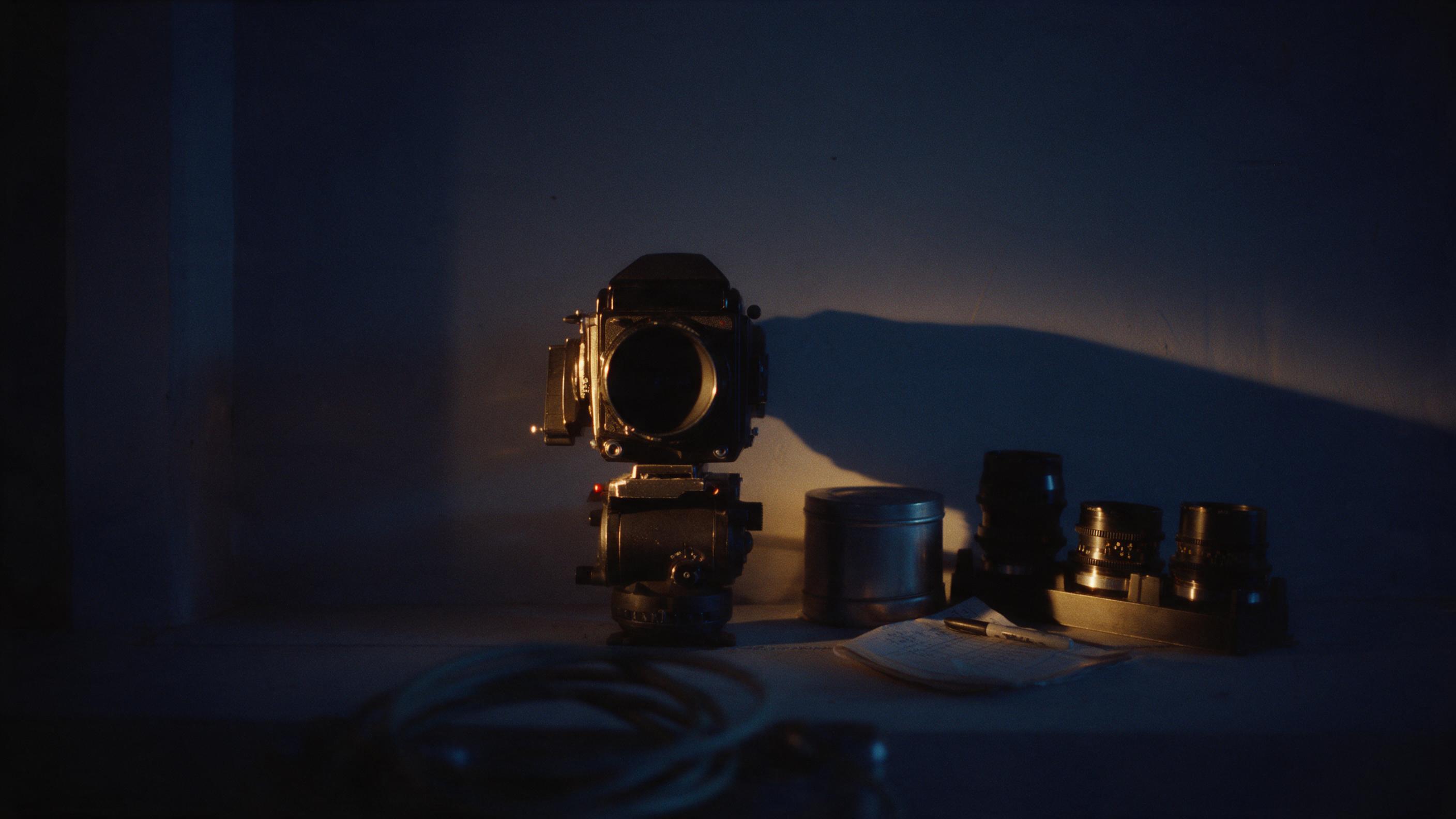
The Camera Is Inside The Scene
Every camera decision answers 1 question: whose point of view is this, and how do I put the viewer inside it. The anamorphic 2.40:1 frame carries dialogue, the 65mm 1.43:1 frame carries the setpieces, and the 2 are cut together inside 1 film rather than cropped into each other. The toolkit is short, specific, and it exists so the audience never watches the scene from above.
Every Camera Decision Answers 1 Question
The camera has 1 job in every shot. It decides whose point of view the audience is standing inside. Format, rig, stock and movement are not style applied afterwards. They are the mechanism that puts a viewer into a room, and the question underneath every one of them is short. Whose point of view is this, and how do I put the viewer inside it? Most decisions on a production day get made against that question without anyone stating it. A monitor shows a 2-dimensional picture, and a camera locked on a tripod 30 feet away shows a scene from the outside. Every technique in this toolkit is a move away from the outside and into the room. The difference is easy to feel and hard to describe. A wide locked-off shot tells an audience where a character is. A handheld shot at 35mm over a shoulder, moving at the pace of the character's own footsteps, shows an audience what that character is about to walk into. Both are 1 shot. Only 1 of them is a point of view. So the work starts with 1 sentence per setup. If the sentence cannot be written, the shot does not yet have a reason to exist. The same failure turns up across twelve countries of production: a beautiful frame that answers nothing, cut into a story that needed an answer.
2 Ratios, Cut Together, Never Cropped
An anamorphic lens squeezes a 2.40:1 image onto the negative, and the grade or the projector de-squeezes it back. That 1 optical fact produces 3 signatures an audience reads immediately: oval bokeh, a horizontal flare that streaks across the frame, and a soft edge falloff that drops the corners. It is the format for dialogue and traditional coverage, because a face inside a wide oval frame with the background falling away is the least distracting way to hold a conversation on screen. The second format is a 65mm large-format camera on a spherical lens, which produces a taller 1.43:1 frame, a wider field of view and more detail per frame than anything else in the room. It is heavy, it is loud, and it is rationed to the shots that justify it. The rule that turns 2 formats into a grammar is that they are cut together inside 1 film, and sometimes inside 1 scene, rather than shot in one and cropped into the other. Cropping a 1.43:1 negative to 2.40:1 keeps about 60 per cent of the frame that was composed for it. Cutting clean between the 2 keeps every frame whole, and lets the change of ratio carry the change of register. The wider toolkit holds 1.85:1, 1.66:1, 1.33:1 and 2:1, and each one changes what a face and a room can do at the same time. Name the ratio before the shot, because a ratio chosen in the grade is a crop, and a crop is a decision made by someone who was not on the set.
The Subversion: The Close-Up Becomes The Vista
The taller frame was built for the big shot. Chases, stunts, aerial establishing frames that need the ground to stay readable. The move that makes the format a grammar instead of a marketing line is pointing it at the opposite thing. A close-up in 1.43:1 puts a face 80 feet tall on a screen 60 feet wide, and a performance nuance that would be invisible in 2.40:1 becomes the subject of the shot. That is a deliberate subversion of what the format is for. The vista is normally where an audience feels small. Turn the same frame on a face and the audience feels close. Same glass, opposite emotion, and the close-up becomes the vista. There is 1 arithmetic note that keeps this practical. A renderer or a camera that can only output 16:9 will letterbox a 1.43:1 request in a way that fights the composition. Name the quality instead - tall frame, immense resolution, 65mm spherical - or shoot 16:9 and add the bars in the grade, with the intention stated to the colourist on the first day rather than on the last.
Roll Is The Third Axis, And It Is Rare
Pan moves side to side. Tilt moves up and down. Roll rotates the camera on the lens axis, and it is the rarest of the 3 axes, because an audience reads a tilted horizon as either a mistake or a state of mind. That scarcity is the entire value. Roll belongs only to a world that genuinely tilts: a subjective fall, a disorientation, reality bending under a character's feet. Executed on a 3-axis remote head it can be added to any move, and on a crane it can travel through space while it rotates. Used without a reason it reads as an operator with a broken horizon. The best known version of the move was solved practically rather than digitally. For a hallway fight that turns over on itself, the rotation was built into the set, a corridor rig that rotated 360 degrees with the actors inside it, so the world rolled and the camera did not. Practical construction beats a post rotation every time, because the light behaves correctly and the actors' weight behaves correctly. No effects pass reproduces either 1 of them.
The camera is not a recorder of the scene. It is the audience's position inside it.
The Hard Mount Is Why It Feels Real
A camera hard-mounted to a picture vehicle is locked to the same object the character is inside. The frame holds the character, the background streaks past, and the audience sits in the cockpit at 60 miles an hour without a cut. The immersion is not a grade. It is real vibration, real reflections and real speed, which are the 3 things an effects shot cannot fake convincingly. The arm car is the exterior partner to it: a fast camera car with a crane arm and a remote head on the roof, which establishes the vehicle in the world with a speed an audience can read in 1 shot. Both rigs run on the same crew of 4. A stunt driver on the wheel, an arm technician on the arm, a DP or operator panning, tilting and rolling the head, and a 1st AC rolling camera, setting wireless and holding focus. Both rigs also discipline the shot list, which is the part nobody plans for. Once a camera is bolted to a car the position cannot be improvised, so the shot is designed in advance or it does not exist. A 4 person crew and 1 locked mount produce something an audience cannot name and can always feel.
Film Stock, The Far-Side Key, And The Grammar
Film stock is a choice about what the image is made of, and it splits into a small set of specific stocks. Kodak Vision3 colour runs 50D and 250D for exteriors in daylight and 500T tungsten for interiors and night, so the stock is selected per lighting condition instead of corrected afterwards. Eastman Double-X 5222 is black and white, and black and white is how 1 timeline is separated from another: 16mm on a debut, 35mm on Memento, a custom 65mm enlargement on Oppenheimer. The negative then licenses the lighting. Film holds richness in the underexposed side of a face. Digital under about 20 to 30 IRE muddies and gains noise, which is why the far-side key only works on film. The key sits far back on the far side of the line, lights the hot half of the face and leaves the rest dark. Take the stock away and the same lighting collapses into mud. The grammar underneath all of it is deceptive in its simplicity, because a complicated story does not need a complicated frame. Negative space, a longer lens to isolate a subject, and deep staging that places 2 or 3 characters at different distances inside 1 shot, so the viewer looks around inside the frame instead of cutting away from it. Primes instead of zoom lenses, because a fixed focal length forces the camera to move, and the performance matches the proximity. No monitor on set, because the shot is a 3-dimensional placement in a room rather than a 2-dimensional picture on a screen. The edit carries the same logic. Cross-cutting 3 storylines at different intensity phases, 1 peaking while another builds and a third begins, produces a continuous rise that never resolves. The audience stays aligned with a character through the whole climb instead of being handed the answer at the top of it. The probability that a viewer stays inside the scene rises with every decision made from the character's position rather than from the outside. That is the test for all of it, and it is the same test that built companies across twelve countries and filled 393 pages of a paperback and Kindle edition. Stop observing the maze from above and walk it with the character. The camera is not a recorder of the scene. It is the audience's position inside it.
Format is a decision, not a filter applied afterwards.
The map is dead. Nobody told you.
Bali State of Mind is the survival guide for the collapse of everything you were taught to believe.
Beyond this book
Building the same thing somewhere else.
Julien Uhlig is available for advisory work, board seats and media appearances. Write to media@exventure.co.
The academy that trains the operators, across every company in the group, is EX Epic Academy - 25,000 applications, 25 seats per cohort, 210 alumni across 19 countries. academy.epicsolutiongroup.com
18-20 November. Online, Las Palmas, Bali.
Three days on what happens to work, capital and institutions when the map stops matching the ground. Seats are limited by cohort.
ex-aisummit.com →