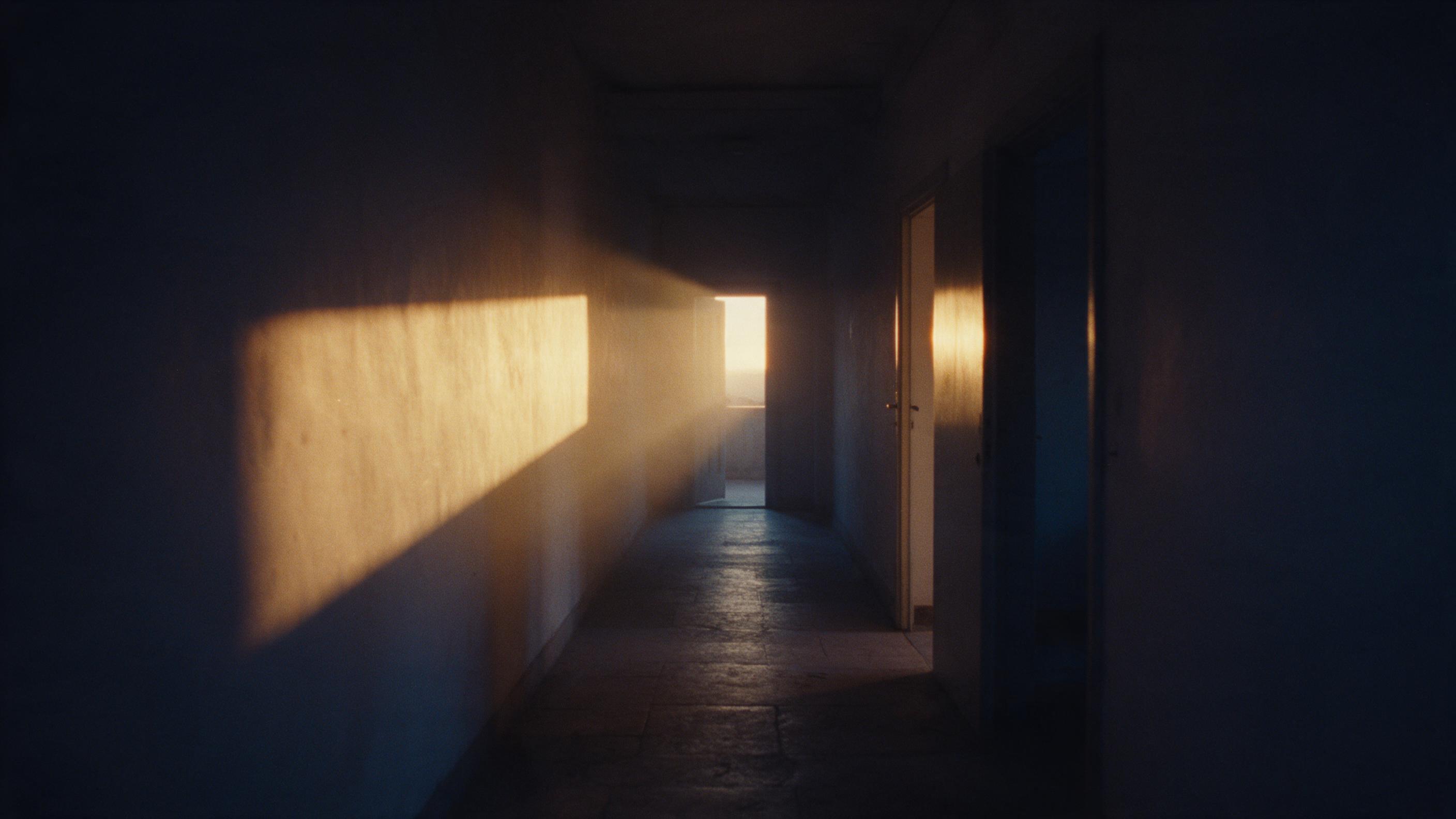
The Camera Flies, The World Holds Still
A generative model has no memory of the frame it produced a moment ago, so a 15 second take is not won with a better prompt. It is won by asking for less. Move the camera, keep the world still, and the only thing that changes frame to frame is parallax, which is exactly what interpolation handles cleanly. The audience reads sweeping and expensive. The model reads easy.
The Take Breaks At Second 3
Watch a generated take long enough and you can name the moment it stops being the same shot. The first 2 seconds are clean. Seconds 3 and 4 are where the trouble starts. A jawline loses a couple of millimetres of its angle, a smile arrives that nobody asked for, and a strand of hair that was hanging still begins to crawl. By second 12 the frame is a slow dissolve between 2 different people standing in what is almost the same room. This is not a prompt problem and it is not a render setting. It is memory, or the lack of it. A 15 second take at 24 frames per second is 360 frames. The model draws frame 1 from your prompt. It draws frame 2 from frame 1 plus your prompt. Nothing in that chain guarantees that frame 360 agrees with frame 1 about the shape of a nose, because the model is not holding the nose anywhere. It is guessing forward, 1 frame at a time, for 360 guesses. So the long take in AI is not a quality problem you solve by spending more. It is an inventory problem. Anything the model has to invent, it will invent slightly differently on the next frame. Anything it does not have to invent, it copies, and copying is where long takes survive. One sentence carries the whole technique: ask the model for less.
Drift Is Invented Detail
Every failure in a long take is the same failure wearing a different mask. Something in the frame was left for the model to invent, so it re-invented it 360 times, and each re-invention was a small bet against the last one. A face held in tight frame drifts first. The jaw, the nose and the eyes move off their own shape inside 2 to 3 seconds, which at 24 frames per second is 48 to 72 frames of quiet disagreement. Keep faces small, distant, behind a shoulder, or in silhouette. A held expression is a shape the model has to maintain, and a maintained shape mutates. That is why a smile in second 10 is never quite the smile of second 2. Emotion in a long take comes from the light and the space, not from a face. Hair in wind is thousands of fine strands in motion, which is thousands of items to re-invent per frame, and the renderer answers with a crawl you cannot unsee. Hoods, hats and silhouettes do not crawl. A nearly still body reads clean for 15 seconds, while a body walking, running or turning warps at the joints and at the hands. Fine repeating patterns are the last trap and the quietest one. Railings, grilles, tiled floors, woven fabric and lettering dissolve into moire the way a camera pointed at a screen produces a rainbow. 1 object with 200 identical edges is 200 chances to lose the pattern. All 5 failures are detail in motion. The fix is not a stronger prompt. The fix is a stiller frame.
Delegate The Motion To The Lens
The alternative is the oldest move in camera work. Move the camera, not the subject. A dolly, a crane or an arc gives you 15 seconds of motion and costs the model almost nothing, because the geometry it has to hold is 1 camera path through 1 static scene. The subject stays where it is. The light stays where it is. Perspective does the work. Parallax is the 1 thing interpolation handles cleanly. 2 objects at different distances slide past each other at different rates, and that difference is what the eye reads as depth, as movement, as a real place. Nothing has to morph for that to happen. The frame content is still and the frame itself is travelling, so the audience reads sweeping and expensive while the model reads easy. This is also why the subject should be a place rather than a person. A room, a corridor, a shoreline, a lit window, a figure at distance in silhouette or from behind. The world is the character in these 15 seconds. The person is a shape inside the light, and a shape has no jawline to lose. The gap between what the audience feels and what the model was asked to do is the entire secret. Nobody watching needs to know how little the renderer was told, and nobody can tell, because depth is real and movement is real and the thing that usually breaks in second 4 was never given to the model in the first place.
The 4 Moves
Every version of this shot is 1 of 4 moves, and each one buys a different feeling. The push in. Dolly forward through a doorway, down a corridor, toward a lit window. This is the approach move, the one that puts the audience inside the world and closes the door behind them. Immersion by entering, and the reason it works is that everything the camera passes is already in place. The crane up or down. Rise above a town, a shoreline, a field, a crowd, or descend into it. Immersion by scale, and the strongest of the 4 for the opening of a film, because a rise tells the audience how big the world is before it tells them anything else. The fly around. A slow orbit around a still figure or a location, 1 direction, 180 degrees or a full 360. Immersion by circling the subject. The figure is the axis and the figure does not move, which is what makes the arc survivable. The lateral track. Glide sideways alongside a shoreline, a street, a train, or a face held in a reflection. Immersion by momentum. Pick 1. Hold 1 direction for the whole take, 12 to 15 seconds, with no cut inside it and no reverse in it. A camera that changes its mind at second 8 tells the audience it is a machine, and the feeling of a real place dies with the reversal. 1 move, 1 speed, 1 direction.
The camera flies; the world holds still.
Glacial, Hazy, And Lit From The Far Side
Glacial and unvarying speed. The move never accelerates and never slows. A change of rate is the clearest tell in a generated take, because the model has no reason to keep 1 speed across 360 frames unless the speed was part of the decision. Write the rate down, then never touch it. Shallow depth of field and atmospheric haze. This is the technical move that hides the weakness and adds the depth in the same gesture. Haze, mist, dust and steam soften the background into tones, and a soft background is a place where detail cannot be caught drifting. It also happens to be the look of the reference films everybody is trying to match, which is not a coincidence. Nolan depth and model safety are the same instruction. Natural light with a far side key. The key comes from behind or beside the subject so most of it stays in shadow. That is what gives the frame its weight and its skin, and it is also what keeps you from holding a brightly lit face in tight frame for 15 seconds. A temperature matched to the climate rather than to your preference. A warm 2800 Kelvin morning over characters in winter coats is incoherent before anyone has time to work out why. The light, the air, the skin and the wardrobe have to agree on 1 climate. A format matched to the film. 35mm grain and halation by default. A 65mm style for a setpiece crane. A 16mm feel for a flashback. The stock is a decision rather than a filter, since daylight sits on the 50 and 250 speed stocks and interiors and night on the 500 tungsten stock. Pick 1 and hold it for the whole piece. Then name what the renderer must avoid, on the page, in writing: glossy, airbrushed, plastic skin, CGI, 3D render, beauty filter, uncanny, wax figure, extra limbs, deformed hands, morphing face, identity drift, text, watermark, fast motion, jitter. The template worth keeping is short. Format and stock, then the camera move, then the subject as place or silhouette, then the light and the temperature, then glacial speed, then continuous take with the subject nearly still, then shallow depth of field and haze, then the negative list.
Early, And Twice At Most
The placement rule is the one people break first. The shot goes in the early part of the film, where it establishes that the audience is somewhere that matters, and it appears at most twice in the whole piece. A signature used 6 times stops reading as a signature and starts reading as a workaround. Keep the count. A 90 minute film with 2 of these in it does not feel like it is missing anything, and both of them land because the audience has not learned the trick yet. A 90 minute film with 1 of these every 5 minutes feels like a template inside the first quarter, and the audience can feel a template long before they can name it. So the shot is not a bigger render. It is a smaller ask, placed carefully, with the camera doing all of the moving and the world doing none of it. The model is never asked to remember anything for 360 frames, because nothing it could forget was ever in the frame. The same discipline that built companies across twelve countries and filled 393 pages of a paperback and Kindle edition applies at the shot card, and it applies the same way every time. Decide once, then hold the decision. The probability that a long take survives is not a property of the model. It is a property of how much you asked it to invent, and most people are still pricing that at zero. One line to keep on the wall above the monitor: the camera flies, the world holds still.
A 15 second take at 24 frames per second is 360 guesses. Anything the model has to invent, it will invent differently on the next frame.
The map is dead. Nobody told you.
Bali State of Mind is the survival guide for the collapse of everything you were taught to believe.
Beyond this book
Building the same thing somewhere else.
Julien Uhlig is available for advisory work, board seats and media appearances. Write to media@exventure.co.
The academy that trains the operators, across every company in the group, is EX Epic Academy - 25,000 applications, 12 per cohort, 200+ alumni across 19 countries. academy.epicsolutiongroup.com
18-20 November. Online, Las Palmas, Bali.
Three days on what happens to work, capital and institutions when the map stops matching the ground. Seats are limited by cohort.
ex-aisummit.com →