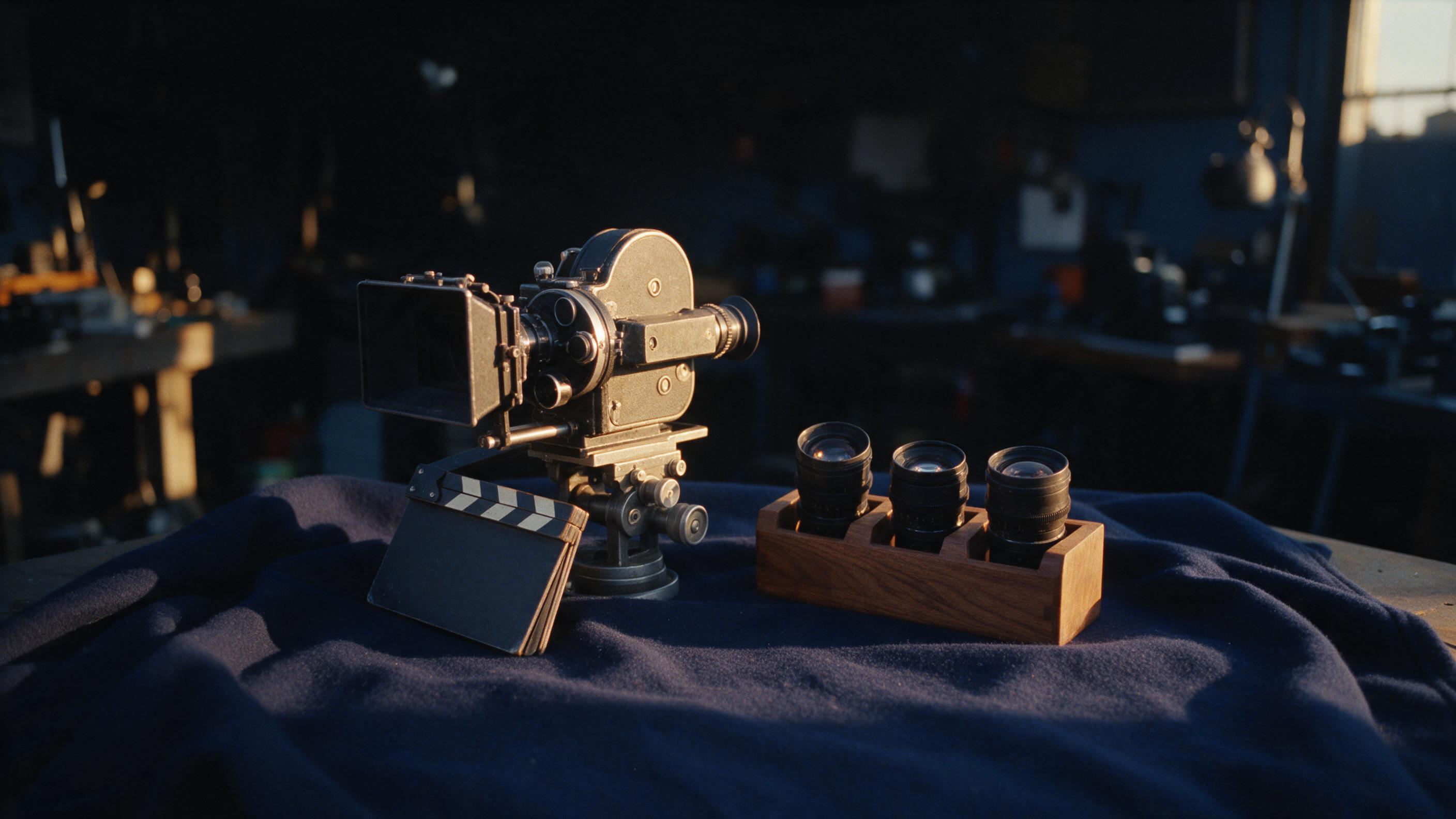
The Camera Decides Whose Eyes
A camera either watches or it participates, and that one choice settles what the audience feels before a line of dialogue arrives. Movement is not decoration. It is point of view made kinetic, and every move answers the same question first: whose eyes am I, and how should they feel about what is happening.
A Camera Either Watches Or Participates
Glass and metal have no opinion, and yet every shot arrives carrying one. The question that settles it is asked before any gear is chosen: whose eyes am I, and how should the audience feel about what is happening. Static answers one way, movement answers the other, and that is the master axis the whole grammar runs on.\n\nA locked-off tripod shot is objective distance. The audience stands outside the room, in the position of someone permitted to watch a thing unfold. A moving shot is subjective immersion. The audience is inside the moment, inside the body of whoever is living it, and the difference lands before a word of dialogue does.\n\nBoth are correct. The failure is arriving at one of them without having chosen it. A camera that drifts because nobody decided reads as neither watching nor participating. It reads as absence, and the audience cannot tell you why the scene felt flat.\n\n16 years of field work in rural Nigeria, post-conflict Serbia, Kazan and Fukushima taught the same lesson outside film. The person in the room sees a different problem from the person reading the report about it. A camera is that distinction made visible, and the operator picks a seat with every frame.
The Vocabulary Is Small, And Each Move Says One Thing
There are about 12 moves and no more, which is why they can be learned in an afternoon and spent across a career. A pan rotates horizontally on a fixed axis and means scanning, surveying, revealing a space. A tilt rotates vertically, and its two readings are opposites: up at power, down at smallness.\n\nA push-in moves the camera physically closer, and closer means intimacy, a thought forming, or dread, depending on what the push is closing on. A pull-back moves away and means revelation, isolation, abandonment, scale, the world being wider than the person in it. A tracking move travels laterally alongside the subject, and its meaning is presence: walking with someone rather than watching them walk.\n\nThe crane rises vertically through space and reads as release and grandeur. The pedestal moves straight up or down without tilting and carries no emotion at all, which is exactly what it is for, reframing without comment. Handheld is held by a body rather than a machine and reads as truth, urgency, something happening now. A gimbal glides and reads as dreamlike, elegant, floating.\n\nAn aerial sees the whole map and shrinks the people inside it. A whip pan blurs across and reads as energy or disorientation. An arc orbits the subject, which is the move of sizing someone up, and it belongs on the confrontations.\n\nNone of these is a style. Each one is a sentence, and a shot that stacks three of them says nothing clearly. Two rules sit above the whole vocabulary and neither is a preference. The 180 degree line decides which side of the action the camera may stand on, and the 30 degree rule says a new angle has to be a new position rather than a stutter. Break either one by accident and the geography of a scene collapses.
Dolly Against Zoom, The One Distinction That Matters
A dolly changes perspective. The camera travels through space, the relationship between foreground and background shifts as it goes, the world separates behind the subject, and the audience moves through the room with it. A zoom magnifies. Nothing moves through space, the world flattens and compresses toward the lens, and the audience is handed a larger picture of the same position.\n\nThat difference was turned into a weapon in Vertigo in 1958, when Hitchcock dollied one way while zooming the other and produced dread out of pure distortion. The move still works because the two motions genuinely disagree.\n\nThe rule that follows is short. Move the camera when you want presence. Zoom only when the shot itself is the zoom. Zooming where a dolly belongs is the lazy substitute for being there, and an audience feels the substitution even when it cannot name it.\n\nThe same discipline shows up in the optics. A 24 mm lens makes the room the statement and the person small inside it. A 50 mm sits close to how much of a room a person actually holds in attention. An 85 mm compresses the background behind a face until the portrait is one idea. Choose the focal length and the movement at the same time, because they argue with each other. A 100 mm tightens the frame further still, until the background is only texture.
Speed And Duration Are The Emotional Dial
Speed is the part of movement a beginner leaves out of the decision and a director makes first. A slow creep reads as intimacy, dread, inevitability, reverence. A medium pace reads as natural presence. A fast whip reads as energy, panic, euphoria, chaos, and it is almost impossible to use twice in the same scene.\n\nDuration carries as much meaning as direction, which is the sentence most shot lists miss. A push that takes 20 seconds and never quite arrives is tension sustained for the whole 20. The same push that lands in 2 seconds is resolution. Same move, same direction, opposite meaning, and the only variable is how long it was allowed to run.\n\nSo the working figure is not how fast the move is, it is when it stops. Hold a shot 5 seconds past the point where the audience has understood it and the shot becomes about waiting. Cut 5 seconds early and the move never delivers what it promised.\n\nIn a 90 minute film the temptation is to keep the camera alive constantly. The counterweight is that a static shot that holds is itself a choice, and it reads as confidence precisely because everything around it is moving. 24 frames per second has been the standard since sound arrived in 1927, and the frame rate has never once been the reason a move worked.
A locked-off shot says I am watching. A moving shot says I am here.
Objective, Subjective, And The Axis Almost Nobody Uses
The point of view decision sorts every shot into two boxes. Objective lives on the tripod, the aerial and the wide: the audience watches from outside. Subjective lives on the shoulder, over the shoulder, and at eye height: the audience is the character. Most of the craft is refusing to mix the two inside one scene without a reason.\n\nThere is a third axis and it is used less than 1 per cent of the time. Roll. The camera rotates sideways on its own axis, so the horizon itself tilts, and the audience loses the ground they were standing on. It works when the character's reality has already bent, which is why it belongs in a story about a mind that can no longer trust its own geometry.\n\nInception put that roll on screen in 2010 and made it mean something by spending it. Once in a 90 minute film it is a statement. Once a minute it is motion sickness, and the audience stops reading the horizon at all.\n\nThe discipline generalises. A move the audience has not seen before is an event. The same move in every scene is furniture.
Name The Move, Or The Model Drifts
For anyone writing this into a prompt, movement vocabulary is where the result goes generic. Generative video has one default and it is a slow drift, applied to everything, which flattens every shot into the same non-meaning. The fix is not more adjectives. It is naming the move and its speed, or explicitly stating that the shot is locked off.\n\nThe fragments that work are the plain ones. Slow dolly-in, pushing closer, intimate. Slow pull-back, revealing the scale, subject growing smaller. Tracking shot, moving alongside her. Handheld, documentary feel, subtle shoulder-rig movement. Slow crane up, rising out of the scene. Aerial establishing shot, drifting over. Whip pan, rapid blur transition. Slow arc around the subject, orbiting. Then anchor the whole thing in a real camera language, documentary film, 35 mm, natural skin texture, or the shot arrives as a digital painting framed by nobody.\n\nThe sequence runs in the same order every time. Whose eyes. What is the beat, reveal or intimacy or isolation or truth or scale. Dolly or zoom. How fast, and for how long. Does the world tilt, and if so, why now. Five answers, then the camera moves.\n\nThe one-line anchor is worth memorising because it fits on a shot list. Static observes. A dolly enters. Handheld makes you feel it. A crane and an aerial see the whole. Roll means the world just broke.\n\nThe same decision discipline that built companies across 12 countries and deployed 210 energy systems across Africa and Asia is the discipline that points a camera. Sequence beats instinct when the clock is running, and the book that came out of it runs 393 pages, published 8 April 2026, every one of them assembled one named decision at a time.\n\nThe probability that an unnamed move reads as intention is close to zero, and it falls with every shot where nobody asked whose eyes they were.
Dolly for presence. Zoom only when the zoom is the shot.
The map is dead. Nobody told you.
Bali State of Mind is the survival guide for the collapse of everything you were taught to believe.
Beyond this book
Building the same thing somewhere else.
Julien Uhlig is available for advisory work, board seats and media appearances. Write to media@exventure.co.
The academy that trains the operators, across every company in the group, is EX Epic Academy - 25,000 applications, 12 per cohort, 200+ alumni across 19 countries. academy.epicsolutiongroup.com
18-20 November. Online, Las Palmas, Bali.
Three days on what happens to work, capital and institutions when the map stops matching the ground. Seats are limited by cohort.
ex-aisummit.com →