The Bug That Beats The Catalyst
A bacterium makes ethanol at body temperature and one atmosphere. A metal catalyst needs 20 to 30 bar and 200 to 350 degrees Celsius. The biology was never the hard part, and the balance sheet says so.
A Reaction Nobody Had To Invent
The organism was isolated in 1994 from rabbit faeces and filed as Clostridium autoethanogenum, strain JA1-1, DSM 10061. It eats carbon monoxide, carbon dioxide and hydrogen, and it excretes ethanol. It does that at about 37 degrees Celsius, at one atmosphere of pressure. The Fischer-Tropsch route I covered earlier this week wants 20 to 30 bar and 200 to 350 degrees Celsius, behind a catalyst that loses activity across two to five years of charge life. The bug wants a warm tank. The pathway is Wood-Ljungdahl, and it has been in the literature since the 1930s. Nobody had to invent the reaction. Somebody had to find an organism that would run it at a yield a steel mill could underwrite. The probability that the binding constraint in this sector is chemistry rather than engineering is not high. Every commercial failure in the file is an engineering problem in biological clothing.
The Machine With No Pressure Vessel
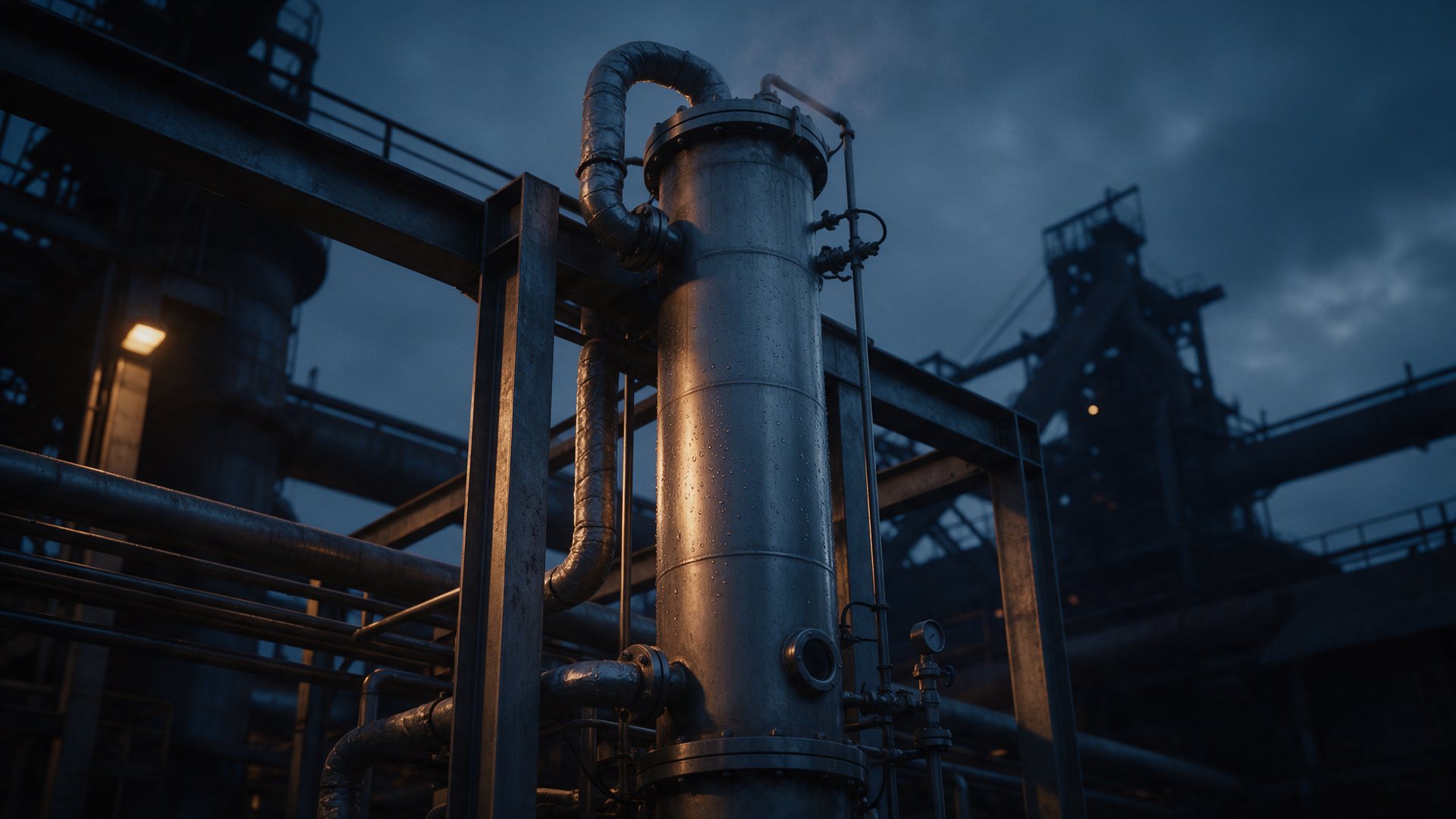
What the bacterium replaces is the pressure vessel, the heat-exchanger train and the catalyst charge. A Fischer-Tropsch reactor holds 20 to 30 bar and 210 to 240 degrees Celsius and keeps the temperature inside a 1 to 2 degree band. A fermenter holds a broth at 37 and sparges gas through it. One is a pressure system with an agitator. The other is a tank. There is a second saving. Metal catalysts are poisoned by sulphur and by trace metals and have to be regenerated off-line. This organism is poisoned by hydrogen cyanide, which is a specific and brutal failure mode I come to below. But it carries no noble-metal load, and it copies itself. Selectivity is where biology pays. The same platform has been pushed past ethanol into 2,3-butanediol, isopropanol, acetone, butanol, succinic acid and isoprene, most of them demonstrated at pilot scale. A modified strain sits at technology readiness level 5 to 6 for isopropanol and acetone. A bacterium that copies itself is a catalyst that never needs replacing.
Six Plants And Eleven Years
LanzaTech licensed the organism out and built the commercial record. Six plants have run since 2018. Shougang in China started in 2018 on steel mill off-gas at 46,000 tonnes of ethanol a year, abating about 90,000 tonnes of carbon dioxide. A ferroalloy site followed in 2021 at 46,000 tonnes. Two more came online in 2022 and 2023 at 60,000 tonnes each. A refinery off-gas unit added 35,500 tonnes in 2023. Steelanol at Ghent in Belgium started in 2023 with ArcelorMittal at 64,000 tonnes, which is 80 million litres, abating about 125,000 tonnes. Installed capacity is about 311,500 tonnes of ethanol a year and about 605,000 tonnes of carbon dioxide abated. A plant at Porsgrunn in Norway is planned at 24,000 tonnes from ferromanganese furnace gas in 2028. Shougang broke ground in November 2024 on a 15,000 tonne anhydrous demonstration at Caofeidian. Every one of those feedstocks was already being flared, vented or burned for heat. The raw material is a waste stream, which is the whole reason the plants exist at all.
The Plant That Died Of Cyanide
The counter-example matters more than the successes. INEOS Bio built the Indian River BioEnergy Center in Florida in 2011 and 2012 and started commercial production in July 2013. It gasified wood waste and fed the syngas to a proprietary bacterium. Capacity was 8 million gallons, about 24,000 tonnes, of cellulosic ethanol a year, plus 6 megawatts of power. Capital was more than 130 million dollars, including a 50 million dollar Department of Energy grant and a 75 million dollar USDA loan. It failed on the gas. Moisture in Florida wood diluted the syngas. Hydrogen cyanide killed the bacteria, and a scrubber had to be installed in 2014. The main fermenter never reached steady state. The plant shut on 2 January 2017, and about 129 million dollars of public money went with it. The lesson is not that biology is fragile. The lesson is that gasification makes a dirty gas, and a living catalyst is less forgiving of trace poisons than a metal one. I have deployed 210 energy systems across Africa and Asia, and the pattern never changes. The machine is the easy buy. The feedstock decides whether the money comes back. That is why the readiness ladder stays flat at level 9 for steel and ferroalloy off-gas, and only 5 to 7 for gasified biomass, eleven years after a 130 million dollar attempt.
Nobody had to invent the reaction. Somebody had to find an organism a steel mill could underwrite.
What The Tonne Costs
Capital runs 3 to 6 dollars per annual gallon, or 0.80 to 1.60 dollars per annual litre. Operating cost runs 1.50 to 3.00 dollars per gallon. Fuel-grade ethanol sells for 2.50 to 4.00 dollars a gallon. The figure the industry repeats as the viability floor is about 2.00 dollars a gallon. On the published accounts, gross margin before depreciation ran about 45 per cent in 2025. The premium is real and it is small. Ethanol from waste gas sells as a circular product to brands including Coty, L’Oréal, Zara and Uniqlo, and that premium carries the plants on the days the fuel price does not. The line was 3.6 million dollars in the fourth quarter of 2025. A commodity with a niche premium is still a commodity.
The Balance Sheet Says The Same Thing
LanzaTech Global trades on Nasdaq as LNZA. Revenue was 62.63 million dollars in 2023, 49.59 million in 2024 and 55.8 million in 2025. Net loss was 137.7 million in 2024 and 49.0 million in 2025, against an adjusted EBITDA loss of 71.3 million. Market capitalisation is about 75.78 million dollars. Read the fourth quarter of 2025 closely. Revenue was 28.0 million dollars, and 16.7 million of it was licensing from LanzaJet. Engineering services were 8.5 million. CarbonSmart, the premium product line, was 3.6 million. Contract research was 0.7 million. The company raised 40 million dollars of preferred equity in May 2025 and still reported substantial doubt about its ability to continue as a going concern. That is not a verdict on the organism. It is a verdict on the business model. The molecules sell at commodity prices and lose money. The licence sells as a position, and the licence is what carries the margin.
The Patent Clock And What Survives It
The foundation patent is CA2703622C, with priority from 2007, covering the strain and the methods. The portfolio runs past 1,000 patents. The foundational strain patents expire in 2027 and 2028. When they do, the wild-type organism enters the public domain. The engineered strains do not, and neither does the operating knowledge behind gas delivery, mass transfer and product recovery. That is the part a competitor cannot lift out of a paper. The rest of the field is far behind. Clostridium ljungdahlii sits at readiness level 6 to 7. Clostridium carboxidivorans sits at 4 to 5. Acetobacterium woodii sits at 4 to 5, and Clostridium kluyveri at 3 to 4 on the route to caproate and caprylate. So the moat is moving. In 2007 it was the organism. Now it is the licence book, the gas clean-up recipe and the running hours.
What Decides The Next Three Years
Three numbers decide this sector. The first is the price of gas that is currently free. Steel decarbonisation is being paid for through other routes, and a waste stream with a price attached is a different business from one that is flared. The second is whether anybody solves clean syngas from biomass. Level 9 on steel off-gas against level 5 to 7 on gasified wood is a gap that has now held for eleven years. The third is the 2027 and 2028 expiry. The day the wild-type strain is public, fermentation capacity becomes a construction and operating-data business rather than a licensing business. The bug works. It has worked at 311,500 tonnes a year since 2018. The open question was never the organism. It was everything built around it.
The bug wants a warm tank.
The map is dead. Nobody told you.
Bali State of Mind is the survival guide for the collapse of everything you were taught to believe.
Beyond this book
Building the same thing somewhere else.
Julien Uhlig is available for advisory work, board seats and media appearances. Write to media@exventure.co.
The academy that trains the operators, across every company in the group, is EX Epic Academy - 25,000 applications, 25 seats per cohort, 210 alumni across 19 countries. academy.epicsolutiongroup.com
18-20 November. Online, Las Palmas, Bali.
Three days on what happens to work, capital and institutions when the map stops matching the ground. Seats are limited by cohort.
ex-aisummit.com →