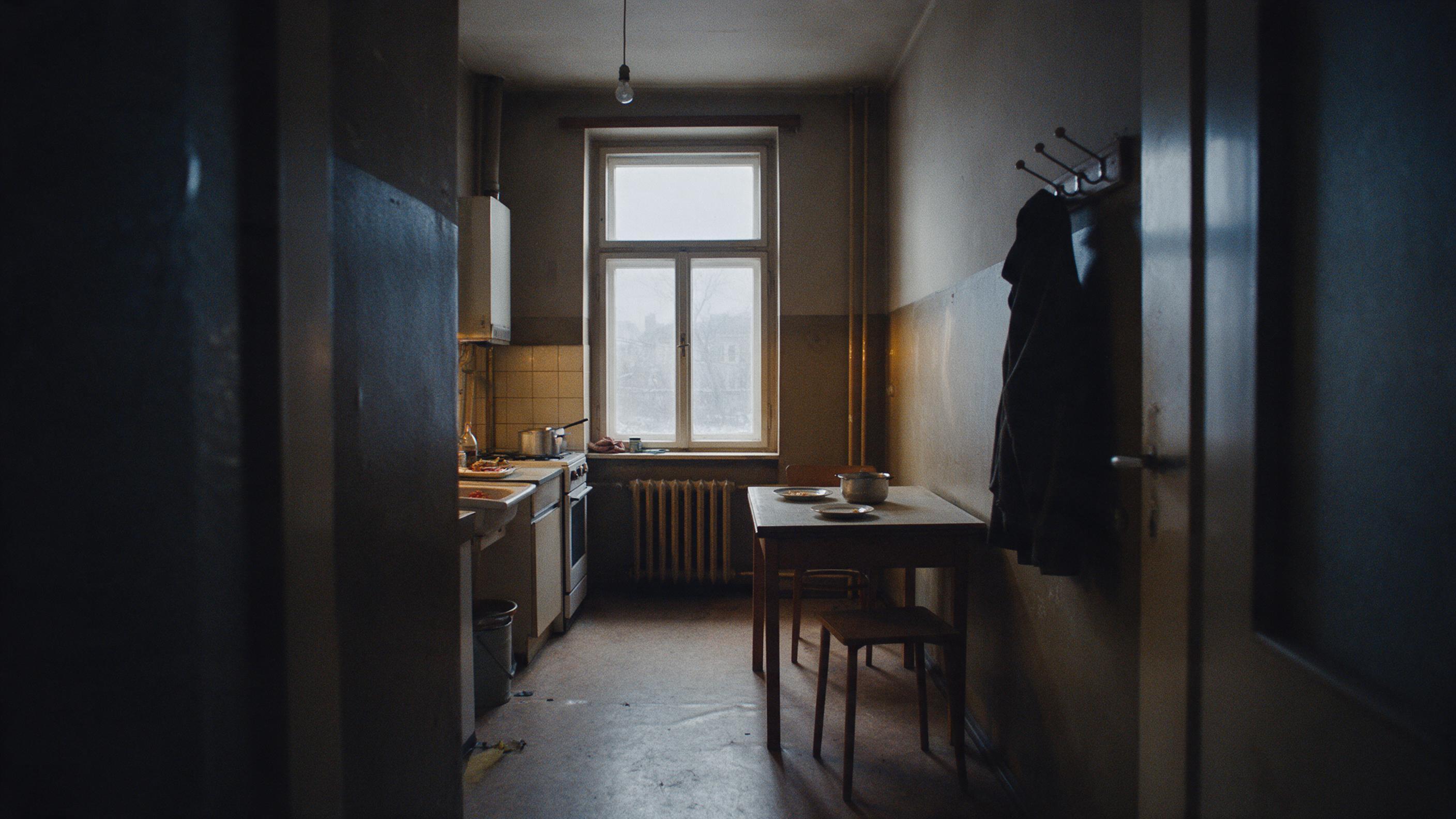
Dinner Was At 6:30 And We Were Fine. I Was Ten.
Bremen, 1985: four rooms, a clanking radiator, a mother who was one of the first women state attorneys general in Germany and a father who was simply gone. Nobody was coming home at three o'clock on a Tuesday, so a ten-year-old wrote the operating system himself. That system later survived Siena, twenty-five, and every zero after it.
The Apartment On The Third Floor
Bremen, 1985. I was 10 years old, standing in a kitchen on the third floor of a stone building that had survived the war because it was not interesting enough to bomb. Four rooms. A radiator that clanked and hissed from October to April. A hallway narrow enough that two people could not pass without turning sideways. My mother left before the light. She was a state attorney general for Hamburg, one of the first women to hold that position in Germany, and she carried a caseload that would have broken most people twice her age. She did not cry. Not in front of me. Not once that I can remember. My father was divorced from her and then absent, which are two different things and only one of them is a legal status. He had his life. She had hers. My sister and I had the apartment, the radiator, and the hours between three and eight in the evening, which in 1985 contained nothing but the sound of the neighbours through the wall doing normal family things. We were not poor. There was food, heat in winter, shoes that fit. What was missing had nothing to do with money. Nobody was coming home to take care of us at three o'clock on a Tuesday, and I understood that this was not a temporary condition. It was the architecture.
Dinner At 6:30 And We Were Fine
I did not make a decision about any of this. There was no moment where a 10-year-old chose to become the adult in the room. What happened was smaller and harder. My younger sister needed someone to say that dinner was at 6:30 and that we were fine. Nobody else was going to say it. So I learned to say it. I learned to cook first, the way you learn anything when there is no one to instruct you. You watch a woman cook once, twice, and you work out the architecture underneath. Eggs can be fried. Potatoes can be boiled. Bread can be toasted. Add butter to almost anything and it tastes less like a lie. By 11 I decided that dinner happened. By 12 I decided when we went to bed. By 13 I ran the whole thing: the food, the schedule, the small emotional labour of making two kids in an apartment feel like a family while one parent fought men in courtrooms and the other one was simply gone. Here is what nobody tells you about carrying weight like that at that age. You do not tell anyone. You do not complain, because complaining needs an audience and the audience is the thing you do not have. You adjust your spine and carry it forward. School at eight. Home at three. Dinner at 6:30. Homework. Bedtime. Then the sound of the door at nine or ten, and the day closes. That is the whole inheritance. Not money, not a name, not a network. An operating system: decide what has to happen, do it whether or not you feel like it, and do not wait for anyone to check whether you are still standing.
Classical Music Was Not Emotion, It Was Architecture
The singing started at 13 for the worst possible reason. I wanted to be Eros Ramazzotti, an Italian pop singer whose voice did something to a room when it came out of the radio, and I had noticed that girls liked singing. So I sang. Badly, then less badly, and then something in the voice turned over that I had not expected. By 15 I was collecting records. Pavarotti, Carreras, Domingo. I played them for hours with headphones on, not to sing along but to work out what these men were doing that everything else on the radio was not. They were singing past the words into something underneath them. That was the thing I wanted. Not the story. The texture of a voice holding a story. I was studying with Julia Hamari, a mezzo-soprano who performed at the state opera houses across Germany. She was kind in the way serious teachers are kind. She told me that classical music was not emotion. It was architecture. Your body is the instrument, your breath is the fuel, everything else is technical. So I sang scales. A thousand times. Then ten thousand. The point was never the scale. The point was to make the mechanics disappear so completely that the music could live in the body without the mind supervising it. At that point, and only at that point, you can actually sing. That training is the most useful thing I have ever been given, and none of it was about music. It taught me that failure is not disqualification. It taught me that repetition is not punishment. It taught me that a body will learn a thing whether or not the mind understands it.
Two Arias In Siena
At 16 I auditioned for Carlo Bergonzi, one of the great tenors of the last century, then in his seventies and teaching master classes in Siena at the Accademia Chigiana. Over 200 singers turned up from all over Europe, many of them trained inside this tradition since childhood. I had two Italian arias prepared and 15 minutes to prove something. I sang the first one technically well and completely invisibly. Mechanics, no soul. Then I started the second, Bergonzi raised his hand, and I stopped. He looked at me across the table for a long time, hands folded, the way a man looks at the thousandth young singer who has walked into the room. Then he said four words. You have to come to Siena. Most people hear that as a compliment. What I felt was terror, because it meant the thing I had been doing alone in a small apartment in Bremen could actually happen, and anything that can happen can also fail in public. It failed in public within a week. The Accademia Chigiana is one of the most demanding conservatories in the world, and I arrived as a 16-year-old from a single-parent household in northern Germany with a voice and almost no repertoire. A soprano from Milan took me apart in front of twenty people and a television crew filming a documentary about the school. I walked out into the courtyard afterwards and understood that I could quit, and that nobody would blame me. I did not quit. I hit the wall again, then again, and at some point the wall gets tired of you before you get tired of it. I asked the other students what they knew and copied it. I stayed late in the rehearsal rooms with the pieces I had failed. By the second year the same people who had dismissed me were asking me about technique. Not because I had become brilliant. Because I kept showing up in a place where showing up was the entire test.
Nobody was coming home to take care of us at three o'clock on a Tuesday, and I understood that this was not a temporary condition. It was the architecture.
The Deal That Made It Real
When I was 17 a girl named Tanja, who I was with in Italy, became pregnant. The choice arrived early and in the ugliest possible shape. I could be a father at seventeen, or I could take the scholarship to Mannes College of Music in New York and keep going. In the world I was actually living in, both was not available. My father had chosen absence. I had spent seven years being the one who showed up, and now the thing that would make me more like him was ambition. I left for New York. I do not regret the decision, because the alternative was not a life, it was a smaller version of the same apartment with the same radiator. I carry the weight anyway. I have carried Tanja and the daughter I never met for 34 years, and being right about the arithmetic has never made the weight lighter. At 18 my mother looked at me and said the thing I have used ever since. You are either going to succeed at this, or you are going to have a very painful failure. She was not comforting me. She was stating a probability. The path was all-in, and if it did not work it was going to hurt. So I wrote a deadline into the operating system. If this has not worked by 25, I stop and rebuild with fifteen working years still ahead of me. I will not be the 45-year-old still auditioning on the side of a day job. The deadline did the work. It turned every year into a measurement instead of a hope. Am I in the top five percent, am I getting better, is this still possible. Carnegie Hall came. The Metropolitan Opera came. So did the year the answer changed, and I walked out at 27, went home to Bremen, and started again.
The Kid Is Still In The Room
The line from that apartment runs through everything since. Opera. A nightclub in New York. Two years inside Lehman Brothers, where I was on the top floor of the building when the power went out in 2003, and where I watched 164 years of permanence evaporate in a weekend in 2008. Luxury real estate in Sardinia. Wood gasification in Ethiopia and across Africa, which put 210 energy systems into places that had none. A firm that now runs 220 interns a year through a campus and an academy with 25,000 applications behind it. None of that happened because I was the most talented person in the room. In most of those rooms I was the least qualified person present. It happened because a ten-year-old learned in a Bremen apartment that systems can be fixed if you are willing to do the boring part, and that permission is something you give yourself, because nobody is coming home to give it to you. The inherited instruction most people are still running says: get the degree, get the title, get the permission, then start. That instruction was written for a labour market that no longer exists. It now reads as a wait, and the wait is the entire cost. Here is the probability I would want a ten-year-old to hear. That the child who decides dinner happens at 6:30 and that the family is fine learns how to run an organisation: close to certain. That the child who waits to be taken care of learns it: close to zero. Discipline is not a personality trait. It is a set of instructions you wrote for yourself when nobody was there to write them for you. The kid in Bremen is still in the room. He is the reason I can walk into a zero without breaking, and the reason I have never needed anyone's permission to start the next thing. He learned too young that nobody was coming to save him. He also learned the better half: he did not need saving. He needed to keep moving.
Discipline is not a personality trait. It is a set of instructions you wrote for yourself when nobody was there to write them for you.
The map is dead. Nobody told you.
Bali State of Mind is the survival guide for the collapse of everything you were taught to believe.
Beyond this book
Building the same thing somewhere else.
Julien Uhlig is available for advisory work, board seats and media appearances. Write to media@exventure.co.
The academy that trains the operators, across every company in the group, is EX Epic Academy - 25,000 applications, 25 seats per cohort, 210 alumni across 19 countries. academy.epicsolutiongroup.com
18-20 November. Online, Las Palmas, Bali.
Three days on what happens to work, capital and institutions when the map stops matching the ground. Seats are limited by cohort.
ex-aisummit.com →