The Bill Is The Water
Dry processes pay for water removal twice, once in the dryer and once in the fuel that never gets made. The literature on water-based conversion reports net energy recovery at 91 per cent moisture, and the plants already run.
The Water Arrives With The Feedstock
There is one number that decides the economics of every wet waste process, and it is the moisture content of the feedstock. Sludge from a municipal plant arrives at around 95 per cent water. Swine manure, food waste, digestate, the algae skimmed off a pond. The solids are a few per cent of what the truck delivers, and the water is the rest of the bill. The instinct is to dry it and treat what is left. Drying means evaporation, and evaporation is the most expensive way to move a tonne of anything. The published record agrees. A review of hydrothermal carbonisation of municipal sludge in Fuel Processing Technology in 2024 reports net energy recovery even at 91 per cent moisture. At 91 per cent there is almost no dry matter left to burn, and the process still comes out ahead. That is the whole argument in one figure. The feedstock arrives wet, and the first decision is whether you pay to remove the water before you do anything else.
A Reaction In Water, Not Despite It
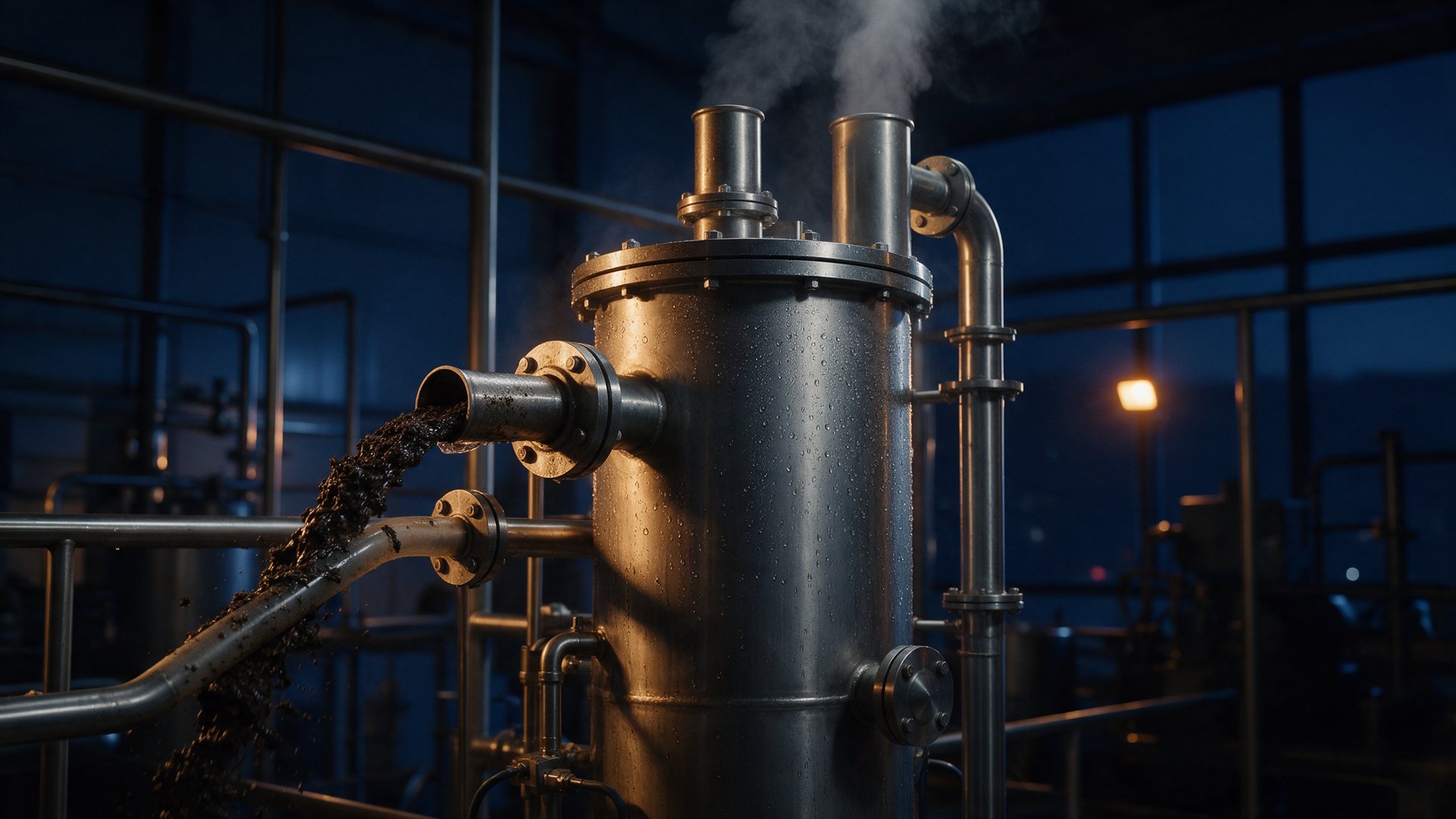
Hydrothermal carbonisation does not fight the water. It uses it. The process runs in hot compressed water, held above its boiling point by its own vapour pressure, with the feedstock mixed straight in. No pre-drying. No evaporator. The wet stream goes in as it is. The idea is not new. Friedrich Bergius filed the original patent in 1913 and took the Nobel Prize in Chemistry in 1931 for the chemistry that followed. The industrial world spent a century learning to work in water and then forgot why. What happens inside is a sequence. The reviews describe hydrolysis first, then dehydration, then decarboxylation, then aromatisation, as the biomass dissolves and rebuilds into a carbon-rich solid. The accepted model has two pathways. Primary char forms on the surface of the starting material. Secondary char forms when the dissolved fragments polymerise into new particles. Funke and Ziegler set that framework out in Biofuels, Bioproducts and Biorefining in 2010. The kinetics are documented too. A 2021 study in Industrial and Engineering Chemistry Research showed hydroxymethylfurfural as the sole intermediate precursor on a first-order rate, at 28 per cent yield from fructose and 72 per cent from glucose. The water is the medium and the reagent. The reactor is a pressure vessel with a stirrer.
The Product Is Not The One You Ordered
Hydrochar and biochar come out of the same furnace conversation, and they are not the same material. A comparative review by Kambo and Dutta in Renewable and Sustainable Energy Reviews in 2015 set the difference down plainly. Hydrochar carries higher hydrogen to carbon and oxygen to carbon ratios, a lower surface area and more oxygen functional groups than biochar. That matters because the tests are different. A biochar specification written around surface area will fail a hydrochar that was never designed to have one. The structural evolution is now mapped in three stages. Component decomposition, then structural rearrangement, then carbonisation. Yang and colleagues reported the sequence in Chemosphere in 2024 with maximum surface areas of 113 square metres per gram. One letter separates the two products. The letter decides the market.
The Liquid Is Not Waste
The water that comes back out is the part most operators throw away, and the literature suggests that is where the margin sits. Recirculating process water raised mass yield by 5 to 6 per cent in a 2024 study in Energies, while the fuel combustion index fell 14 to 18 per cent. Less water to treat, more carbon in the product. Pair recirculation with anaerobic digestion and the numbers stack. A 2024 paper in ACS Sustainable Chemistry and Engineering reported up to 90 per cent total energy recovery with 75 per cent of the chemical oxygen demand removed in the digester. The liquor is also a fertiliser. A 2026 study in Biochar reported rice yield increases of 6.7 to 29.2 per cent, with total organic carbon in the process water between 4,000 and 31,700 milligrams per litre. Phosphorus comes out as well. Struvite recovery from hydrothermal liquor reached 99.96 per cent in work published in the Journal of Environmental Chemical Engineering in 2022, with oxalic acid removing 86.7 per cent of the iron first. There is no waste stream. There is a product you have not priced.
At 91 per cent moisture there is almost no dry matter left to burn, and the process still comes out ahead.
The Hardware Already Exists
This is not a laboratory curiosity waiting for a breakthrough. It is a shipped technology with a patent record. Ingelia has run at technology readiness level nine since 2010 with more than eight plants, and holds the continuous reactor patent ES2768236T3. CPL Industries commissioned a plant in the United Kingdom in 2018. C-Green holds US11724952 for a process that pairs carbonisation with wet oxidation, runs at Heinola in Finland, and raised EUR 3.7 million in 2025. TerraNova Energy holds US10343917 and US10287505 and operates the largest installation of its type, in Mexico City. The economics are published as well. A 2025 holistic comparison in ACS Sustainable Chemistry and Engineering put carbonised product at 0.0063 dollars per megajoule, 23.2 per cent below slow pyrolysis, with a 71.8 per cent probability that the wet route is the environmentally preferred one. The reactor is a commodity. The advantage is somewhere else.
What The Papers Admit They Do Not Know
Every review carries a section the marketing never quotes. This field is honest about its gaps. A systematic review of sewage sludge carbonisation in Environmental Engineering Research in 2025 screened the literature down to 47 studies and found the gaseous phase under-researched. A life cycle assessment review in Agronomy in 2024 identified the gaps in system-level integration, meaning how the unit bolts onto the plant it feeds. The Agronomy review published in 2025 found temperature to be the most influential single parameter, and confirmed that the product raises water holding capacity in sandy soils. Adsorption is another open door. A 2024 paper in Science of the Total Environment described heavy metal capture through surface complexation, electrostatic interaction and ion exchange. Each of those sentences is a research question with a budget attached. The unanswered parts are the ones worth doing.
The Two Bills You Can Pay
There are only two ways to handle a wet feedstock. You can remove the water, or you can hold it. Removing it means thermal drying, and thermal drying spends energy that the product then has to earn back. At 30 per cent moisture that arithmetic can work. At 90 per cent it does not. Holding it means a vessel that keeps water liquid above 100 degrees Celsius under its own pressure. Pressure vessels cost capital, and capital is paid once. That is the trade. A dryer is a running cost that never stops. A reactor is a purchase. Moisture content decides which one you buy. Nothing else in the comparison moves the number as much. Sort your feedstock by water before you sort it by anything else.
The Part Nobody Prices
I restructured a EUR 75 million industrial group and built companies across twelve countries. I have deployed 210 energy systems across Africa and Asia, and I have watched moisture content decide which of them paid for themselves. Entrade built 200 wood gasification machines across Britain and Europe. That equipment wanted dry fuel, and the cost of getting the water out was written into the machine before it was ever written into a spreadsheet. The same trade is available again, in the other direction. The wet feedstocks written off as a disposal problem are the ones a water-based process prefers. The probability that the cheapest tonne in 2035 comes from a pile somebody is paying to dry today is not zero, and most people are pricing it at zero. The water was never the impurity. It was the bill nobody wanted to read.
Hydrochar and biochar come out of the same furnace conversation, and they are not the same material.
The map is dead. Nobody told you.
Bali State of Mind is the survival guide for the collapse of everything you were taught to believe.
Beyond this book
Building the same thing somewhere else.
Julien Uhlig is available for advisory work, board seats and media appearances. Write to media@exventure.co.
The academy that trains the operators, across every company in the group, is EX Epic Academy - 25,000 applications, 25 seats per cohort, 210 alumni across 19 countries. academy.epicsolutiongroup.com
18-20 November. Online, Las Palmas, Bali.
Three days on what happens to work, capital and institutions when the map stops matching the ground. Seats are limited by cohort.
ex-aisummit.com →