Seven Standards And Not One Of Them Measures Touch
Force measurement has ISO 376 and ASTM E74. Touch has seven partial instruments that each cover a fragment, and not one of them fixes spatial resolution, taxel pitch, hysteresis, drift under shear, temperature cross-sensitivity or slip-detection latency. In a field with no benchmark, the specification you write is the standard until somebody else writes one.
Two Datasheets On A Bench
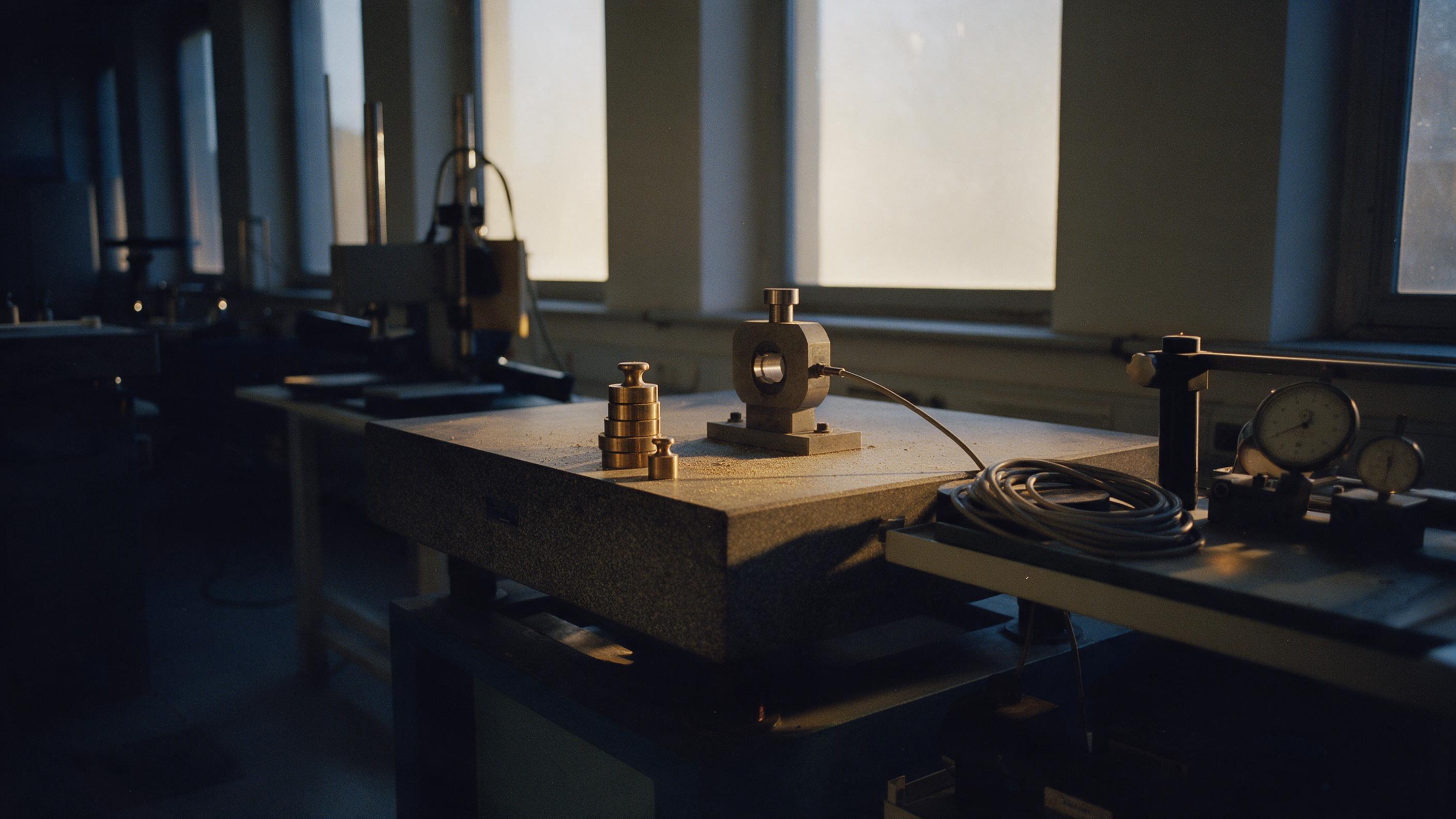
Two datasheets side by side on a bench. Both say tactile sensor. One gives a force range from 0.01 to 100 newtons. The other gives a sensitivity and a response time in milliseconds. Neither gives drift. Neither gives the temperature coefficient. If you have to decide which of the two is better, you have almost nothing. Force measurement settled this decades ago. ISO 376 calibrates force transducers. ASTM E74 verifies the machines that measure force. Touch got a drawer of documents that each hold one corner of the problem: ASTM F2668 for the physical characterisation of wearable sensors, IEEE 2700 for sensor performance parameter definitions, ISO 13405 for prosthetic testing, IEC 62368 for equipment safety, ASTM E2548 for sampling air, RoHS and REACH for materials. Seven instruments. Seven fragments. Not one of them fixes how a tactile sensor gets measured.
A Vocabulary Is Not A Ruler
ISO 376 fixes a procedure and an uncertainty budget for force. Put two force transducers from two continents on the same machine and the readings land inside a stated tolerance. IEEE 2700 does something else entirely. It defines the parameter names, so every lab writes hysteresis and drift on the same line of the same table, which is a real advance, and then it stops. Names with no limits attached. A shared vocabulary in place of a shared method. That gap is why one laboratory reports 5 per cent hysteresis and another reports 2 per cent for the same device, and both are honest. Hysteresis under what load. Over what range. At what temperature. On the first cycle or the ten thousandth. A vocabulary is not a ruler. Nothing in the field says otherwise.
The Three Metrics Nobody Reports
Something like a convention formed anyway, by habit rather than by standard. Force range appears in about 80 per cent of published papers, usually as a graph with a minimum and a maximum. Sensitivity in 75 per cent, in kilopascals to the minus one or picofarads per kilopascal. Response time in 50 per cent, in milliseconds from a step input. Hysteresis in 40 per cent, as a percentage of full scale. Spatial resolution in 35 per cent, in millimetres of pitch. Then the numbers fall off a ledge. Cycle stability in 25 per cent. Temperature dependence in 15 per cent. Drift in 10 per cent, as a percentage per hour under constant load. Those last three decide whether the sensor still reads correctly six months after the demo. That is not a coincidence.
Same Unit, Different Measurement
Take the units one at a time and the problem becomes visible. Drift under constant load, as a percentage per hour. Hysteresis, as a percentage of full scale. Temperature coefficient, as a percentage per degree, and the field usually means a window of 20 to 40 degrees. Slip detection latency, in milliseconds, from the first relative motion to the output. Cross-modal delay, the offset between the force channel and the vibration channel, also in milliseconds. Spatial resolution, in millimetres of taxel pitch. Vibration sensitivity, in metres per second squared at a stated frequency, because without the frequency the number carries nothing. Each unit hides a protocol inside it. Constant load of how much. Ramp rate. Hold time. Ambient humidity. Cycles before the measurement counted. Two labs report 3 per cent drift and have not measured the same thing.
Seven instruments. Seven fragments. Not one of them fixes how a tactile sensor gets measured.
Four Groups Already Moving
The field has stopped waiting for permission. IEEE P2814 is in development, and its brief is the missing piece itself, terminology and performance metrics for tactile sensing. ISO/TC 184/SC 2 is active on robotics standards, tactile sensing for human-robot interaction among them. In the United States a Tactile Metrology Working Group formed in 2024 to write standardised test protocols for e-skin evaluation. OpenTactile is a research project building open-source hardware and software toward the benchmark the field keeps comparing to ImageNet and keeps not having. Look at the verbs on that list. In development. Active. Formed. Aiming. None of them is a standard yet. A standard is a draft that turned into a gate, and the tactile version has not turned.
Write The Specification You Wish Existed
Until one of those lands, the minimum is small and in your own hands. Force range and sensitivity. Spatial resolution and array size. Hysteresis as a percentage of full scale. Response time from 10 to 90 per cent. Cycle stability as cycles to 20 per cent degradation. Temperature coefficient as a percentage per degree across 20 to 40 degrees. Drift over one hour at 50 per cent of maximum load. Seven lines, all answerable before a demo. I restructured a EUR 75 million industrial group and built companies across twelve countries, and the pattern held in every one of them: in the absence of a standard, the specification you write becomes the standard. The probability that the first tactile benchmark arrives from a startup rather than a committee is not zero. Most of the field prices it at zero.
A vocabulary is not a ruler.
The map is dead. Nobody told you.
Bali State of Mind is the survival guide for the collapse of everything you were taught to believe.
Beyond this book
Building the same thing somewhere else.
Julien Uhlig is available for advisory work, board seats and media appearances. Write to media@exventure.co.
The academy that trains the operators, across every company in the group, is EX Epic Academy - 25,000 applications, 25 seats per cohort, 210 alumni across 19 countries. academy.epicsolutiongroup.com
18-20 November. Online, Las Palmas, Bali.
Three days on what happens to work, capital and institutions when the map stops matching the ground. Seats are limited by cohort.
ex-aisummit.com →