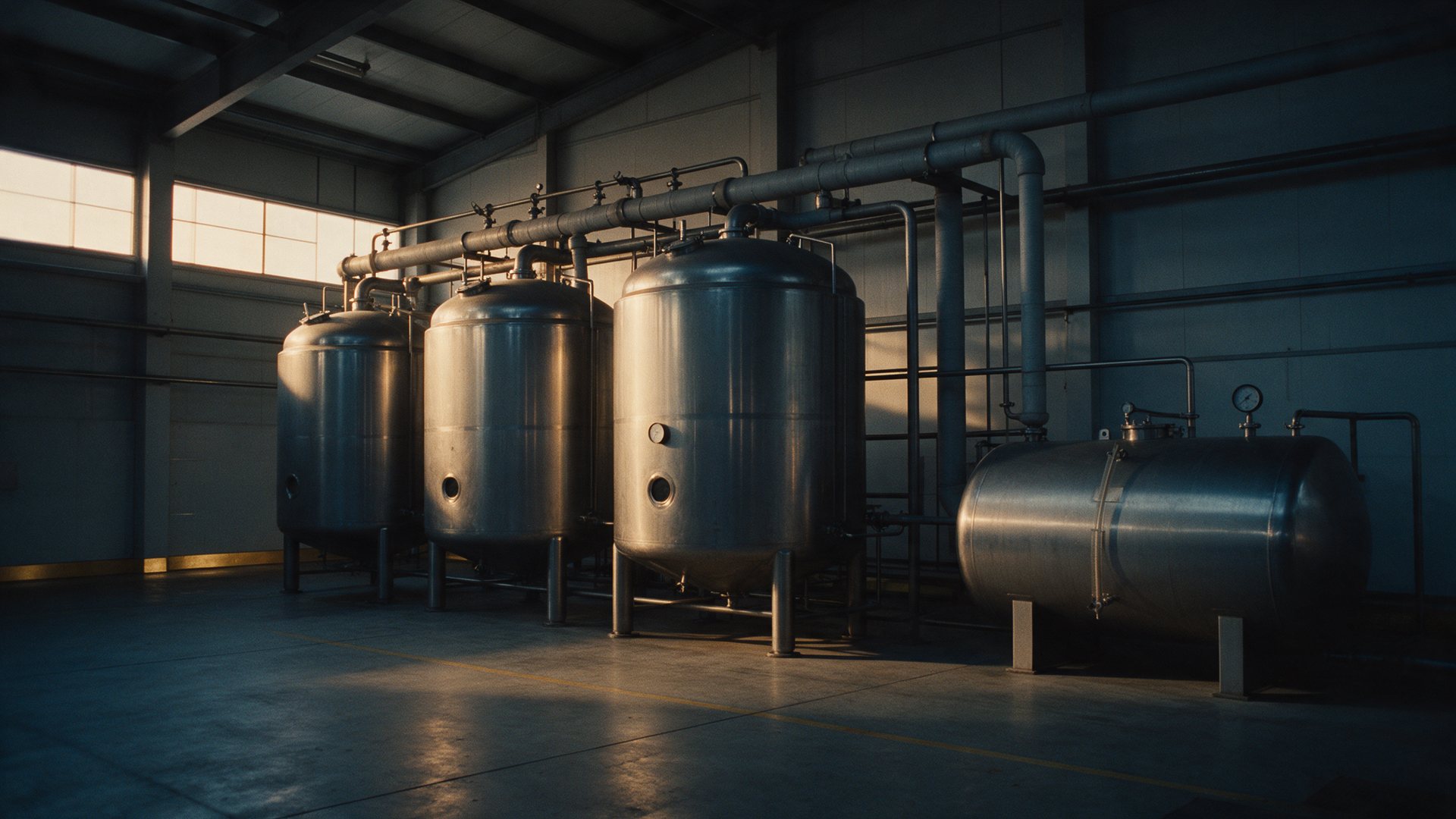
The Bacteria That Eat Steel Fumes
A Chinese steel mill opened the first commercial gas-fermentation plant in 2018, fed the off-gas to a single bacterial strain, and produced 46,000 tonnes of ethanol a year. Seven years later, six plants are running on the same idea, and the order they came online is the order the market was actually built.
The Bacterium And The Gas
Clostridium autoethanogenum, strain JA1-1, was first isolated from rabbit faeces in 1994. Twenty-four years later a steel mill in China fed it the off-gas from a blast furnace, and the first commercial gas-fermentation plant came online in 2018. The bacterium runs the Wood-Ljungdahl pathway in reverse of how most biology uses it. Most biology oxidises carbon. This one reduces it. Carbon monoxide plus carbon dioxide plus hydrogen plus water becomes acetyl-CoA becomes ethanol, with the bacteria doing the work at atmospheric pressure and a temperature the process engineers call mesophilic. No compressor train. No reformer. No Fischer-Tropsch reactor at ten megapascals. The gas does not need to be clean. The bacterium does not need to be coaxed. The pressure is atmospheric. That sentence is the technology. Everything else in this article is the consequence.
Six Plants, In The Order They Came
The Shougang plant in Caofeidian came online in 2018, fed by steel mill off-gas, rated at 46,000 tonnes of ethanol per year, with carbon dioxide abatement stated by LanzaTech at around 90,000 tonnes a year. The partner on the project was Shougang Group. Three more plants came online in China on ferroalloy off-gas. NXBZ Site 1 in 2021, also at 46,000 tonnes a year. NXBZ Site 2 in 2022 at 60,000 tonnes a year. NXBZ Site 3 in 2023 at 60,000 tonnes a year. The partner names on those three plants were undisclosed at the time LanzaTech published the biorefining page. A refinery off-gas plant came online in 2023 at 35,500 tonnes a year. The partner was undisclosed. Then Steelanol in Ghent, Belgium, came online in 2023 at 64,000 tonnes a year on blast furnace gas from ArcelorMittal. Six commercial plants by the end of 2023. Total installed capacity around 311,500 tonnes a year. Total carbon dioxide abatement stated at around 605,000 tonnes a year. A seventh plant, Porsgrunn in Norway, with Eramet Norway ferromanganese off-gas at 24,000 tonnes a year, is published as starting operations in 2028. That is the market. Six plants running, one in build, total capacity under one million tonnes a year. The order they came online is the order the market was actually built: steel, then ferroalloy, then refinery, then blast furnace, then ferromanganese.
What The Off-Gas Pays For
The feedstock is the part the process economics depend on. Industrial off-gas from a steel mill or a ferroalloy plant is, in the published accounting, a waste stream with a negative value. The mill has to flare it or vent it, with a carbon cost in jurisdictions that price carbon. A bacterium that eats the gas turns the line item into a product. The published CAPEX range for a gas-fermentation ethanol plant, per annual gallon of capacity, is USD 3 to 6 per gallon. The published operating cost range, per gallon of ethanol, is USD 1.50 to 3.00. The published ethanol selling price for fuel grade is USD 2.50 to 4.00 per gallon, depending on market. The published minimum ethanol price for viability is around USD 2.00 per gallon. Below that, the process does not pay for itself on fuel ethanol economics. Above that, on the right feedstock, it does. The published gross margin for LanzaTech in FY2025, before depreciation, is around 45 per cent on USD 55.8 million of revenue. That number is not a commodity ethanol number. That number is a specialty chemical number.
The Premium Is The Business
the premium product line at LanzaTech is called CarbonSmart. The product is ethanol. The molecule is identical to grain ethanol. The provenance is the difference. Brands in cosmetics and apparel - Coty, Lancome, Zara, Uniqlo - publish their willingness to pay extra for the same molecule made from waste gas rather than from a feed crop. The CarbonSmart revenue line in the LanzaTech Q4 2025 report is USD 3.6 million. The licensing line is USD 16.7 million. The engineering services line is USD 8.5 million. The total revenue in Q4 2025 was USD 28 million. The licensing line is dominated by LanzaJet, the alcohol-to-jet subsidiary LanzaTech holds a 37 per cent stake in. Without that licensing revenue, the quarterly picture is thinner. The market is not the commodity ethanol market. The market is the brands willing to pay extra for the same molecule with a different provenance. That market is published. That market is small. That market is what makes the current plants viable. The probability that the next million tonnes of installed capacity goes to steel mill gas is not zero. The probability that it goes to biomass gasification is being priced at zero by everyone who watched Indian River close.
A bacterium called Clostridium autoethanogenum turns carbon monoxide into ethanol at ambient pressure, and the plants doing it have been running since 2018.
What INEOS Bio Proved
Indian River BioEnergy Center in Indian River, Florida, came online in July 2013. Capacity: 8 million gallons a year of cellulosic ethanol, plus 6 megawatts of electricity. Technology: gasification of biomass, then fermentation of the resulting syngas. Total cost: USD 130 million-plus, with USD 50 million from the Department of Energy and USD 75 million from the United States Department of Agriculture. The plant closed on 2 January 2017. Total taxpayer loss, including grants, loan guarantees and tax breaks, was published at USD 129 million. The documented problems were published. The Florida wood was wet. Moisture diluted the syngas. Hydrogen cyanide in the syngas killed the bacteria. A scrubber was installed in 2014. Other scale-up problems in the main fermenter were not solved. Limited run time. INEOS Bio demonstrated what gas fermentation on biomass-derived syngas cannot yet do. LanzaTech demonstrated what gas fermentation on industrial off-gas can do. The published lesson is in the gas quality. Wet biomass syngas carries tars, ammonia, hydrogen cyanide, particulates. Steel mill off-gas is mostly carbon monoxide, carbon dioxide, hydrogen and nitrogen, with low moisture and low contaminants. The lesson is not that gas fermentation is fragile. The lesson is that gas fermentation is feedstock-specific.
The TRL Map
Ethanol from steel mill off-gas is at TRL 9 - six commercial plants operating since 2018. Ethanol from ferroalloy off-gas is at TRL 9 - three plants in China and one planned in Norway. Ethanol from biomass syngas is at TRL 5 to 7, with INEOS Bio as the failed precedent and no current commercial attempts. Acetone, isopropanol and 2,3-butanediol from syngas are at TRL 5 to 6, pilot stage. Protein from carbon dioxide is at TRL 5 to 6, with a published LanzaTech Nutritional Protein pilot designed for 0.5 to 1.5 tonnes a day, operational in 2026, commercial target 2028. Butanol and hexanol from syngas are at TRL 4 to 5, lab to pilot. Direct carbon dioxide-to-ethanol by electrochemistry is at TRL 3 to 4. The TRL line goes: 9 for steel mill gas, 9 for ferroalloy gas, 5 to 7 for biomass syngas, 5 to 6 for other fermentation products, 4 to 5 for higher alcohols, 3 to 4 for electrochemistry. Every published product slot above TRL 6 is the same feedstock: industrial off-gas from a steel or ferroalloy plant. Every published product slot below TRL 6 is feedstock the technology has not yet been proven on.
The Patent Wall And The Hole In It
LanzaTech holds more than 1,000 patents globally, with an estimated 1,400-plus filings. The foundational patent, CA2703622C, covers the Clostridium autoethanogenum strain and the methods for ethanol and acetate production. Priority date 2007. Active. The patent families cover the organism, the bioreactor design, the gas delivery system, the strain engineering for non-ethanol products, and the product recovery train. A separate set covers the LanzaJet alcohol-to-jet technology, which LanzaTech holds an exclusive licence on. The published freedom-to-operate note in the LanzaTech 10-K for 2025 states the foundational strain patents expire in 2027 to 2028. After that, the wild-type Clostridium autoethanogenum JA1-1 strain enters the public domain. The LanzaTech engineered strains do not. The patent wall is wide. The hole in it is small and specific to the wild-type organism.
The Financials In One Picture
LanzaTech Global is listed on NASDAQ as LNZA. FY2023 revenue: USD 62.63 million. FY2024 revenue: USD 49.59 million. FY2025 preliminary revenue: USD 55.8 million. FY2024 net loss: USD 137.7 million. FY2025 preliminary net loss: USD 49 million. FY2025 preliminary adjusted EBITDA: minus USD 71.3 million. Market capitalisation published in 2025: around USD 75.78 million. The company raised USD 40 million of preferred equity in May 2025. The published GAAP assessment at the same time carried a substantial doubt about going concern. The market for the technology is published. Six plants running, total installed capacity around 311,500 tonnes a year, total abatement around 605,000 tonnes a year. The financial outcome for the publicly listed parent is published. The financials are not the plant economics. The financials are the corporate overhead, the R and D pipeline and the LanzaJet licensing. The technology is at TRL 9. The corporate balance sheet is at a different number.
The first commercial plant was a steel mill in China. The second was a ferroalloy plant in China. The third was another ferroalloy plant in China.
The map is dead. Nobody told you.
Bali State of Mind is the survival guide for the collapse of everything you were taught to believe.
Beyond this book
Building the same thing somewhere else.
Julien Uhlig is available for advisory work, board seats and media appearances. Write to media@exventure.co.
The academy that trains the operators, across every company in the group, is EX Epic Academy - 25,000 applications, 12 per cohort, 200+ alumni across 19 countries. academy.epicsolutiongroup.com
18-20 November. Online, Las Palmas, Bali.
Three days on what happens to work, capital and institutions when the map stops matching the ground. Seats are limited by cohort.
ex-aisummit.com →