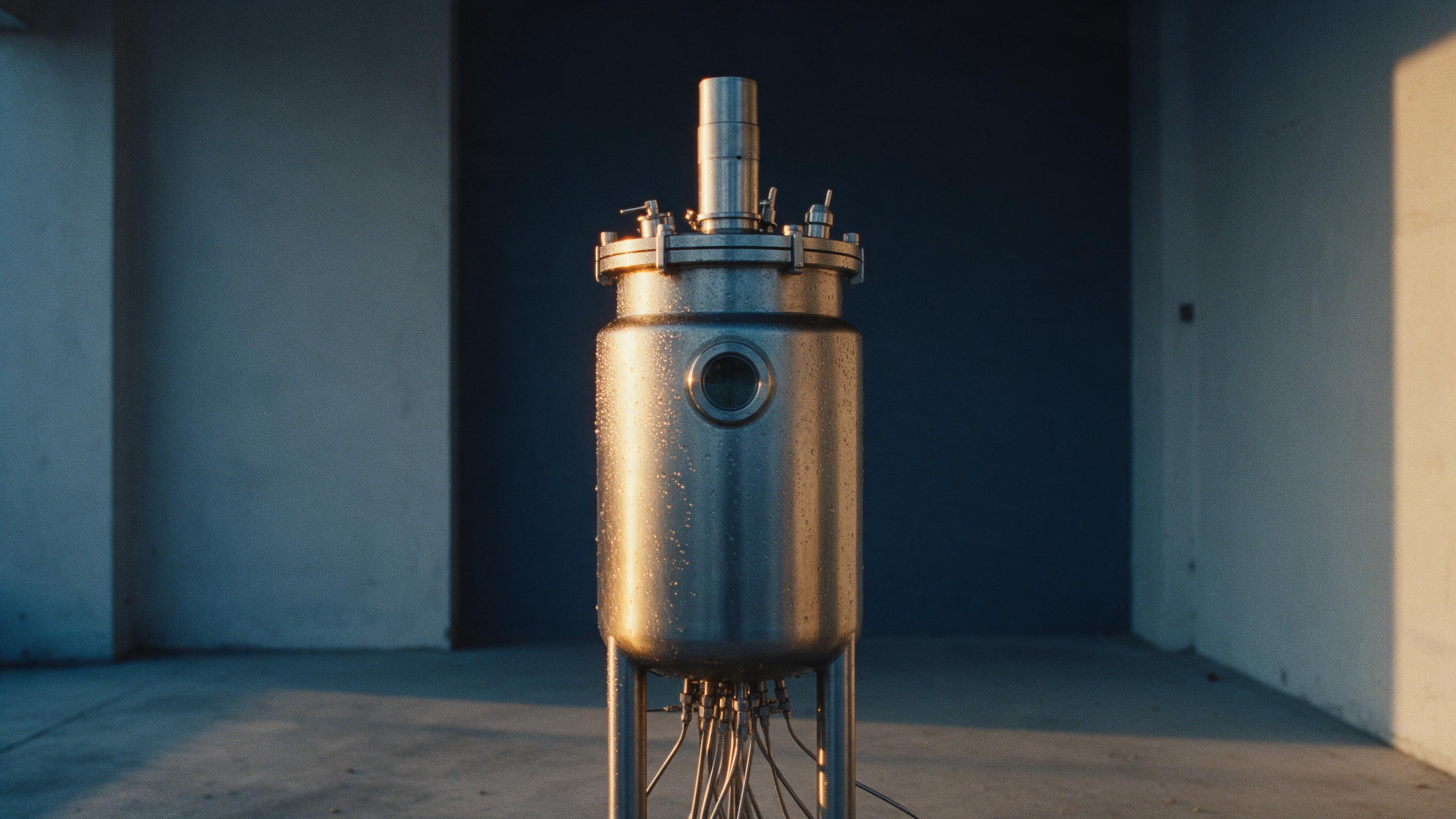
The Bacteria That Beat The Catalyst
Acetogens run on the same gas a Fischer-Tropsch train needs 200 to 350 degrees Celsius to touch, at room temperature and 1 to 10 bar. Six commercial plants and 100 million gallons later, the constraint is no longer the biology.
The Reaction That Never Needed The Heat
A Fischer-Tropsch train wants 200 to 350 degrees Celsius and 20 to 30 bar before it will accept a single molecule of syngas. The bacteria want 30 to 40 degrees and 1 to 10 bar. Room conditions, roughly. The pressure vessel becomes optional. Same gas. Same carbon monoxide, same hydrogen. One route needs a catalyst bed, a furnace and a metallurgy that fails when sulphur slips through. The other route needs a warm tank and something to eat. Clostridium autoethanogenum fixes carbon through the Wood-Ljungdahl pathway, chemistry acetogens have been running in the dark for a few billion years. Feed it CO, or CO2 with hydrogen, and it hands back ethanol, acetate, 2,3-butanediol, isopropanol. The feedstock flexibility is the part that changes a business case. Steel mill off-gas, syngas from municipal waste gasification, captured industrial CO2. The organism is not particular. Impurities that poison a catalyst are a meal to a bacterium. For thirty years the assumption was that biology is the fragile option. On syngas, it is the tolerant one.
Six Plants, Not A Pilot
LanzaTech operates 6 commercial gas fermentation facilities, in China, India, Belgium and the United States, converting steel mill off-gas into ethanol. Not a demonstration. Commercial. The company reports more than 100 million gallons of sustainable ethanol produced from captured carbon as of 2026. It trades on NASDAQ as LNZA. Dr. Jennifer Holmgren runs it. ArcelorMittal, Indian Oil and Sekisui Chemical are partners. The University of Queensland has been running genome-scale modelling with the company since 2012. INEOS Bio, the other name in the field, reached pilot and demonstration. No commercial plants confirmed operational. That is the whole competitive picture. One player at commercial scale, one stalled, and a set of academic groups modelling a pathway that is already making fuel. The reference material is not a whitepaper. Mihalcea et al., Springer, 2024, "R&D&I and Industry Examples: LanzaTech's Gas Fermentation", pages 333 to 343. A company wrote a chapter about its own plant. When a process has 6 commercial units and a named chief executive, the question stops being whether it works. It becomes who runs the next one, closer to the waste.
The Bottleneck Moved
Here is the number that matters, and the open literature will not give it to you: reactor productivity, grams of ethanol per litre per hour. LanzaTech does not publish it and the searches come back empty. What is published is the constraint. Gas-liquid mass transfer. The bacteria are fast enough. Dissolving carbon monoxide into the liquid, where the cells can reach it, is not. That single sentence reorders the engineering. Scale the organism and you inherit a ceiling someone else already found. Scale the interface, through biofilm reactors, hollow-fibre membranes or bubble column geometry, and you are working on the part that is still open. The ceiling is what caps the plant. Not the feedstock. Not the strain. The grant language changes with it. A proposal built on a better organism competes with a company holding 6 plants and 100 million gallons behind it. A proposal built on mass transfer at small scale competes with nobody. Reviewers read the same literature. They know where the constraint sits. A file that names it is a file that has done the reading.
The Jet Fuel Door
LanzaJet, spun out of LanzaTech, runs the world's first commercial ethanol-to-jet fuel plant. Ethanol in, alcohol-to-jet fuel out. The backers: Airbus, British Airways, Breakthrough Energy, Shell, Mitsui, the Microsoft Climate Innovation Fund, the US Department of Energy. Read that list as a signal. Aviation has no battery route. It has to buy molecules, and the supply of jet-range molecules made from waste carbon is one company wide. The chain closes like this. Waste carbon gasified into syngas, syngas fermented into ethanol, ethanol upgraded into jet. Every step in that chain has an operating plant behind it. None of it is a laboratory claim. For anyone holding a gasification concept, the interesting link is the middle one. Fermentation is where the bottleneck has a name and the ceiling has been published. The probability that the next round of aviation fuel money lands on the feedstock side rather than the interface side is not zero. Most boards are pricing it at zero.
The bacteria are fast enough. Getting the gas into the water is not.
Where It Does Not Compete
LanzaTech's model is steel mills. Off-gas from a blast furnace, at the volume a blast furnace produces, in a country where a single partner owns the pipe. A distributed gasifier on biogenic waste is a different animal. Smaller, dirtier feedstock, no industrial owner on site, and the economics sitting in local fuel prices rather than a global ethanol price. Compete there and you lose before the first drawing. The defensible ground is small-scale fermentation around a reactor designed for mass transfer, feedstock flexibility across whatever a region actually produces, and integration with a gasifier that already exists on the site. That is the positioning, and it is one the incumbent has no reason to contest. Nobody ferments blast furnace gas in a 200-kilowatt installation. The EU instruments that fund industrial decarbonisation carry a small-scale category, and the phrase in the guidance is novel reactor design. Bring a reactor, not a concept. One more thing worth copying from the incumbent: measure the gas-liquid interface, in writing, from the first week. That number is the whole project.
The Number Nobody Published
I have signed a EUR 20 million personal guarantee. I have built machines and energy systems across twelve countries. Entrade put 200 wood-gasification machines across the UK and Europe, and the machines worked. The failure mode was never the gasifier on the floor. It was the assumption that the difficult part is the chemistry. The chemistry is solved. LanzaTech solved it with 6 plants, a NASDAQ listing and the gas the steel industry was already throwing away. What is left is the interface, the small scale and the file. The probability that a good gasification project dies on a mass transfer number nobody could cite is not zero. Most of them price it at zero and spend the year on the organism. Read the literature for the bottleneck before the proposal exists. If the number is not published, that is the opening, and it is a small one with a lot of room in it.
Find the bottleneck in the literature before you write the proposal.
The map is dead. Nobody told you.
Bali State of Mind is the survival guide for the collapse of everything you were taught to believe.
Beyond this book
Building the same thing somewhere else.
Julien Uhlig is available for advisory work, board seats and media appearances. Write to media@exventure.co.
The academy that trains the operators, across every company in the group, is EX Epic Academy - 25,000 applications, 25 seats per cohort, 210 alumni across 19 countries. academy.epicsolutiongroup.com
18-20 November. Online, Las Palmas, Bali.
Three days on what happens to work, capital and institutions when the map stops matching the ground. Seats are limited by cohort.
ex-aisummit.com →