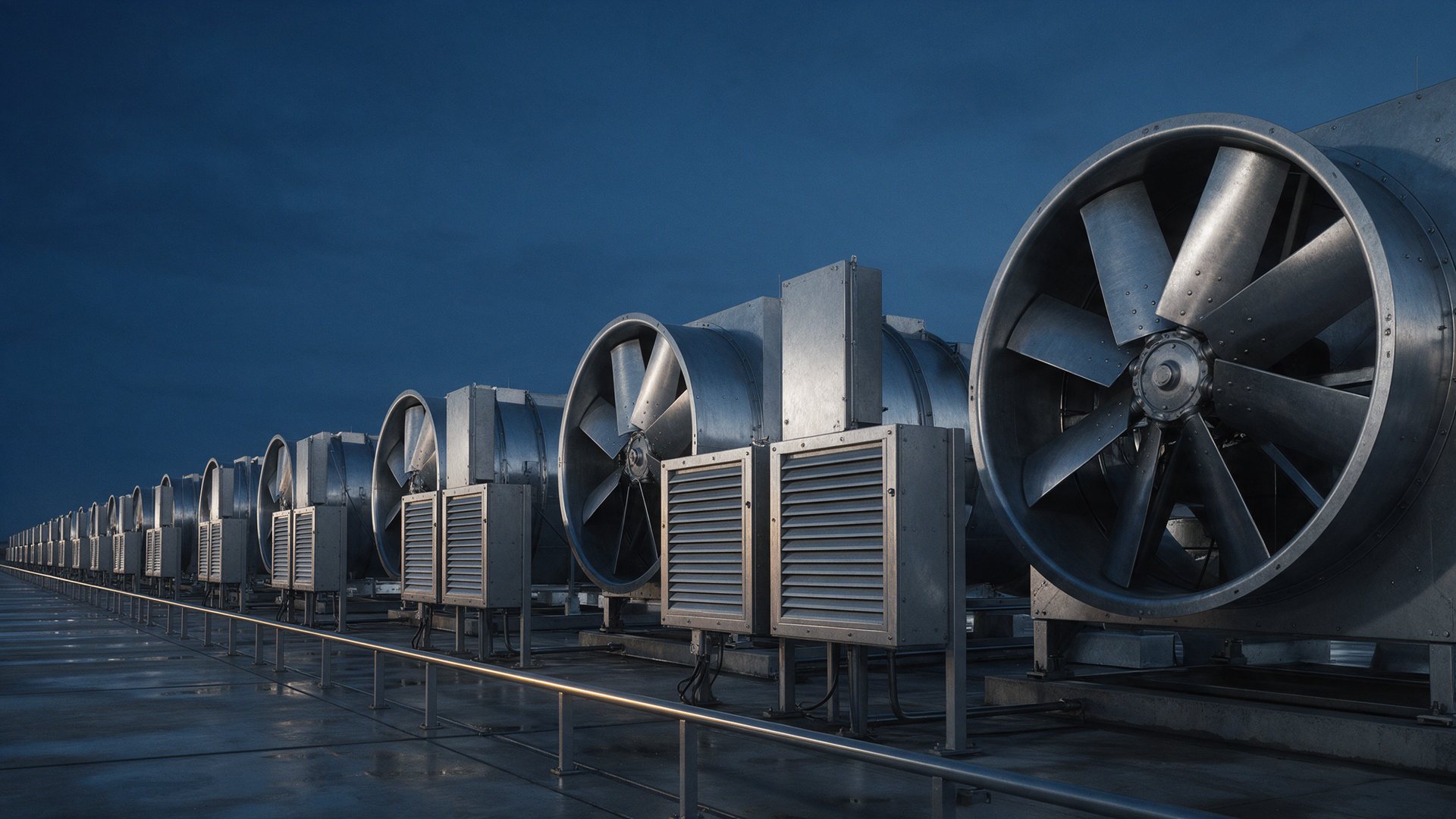
The Air That Will Not Concentrate
Flue gas carries carbon dioxide at ten per cent. Open air carries it at 0.042 per cent. One route has been commercial for forty years at tens of dollars a tonne, the other has two plants and a target column, and the concentration decides which price is real.
Four Hundred And Twenty Parts Per Million
Flue gas from a gas-fired plant carries carbon dioxide at 4 to 15 per cent. A cement kiln or a steel stack runs 12 to 30 per cent. Open air carries 0.042 per cent, which is 420 parts per million. That single number prices everything downstream. A capture unit on a flue stack separates roughly one molecule in ten. A unit on ambient air separates one in two thousand four hundred. The thermodynamics move the same way. The minimum work to pull a kilogram of carbon dioxide out of flue gas is about 0.25 megajoules. Out of air it is about 0.45. The floor nearly doubles while the concentration falls by a factor of two hundred. A hundredfold dilution with a floor twice as high is not a harder project. It is a different industry.
One Is Forty Years Old, The Other Is Not
Amine scrubbing sits at technology readiness level 9. It has been commercial for more than forty years, captures 85 to 95 per cent of the carbon dioxide it is fed, and is sold by Shell CANSOLV, Mitsubishi Heavy Industries, BASF and Aker Carbon Capture. Chilled ammonia holds at level 7 to 8 and runs at demonstration scale at Mongstad in Norway. Direct air capture sits at level 7. Two commercial plants exist, both in Iceland. Orca removes 4,000 tonnes a year. Mammoth removes 36,000. Readiness is not a marketing grade. It is a count of how many times the thing has been built, financed, insured, permitted and repaired. The flue-gas route has been built by other people hundreds of times. The air route has been built by one company twice. The first unit of anything costs more than the model, and the schedule slips hardest where nothing has been built before.
The Cost Column Says It Plainly
Point-source capture runs USD 40 to 120 per tonne. Direct air capture runs USD 400 to 1,000, and the top of that band is not a ceiling. The rows underneath carry the same gap. Amine on coal sits at 50 to 80 dollars a tonne. Amine on a gas plant sits at 70 to 120, because the flue stream is more dilute. Chilled ammonia runs 50 to 90. Solid sorbents using metal-organic frameworks run 40 to 90. Polymeric membranes run 60 to 100. On the air side: liquid solvent direct air capture runs 500 to 1,000 dollars a tonne. Solid sorbent runs 400 to 800. The next generation of approaches is quoted at 200 to 500. A capture credit buys five to twenty times more carbon dioxide through the flue-gas route than through the air route. That is the whole table, and it does not move for story.
The Energy Is The Bill
Amine scrubbing consumes 2.5 to 3.7 gigajoules of steam per tonne and costs the host plant 15 to 45 per cent of its efficiency. It also loses 0.5 to 3.0 kilograms of solvent per tonne captured. Direct air capture spends more on both forms of energy. Liquid solvent needs 6 to 9 gigajoules of heat and 0.5 to 1.0 megawatt hours of electricity per tonne. Solid sorbent needs 3 to 5 gigajoules and 0.6 to 1.0 megawatt hours. Total demand lands at 1.5 to 2.5 megawatt hours per tonne. To remove one gigatonne a year that way takes 1,500 to 2,500 terawatt hours a year, or 5 to 8 per cent of global electricity. Wind, solar and batteries to serve it were estimated at about USD 4 trillion by the NCEA. There the energy is the product and the plant is the receipt.
A hundredfold dilution with a floor twice as high is not a harder project. It is a different industry.
The Subsidy Sets The Price
The United States 45Q credit pays USD 180 a tonne for direct air capture and USD 85 a tonne for point-source capture. The first number is roughly the floor of the second technology and the second number is the ceiling of the first. Stratos, Occidental's 500,000 tonne plant in Texas, is quoted at USD 180 a tonne and is explicitly 45Q eligible. That is the credit, to the dollar. Climeworks has megaton hubs planned in Louisiana, California and North Dakota with USD 600 million of Department of Energy funding behind them, and Svante supplying contactor blocks. Every published number in this comparison also excludes transport and storage, which adds USD 50 to 150 a tonne. None of that is a margin. The credit is a gate, and the gate is set by statute rather than by cost.
The Cost Curve Is A Scale Curve
First-of-a-kind direct air capture at 10,000 tonnes a year is quoted at 700 to 1,000 dollars a tonne for liquid solvent and 500 to 900 for solid sorbent. A 100,000 tonne cluster drops to 400 to 600 and 300 to 500. A megatonne plant is modelled at 200 to 400 and 150 to 300. The targets are lower again. Carbon Engineering and Occidental target 150 to 300 dollars a tonne at megatonne scale. Climeworks targets 200 to 400 by 2030. Heirloom targets under 108 dollars using calcium looping with solar calcination. Sustaera targets under 100 with an electrochemical cell. Spiritus targets under 100 by freezing carbon dioxide out of cold air. A target is a number an equity story needs. The most mature capture technology in the world missed its own cost estimate by a factor of two, in public, with its own engineers holding the spreadsheet. I place the probability that a first-of-a-kind direct air capture plant lands inside its published target range on first build at close to zero.
The Revision Nobody Quotes
Between 2019 and 2020 the published cost of amine capture was about USD 40 a tonne. By the 2024 revision, real project budgets put it at USD 80 to 130 a tonne, with real-world capital cost of about USD 400 per tonne of annual capacity. That is the incumbent. Forty years of operating history, hundreds of reference plants, a competitive vendor market, and the estimate still doubled once the ink was dry. The air route has two plants behind it and a target column that assumes megatonne scale it has not reached. A cost curve drawn from nameplate capacity rather than from completed builds is a forecast wearing the clothes of a measurement. Anyone pricing a capture company is pricing the distance between the two.
What I Would Price
I restructured a EUR 75 million industrial group and built companies across twelve countries. Entrade built 200 wood-gasification machines across the UK and Europe, and the first units were never the ones that set the price. The tenth build set the price. Everything before it was tuition. Capture is the same instrument. Point-source capture is mitigation, it stops new carbon dioxide entering the air, and it is priced in tens of dollars a tonne. Direct air capture is removal, it takes back what is already up there, and it is priced in hundreds. They are not substitutes and they do not belong on one cost curve. The probability that a removal tonne and a mitigation tonne are worth the same money is close to zero, whatever the register currently says. Read the concentration before you read the ambition. Four hundred and twenty parts per million decides the price.
Readiness is not a marketing grade. It is a count of how many times the thing has been built, financed, insured, permitted and repaired.
The map is dead. Nobody told you.
Bali State of Mind is the survival guide for the collapse of everything you were taught to believe.
Beyond this book
Building the same thing somewhere else.
Julien Uhlig is available for advisory work, board seats and media appearances. Write to media@exventure.co.
The academy that trains the operators, across every company in the group, is EX Epic Academy - 25,000 applications, 25 seats per cohort, 210 alumni across 19 countries. academy.epicsolutiongroup.com
18-20 November. Online, Las Palmas, Bali.
Three days on what happens to work, capital and institutions when the map stops matching the ground. Seats are limited by cohort.
ex-aisummit.com →