The Air Has A Temperature
Temperature is a system rather than a setting on 1 light, and 4 variables have to agree or the frame breaks in a way an audience feels without being able to name it: the colour temperature of the light, the air it travels through, the skin's response to the ambient heat, and the wardrobe that belongs to that climate. A hot tropical sunrise and a cold winter sunrise can sit at the same number in the sky. They do not look remotely the same.
Temperature Is A System, Not A Setting
The light on a set carries a number, and the number is the smallest part of the decision. A tungsten lamp sits near 3200. A candle flame sits near 1800. Clear midday sun sits around 5500, and open shade under a blue sky runs to 8000 or past it. Those figures are easy to look up, and most productions stop there. The number is 1 of 4 variables that have to agree on 1 climate. The light has a colour temperature. The air that the light travels through has a state, which can be humidity haze, heat shimmer, fog, mist, breath or steam. The skin in the frame responds to the ambient heat. The wardrobe belongs to a climate rather than to a colour scheme. Move any 1 of those 4 on its own and the other 3 turn into a contradiction. A warm 2800 sunrise over characters in heavy winter coats is incoherent. So is a deep blue 10000 winter dawn with the same characters in thin summer linen. Both frames contain good light. Neither one contains a place. The check takes about 15 seconds per setup. Name the climate. Lock the time of day. Then confirm that the light, the air, the skin and the wardrobe all belong to that same answer. A mismatch here is not a grade problem and it is not a wardrobe problem. It is a coherence problem, and it is cheaper to catch on the shot card than in a render.
The Scale Runs From About 1800 To Past 10000
The scale is short. A candle or a match flame sits near 1800 and reads deep amber and intimate. Tungsten and household lamps run 2700 to 3200 and read warm orange. Sunrise and sunset light the sky at 2000 to 3500, and that band is the one that behaves differently depending on what is in the air. Early morning and late afternoon sun sits at 3500 to 4500. Then the middle of the day flattens out. Fluorescent sources run 4000 to 5000 and read slightly green. Clear midday sun sits at 5000 to 5600 and reads neutral white. Overcast runs 6000 to 7000 and reads cool grey. Open shade under blue sky jumps to 8000 to 10000 and reads cool blue. Blue hour and twilight pass 10000 and go darker from there. Moonlight is the outlier. It measures around 4100 to 4500, which is warm by the numbers, and it is pushed blue in the grade because that is what the eye expects of a night exterior. The measurement and the expectation disagree, and the expectation wins. The practical use of the list is that it gives a target for the light and a target for the shadows in the same breath. A winter exterior at 2500 in the sky with an 8000 shadow side is not an error. It is 2 temperatures inside 1 frame, and that split is the shot.
4 Variables, 1 Climate
Once the light has a number, 3 more variables have to be pointed at the same climate. The air is the one productions forget, because it is invisible until it is not. Humidity haze lifts and softens everything past about 20 feet behind the subject, which is why a distant ridge in a hot country reads milky while a distant ridge in cold dry air stays sharp at 30 miles. Heat shimmer moves the air above hot ground and above asphalt, water and sand equally, and it is the reason a long lens on a hot day will not hold focus at 200mm. Dust haze adds a warm brown and stretches every shadow that passes through it. Fog and mist sit between the 2 extremes and change their character with the temperature. Breath belongs to the cold. Visible condensation at the mouth is the signature of cold air, and it cannot appear in a frame that is selling heat. Steam is the opposite edge case, and it belongs where hot meets cold: a hot drink in winter air, a warm body in frost. Skin is the third variable. The body keeps a physical record of the room. Sweat sheen appears across the forehead and cheekbones once ambient heat passes roughly 28 degrees, and damp hair follows at the hairline. Cold does the reverse: flushed cheeks and nose, pale lips, goosebumps on the arms below about 15 degrees and visible breath. These are not makeup decisions applied afterwards. They are evidence, and an audience reads them without being told to. Wardrobe is the fourth. Linen, cotton and silk in light or white, loose and with exposed skin, belong to heat. Wool, down and fur in dark or muted tones, layered, with scarf, gloves and hat, belong to cold. Fabric, coverage and colour are 1 decision, and it answers to the same climate as the light and the air. The rule for all 4 is short. Name the climate and the time of day 1 time. Then lock the Kelvin value, the air, the skin response and the clothing to that single decision. Do not renegotiate it scene by scene. The climate is decided once and the rest of the frame answers to it.
2 Sunrises At The Same Number
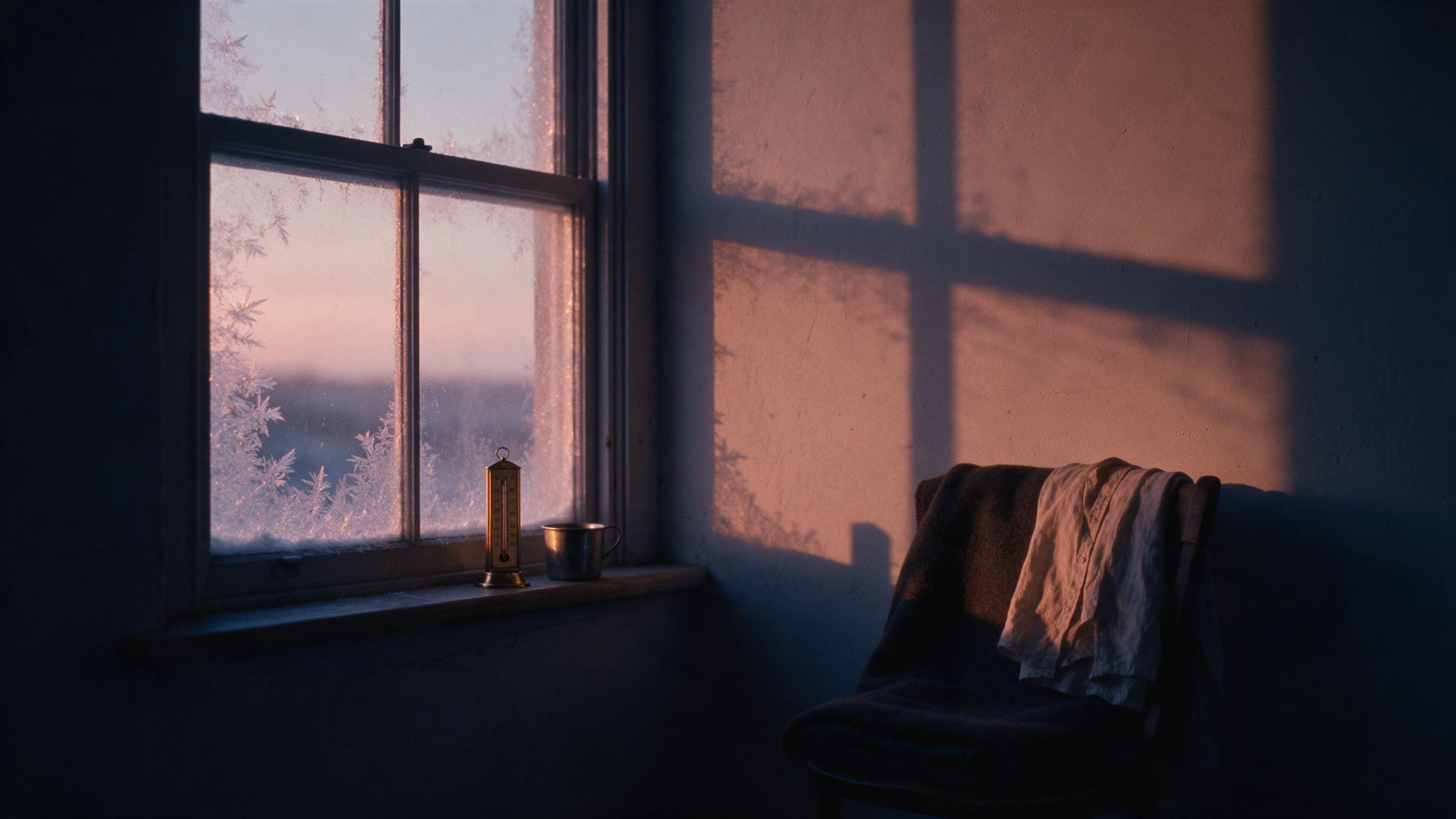
A sunrise in the tropics and a sunrise in a Norwegian winter can both sit at 2000 to 3500 in the sky and produce 2 completely different pictures. This is the section that matters. The tropical version is warm light travelling through wet air. Humidity scatters it, so the horizon glow reads milky and diffuse rather than clean, and the golden phase is over fast because the sun rises steeply near the equator. Shadows stay warm and soft because humid air bounces light back into them. Skin carries sweat sheen. Fog over water burns off by mid-morning. The grade stays saturated but hazy, greens and golds, and the blacks never fully close. The winter version is the same warm light travelling through frozen air. The air is clear, so the light is hard and the shadows run long and blue at 8000 or beyond. The sun climbs slowly from a low angle, so the rose-gold phase holds for 30 minutes instead of 5. Frost coats the ground. Breath condenses at every mouth. Skin flushes at the cheeks and nose. The grade sits rose-gold sky against blue-black shadow, high in contrast and a touch desaturated. The 1 sentence version of the whole section is this. A hot sunrise is warm light in wet air. A cold sunrise is warm light in frozen air. Same sun, same 2800 in the sky, opposite atmosphere, and the audience knows which one they are standing in within 2 seconds of the frame.
Temperature is a system, not a setting on 1 light.
What Temperature Does To The Air
Temperature changes the air, and the air is what the light passes through, so 2 shots with identical lamps can read as 2 different countries. Warm and humid fog is thin, luminous and soft. It reads warm white, it hugs water and low ground, and it burns off by mid-morning. Cold fog is the opposite in every property. It is dense, low, flat and white-grey, it crusts at the edges with frost, it persists through the day, and it casts everything inside it a cold blue-grey. Heat shimmer is a hot-country midday effect, and it is why a long lens on a hot day refuses to hold focus at 200mm. Dust and dry haze produce warm brown particulate and long shadows that pass through it. Breath is the cold signature and cannot be borrowed. The time-of-day structure holds across climates. A tropical dawn runs about 2500 with humid haze, mist over water, sweat and linen. Tropical noon runs about 5500 with strong shimmer and heavy humidity haze. Tropical golden hour is a saturated 2800 that fades fast. A tropical night stays near 4200 and the humidity keeps the blacks lifted, so nothing goes truly black. A desert dawn is a crisp 2500 with dust haze and dry skin. Desert noon is a brutal 5600 that blows the highlights, and desert night drops to 4500 with sharp stars and air that loses its heat fast. Temperate summer runs 3000 at dawn with valley mist, 5500 at noon and 2800 through a long golden hour. Temperate winter runs a rose-gold 2500 over frost and radiation fog, a weak 5000 at noon with blue shadows, and a brief cold 2500 near the end of the day with breath visible in all of it. Altitude is its own case. Air up high is thin, so the light arrives un-hazed. That gives a warm 2600 at dawn, a harsh 5600 at midday with hard shadows and a UV-blue bias, and a rapid saturated golden hour that gives the eye less time than it expects. The mismatch between thin air and the light inside it is invisible and total.
Skin, Wardrobe, And The Answer That Has To Match
The last 2 variables are the ones the audience reads on the body rather than in the frame. Heat and cold produce opposite signatures on skin. Heat gives sweat sheen at 28 degrees and above, a dewy highlight across the forehead and cheekbones, and damp hair at the hairline. Cold gives flushed cheeks and nose, pale lips, goosebumps on the arms below about 15 degrees, and visible breath at the mouth. Putting sweat on a cold face or breath in hot air is the fastest way to lose a frame, because the body is the part of the picture audiences trust without thinking about it. Wardrobe carries the same 2-sided logic. Heat means linen, cotton or silk, light or white, loose and exposed, with minimal layers. Cold means wool, down or fur, dark or muted, layered, with scarf, gloves and hat and almost no exposed skin. Neither list is a palette. Both are records of a physical situation, and colour is subordinate to that. So the working method is 1 decision and 3 checks. Decide the climate. Lock the time of day. Lock the Kelvin value. Lock the air to that climate: haze and shimmer for heat, frost, dense fog and breath for cold. Then lock the skin response and the wardrobe to the same answer. The 5 second test at the monitor is whether all 4 agree. A 3200 key with frost outside the window fails. A 10000 blue dawn with bare arms fails. A heatwave exterior in a wool coat fails, and 30 seconds of a re-dress fixes it before 12 hours of a render makes it permanent. The probability that an audience stays inside a frame rises when every variable in it belongs to the same place. The same discipline that built companies across twelve countries and filled 393 pages of a paperback and Kindle edition applies at the shot card: decide once, then hold the decision. A hot sunrise is warm light in wet air with sweat and linen. A cold sunrise is warm light in frozen air with breath and wool. Mix them and the audience knows something is wrong before they know why.
The same 2800 in the sky is warm light in wet air or warm light in frozen air. Those are not the same picture.
The map is dead. Nobody told you.
Bali State of Mind is the survival guide for the collapse of everything you were taught to believe.
Beyond this book
Building the same thing somewhere else.
Julien Uhlig is available for advisory work, board seats and media appearances. Write to media@exventure.co.
The academy that trains the operators, across every company in the group, is EX Epic Academy - 25,000 applications, 12 per cohort, 200+ alumni across 19 countries. academy.epicsolutiongroup.com
18-20 November. Online, Las Palmas, Bali.
Three days on what happens to work, capital and institutions when the map stops matching the ground. Seats are limited by cohort.
ex-aisummit.com →