The Agent Economy Is Not Coming. It Is On Four Screens.
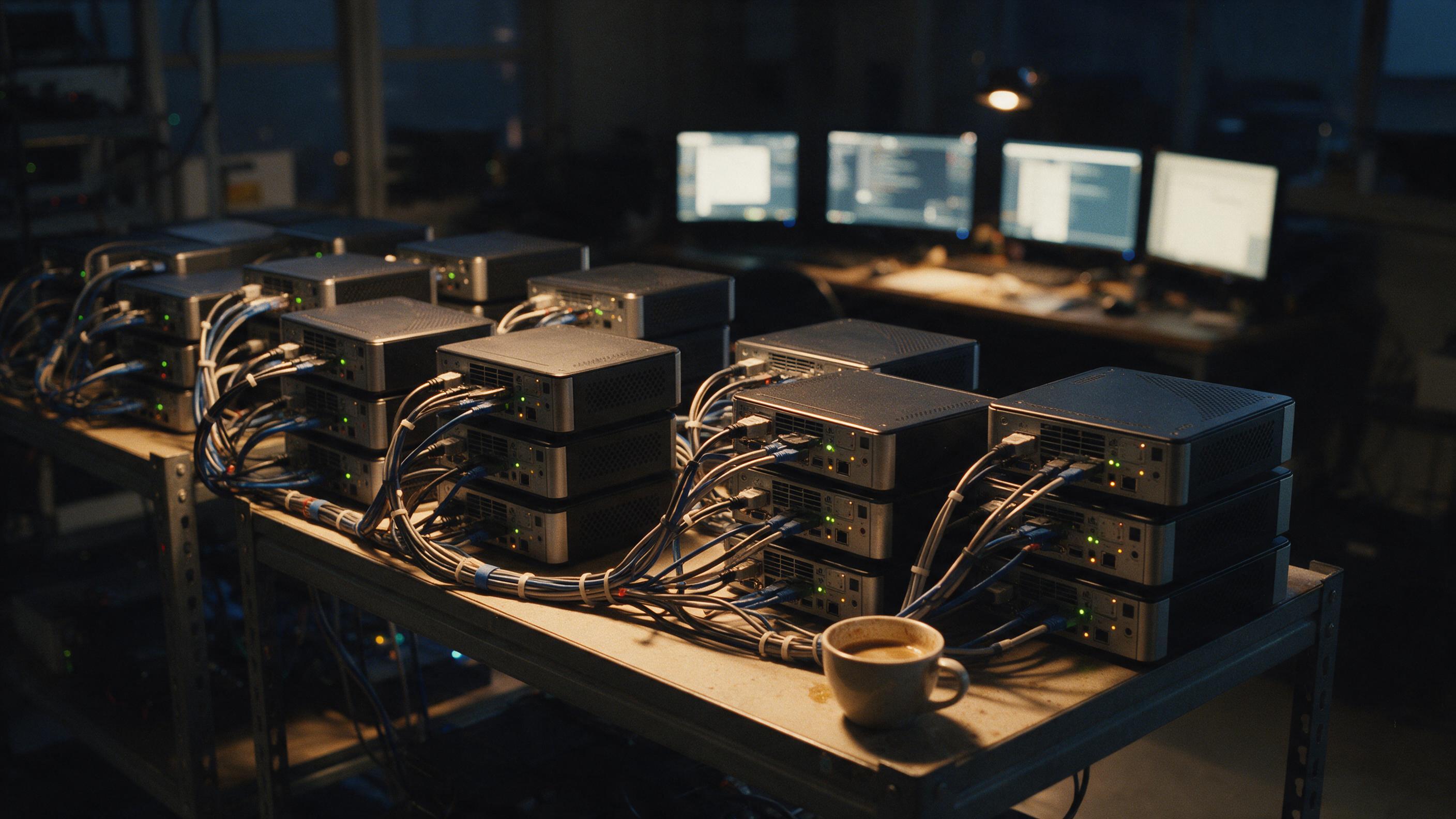
It is 5:47 in the morning and fourteen Mac Minis on two shelves are running fifty agents. One rebuilt a consultant's three weeks of work in six hours. One is arguing with another about whether its solar analysis was lazy. The staffing cost is the electricity bill.
Four Screens, 5:47 In The Morning
It is 5:47 in the morning and the room is quiet except for the fans. Four monitors across the desk. I am not sitting at the desk. I am standing, coffee in hand, watching. Screen one runs an agent that wakes every six hours, pulls patent filings from the US Patent Office API and reads every one of them. Not the titles. The claims. It extracts what is being defended right now, which domains are accelerating, and it flags the parts it is uncertain about. Then it goes back and corrects itself. Screen two is writing a compliance report that would have taken a consultant three weeks. Fourteen days of research, seven days of synthesis, seven days of revision. The agent did it in six hours. Screen three is an energy market analyst that has been running for three days, modelling what happens if certain policy changes land. Screen four is the orchestrator. It reads the patent agent's output and tells it that its pharmaceutical analysis is undisciplined and to go deeper into the chemical compound relationships. It tells the energy analyst its solar work is lazy. Not cruel. Technical. Four screens, no humans in the room, and a shelf behind me holding fourteen Mac Minis that draw thirty watts each at idle. They run about fifty agents between them. They have been running for three months. The staffing cost is the electricity bill.
A Box That Took Text In And Gave Text Out
For two years an agent was one task, one tool, one result. You asked a question, the model answered. It could not reach into the world. It was a box that took text in and gave text out. Then Model Context Protocol arrived. An open standard that lets an agent pick up external tools: APIs, databases, file systems, code execution, specialised models. Any tool that exists can be wired in. The agent stops only thinking and starts moving through systems. The adoption numbers are not subtle. In November 2024, MCP servers passed 100,000 downloads. Five months later, in April 2025, the ecosystem listed 5,800 servers. By December 2025, one year after launch, monthly SDK downloads hit 97 million. That is not a pilot. That is the plumbing of the next economy being laid in public. Here is the difference in one job. To answer a hard market question the old way you hire five people: a researcher, a market analyst, a modeller, somebody to talk to experts, somebody to write it up. Weeks of work, and a 200-page report at the end. The new way: describe the problem to one agent, let it chain the tools, read the output in an afternoon. The agent does not get bored at page 140.
The Competence Nobody On The Team Has
Nobody on our team writes code from a blank file. Not the way an engineer means it, sitting down and producing a thousand lines of Python from memory. What happens instead: somebody finds an open-source repository, describes in one line what should change, and the work is done by the time the coffee is cold. The model reads every file, understands the architecture, proposes the changes and explains the trade-offs. If it breaks, it reads its own error message and fixes it. If the error is genuinely hard, it explains why and offers three alternative routes. An afternoon, not a sprint. And no senior engineer to hire. We used to run n8n, the self-hosted automation tool, rules wired together in a visual editor. When the input did not match the rule, the rule broke, and a human had to go and repair it. We do not run n8n anymore. An agent does not need the input to match the rule. It reads the weird email, works out what it means in context, and answers. The setup took longer. The maintenance is a fraction. The exceptions stopped being crashes and became slightly harder decisions. Stop thinking about rules. Start thinking about agents that reason about what to do.
Where Value Moves Now
The agent economy is not only AI getting better. It is the structure of work being rebuilt for machines to operate. We spent thirty years making the digital economy human-readable: websites, apps, screens, buttons. The next layer is being built machine-operable: documents becoming structured data, workflows becoming agent workflows, interfaces becoming APIs that no human ever looks at. Follow the money to see where that lands. EX FI is building regulated financial infrastructure for agents, not for people: agents invoicing, agents routing payments, agents managing compliance, settlement that runs without a human approving each move. Regulated, licensed, boring on purpose. When value moves between machines, the middle of the labour market hollows out fast. Not the top, which decides what the machines should do. Not the bottom, which the machines still cannot reach. The middle: the analyst, the researcher, the compliance reviewer, the coordinator. The work that was priced on scarcity of attention and now costs nothing per unit. There are two positions left. Consumer of what the machines produce, which is a slow liquidation with a pleasant interface. Or decision-maker, standing between the machines and the outcome, carrying the risk that the answer is wrong. One of those positions has a future. The other has a schedule.
The work happens in the decision, not the execution. The execution is now nearly free.
The Work Is The Decision
For thirty years my value came from doing. The company I built, the group I restructured, the machines we shipped to three continents. I have built companies across twelve countries and restructured a EUR 75 million industrial group. You could point at the output and say: I made that. In the agent economy the value comes from deciding and directing. The hardest thing I have had to learn, at forty-nine, is that watching four screens is not laziness. It is the job. Understand the problem clearly enough to brief the agents. Judge what comes back. Find the gap they cannot see in their own work. Integrate ten streams of machine output into one decision. The execution is nearly free now. That is the whole shift, and it breaks the only metric most high performers have ever used: am I working hard enough. You will never out-effort the machines. They do not sleep. Here is the number that matters. The probability that a twenty-four month software roadmap, built by eight people and a raised round, gets rebuilt by three people with agents before that round closes is not small. I would price it above half. Most founders I meet are pricing it at zero, which is why they are still hiring for the roadmap instead of re-scoping it. I am not clever about this. I just read the direction of the river. In the 1990s I was in New York while the internet was minting its first fortunes. Around 2002 finance became the centre of gravity and I built a route into those rooms. In every case I moved with the current, not against it, and the current now runs toward people who can direct machines.
Six Months, Not Sixty Years
One thing nobody says out loud: the transition is not a decade away, and it is not gentle. The financial system is not ready. The regulatory system is not ready. The labour markets are certainly not ready. The technology is ready. That is an unusual order of events, and it is the reason the next two years will not look like the last twenty. The industrial revolution took sixty years to restructure the labour economy. The agent economy is restructuring in six. When a window like this closes, it closes fast: the positions fill, the infrastructure gets owned, the cheap land is gone. If you are twenty-two and reading this in a lecture hall, the choice in front of you is not a career. It is a category. You can spend three years becoming excellent at work the agents already do better than you: market analysis, legal research, compliance review. Or you can spend three years learning to direct them, to ask the right question, to spot the output that looks right and is wrong. One of those produces a job that exists in five years. The other produces a job that exists for two more. The agents do not sleep. The only question is whether you are directing them or competing with them.
The industrial revolution took sixty years to restructure labour. The agent economy is doing it in six.
The map is dead. Nobody told you.
Bali State of Mind is the survival guide for the collapse of everything you were taught to believe.
Beyond this book
Building the same thing somewhere else.
Julien Uhlig is available for advisory work, board seats and media appearances. Write to media@exventure.co.
The academy that trains the operators, across every company in the group, is EX Epic Academy - 25,000 applications, 25 seats per cohort, 210 alumni across 19 countries. academy.epicsolutiongroup.com
18-20 November. Online, Las Palmas, Bali.
Three days on what happens to work, capital and institutions when the map stops matching the ground. Seats are limited by cohort.
ex-aisummit.com →