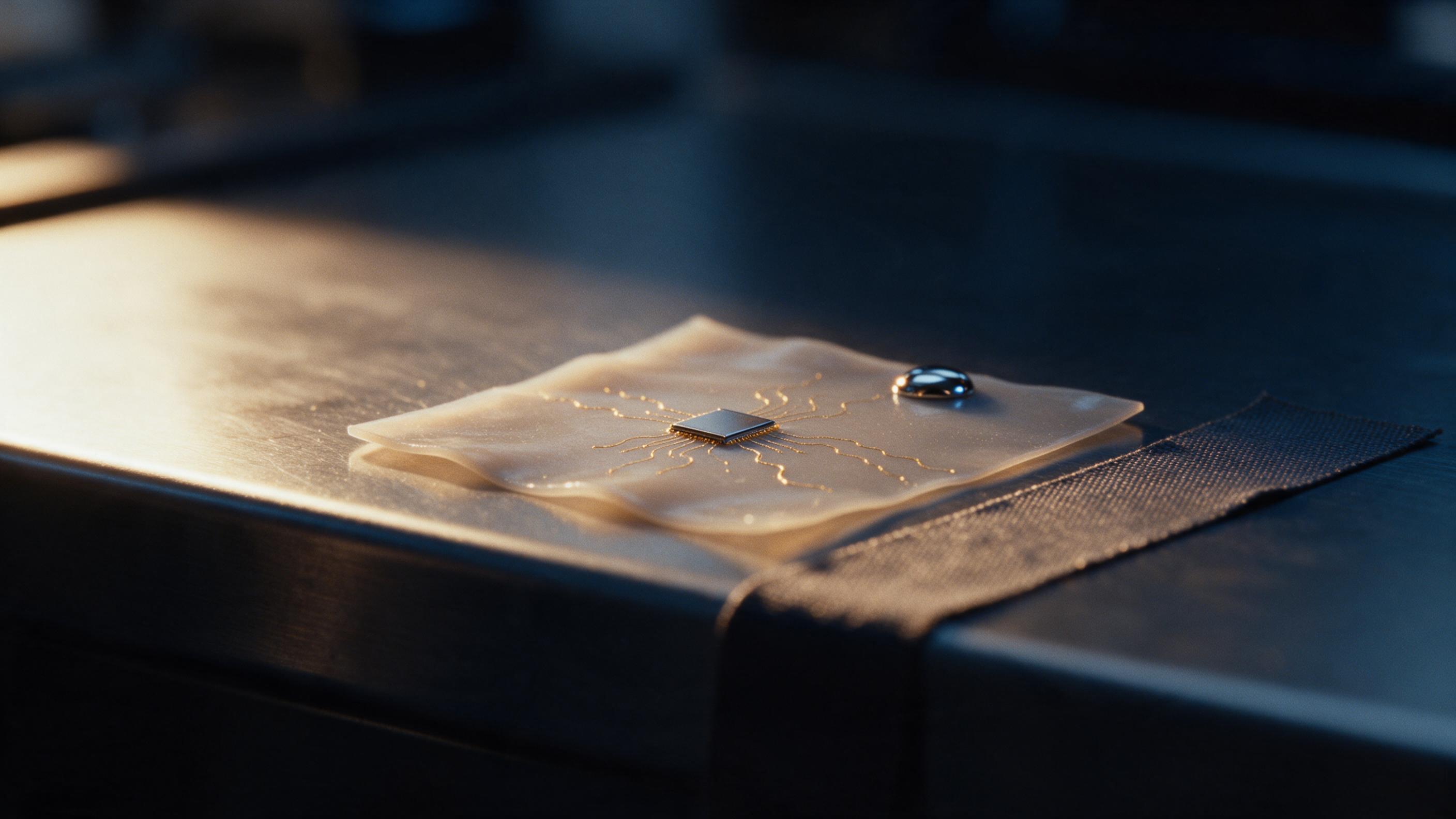
Six Orders Of Magnitude Softer
Silicon sits near 150 gigapascals and human skin sits between 10 and 100 kilopascals, so the mismatch between the electronics and the body runs to six orders of magnitude. Every materials strategy in the field is a different answer to that one number. There are five routes, each one wins on a different axis, and the decision rule is the strain the part will actually see rather than the modulus on the datasheet.
Put The Two Numbers Side By Side
Silicon has a Young's modulus near 150 gigapascals. Copper sits at 110. Polyimide, the flexible substrate the industry actually prints circuits on, comes in at 2.5 gigapascals. PDMS silicone is 1 megapascal. Human skin runs 10 to 100 kilopascals, and the fat under it is softer again at roughly 10. Set the first figure against the last and the mismatch is six orders of magnitude. Rigid electronics on living tissue is a steel plate bolted to a marshmallow. The plate does not fail. The marshmallow does, and the place it fails is the bond between them. This is why a sensor that works on a bench for 2 years dies on a forearm in 2 weeks. The chip was never the fragile part. The stack was, and it took the strain the body puts through it 20,000 times a day without a single material changed to survive it. Read the field through that lens and it stops looking like a materials catalogue. It looks like five different answers to one engineering question, and the answers do not compete on the same axis.
Rigid Islands In A Soft Sea
The first answer keeps the electronics exactly as they are and moves the compliance into the wiring. Tiny rigid chips sit as islands on a soft substrate, joined by interconnects cut into serpentine, horseshoe or fractal geometry. The islands stay rigid and functional. The copper's shape absorbs the stretch. This is the route pioneered by the John Rogers group, and it reaches 50 to 100 per cent stretch while holding conventional silicon performance. Nothing about the transistor changes. You are buying compliance with layout area, and the cost is density: the serpentine consumes the real estate a straight trace would have used for devices. It is the correct answer when the electronics have to be high performance and the area is small. It is the wrong answer when the surface is a whole torso, because you cannot buy that much area back.
Liquid Metal And The Conductivity Tax
The second answer changes the material instead of the geometry. Replace the rigid conductor with something inherently soft: conductive polymers such as PEDOT:PSS, ionic conductors, or liquid metal. The most interesting entry is EGaIn, a gallium indium alloy that is liquid at room temperature. A liquid conductor cannot fatigue-fail, because fatigue is a property of a solid that cracks under cycling. Push EGaIn past 100 per cent stretch and it simply flows into the new shape. The bill arrives as conductivity retention. These materials carry current worse than copper by an order of magnitude or more, and their resistance drifts as they strain, so the sensing channel carries a moving error term. That drift is the part most roadmaps skip. A soft conductor that changes resistance under the same deformation it is meant to measure is a hard calibration problem dressed as a materials win.
The Perfect Match That Dries Out
Hydrogels and ionotronics take the third route and get the closest match available. A water-swollen polymer network sits between 1 and 100 kilopascals, which is the same range as the tissue it touches. Conduction is ionic rather than electronic, the material is transparent, and it is biocompatible enough to sit against an organ. Then the failure modes arrive in a group. Water leaves the network, so the hydrogel dries, shrinks and stops conducting. It freezes at temperatures a winter shipment will meet. Ionic conduction is slow, in the kilohertz range at best, so it reads a heartbeat and cannot follow a texture sliding under a fingerpad at 100 millimetres a second. This is the most instructive failure in the set. The mechanical answer was perfect. The engineering answer was not, and the field spent years learning that a modulus match is necessary and nowhere near sufficient.
The plate does not fail. The marshmallow does.
Self-Healing, And The Route That Inverts The Question
The fourth answer accepts that the surface will be damaged. Polymers with reversible bonds, whether dynamic covalent, hydrogen bonding or Diels-Alder, re-knit after a cut and restore mechanical and electrical continuity. Recent work reports around 93 per cent mechanical healing efficiency. When the sensor is the surface that gets scratched, healing stops being a feature and becomes the specification. The fifth route is not a polymer at all. E-textiles invert the problem: instead of making electronics flexible like fabric, make fabric sense like electronics. It is a separate branch because it is produced on textile equipment at square-metre scale rather than in a cleanroom, which changes the unit economics more than it changes the physics. Fabric wins on coverage and comfort, and it is the only route that covers a whole body without quoting a wafer price. It also reads on skin better than anything laminated to it, because there is no adhesive interface to fail.
Pick By Strain, Not By Datasheet
Here is the decision rule that matters. Choose the strategy from the strain the part will actually see, not from the modulus printed on the datasheet. A fingertip sees small displacement and needs high resolution, so rigid islands or an optical stack win there. A forearm moves through large, repeated strain, so e-textile wins. A torso wants coverage and a soft interface, so the answer is a fabric or a hydrogel, and the hydrogel has to be sealed against water loss. Anywhere the surface is exposed to damage, self-healing pays for itself. Anywhere the volume is measured in square metres, fabric is the only route that meets the brief. The state of the art is already hybrid, and it has been for years. A rigid island fingerpad, an e-textile palm, a self-healing outer coating. One device, three material strategies, chosen per zone. My probability that a single materials strategy covers most of the field by 2030 is under 15 per cent. The mismatch is not going away, and no one material fixed it. I have built companies across twelve countries and restructured a industrial group, and this pattern repeats outside electronics. The team that wins is the one that stops looking for the material that solves everything and starts assigning the right material to each square centimetre.
Six orders of magnitude is not a tolerance problem. It is a design brief.
The map is dead. Nobody told you.
Bali State of Mind is the survival guide for the collapse of everything you were taught to believe.
Beyond this book
Building the same thing somewhere else.
Julien Uhlig is available for advisory work, board seats and media appearances. Write to media@exventure.co.
The academy that trains the operators, across every company in the group, is EX Epic Academy - 25,000 applications, 12 per cohort, 200+ alumni across 19 countries. academy.epicsolutiongroup.com
18-20 November. Online, Las Palmas, Bali.
Three days on what happens to work, capital and institutions when the map stops matching the ground. Seats are limited by cohort.
ex-aisummit.com →