Re-Master, Don't Generate
A generated shot starts from nothing, so it pays for composition, colour and lens on every frame. 400 frames pulled out of one film you already like hands you all 3 for free, and leaves your taste for the story.
Pick One Film And Own Its Look
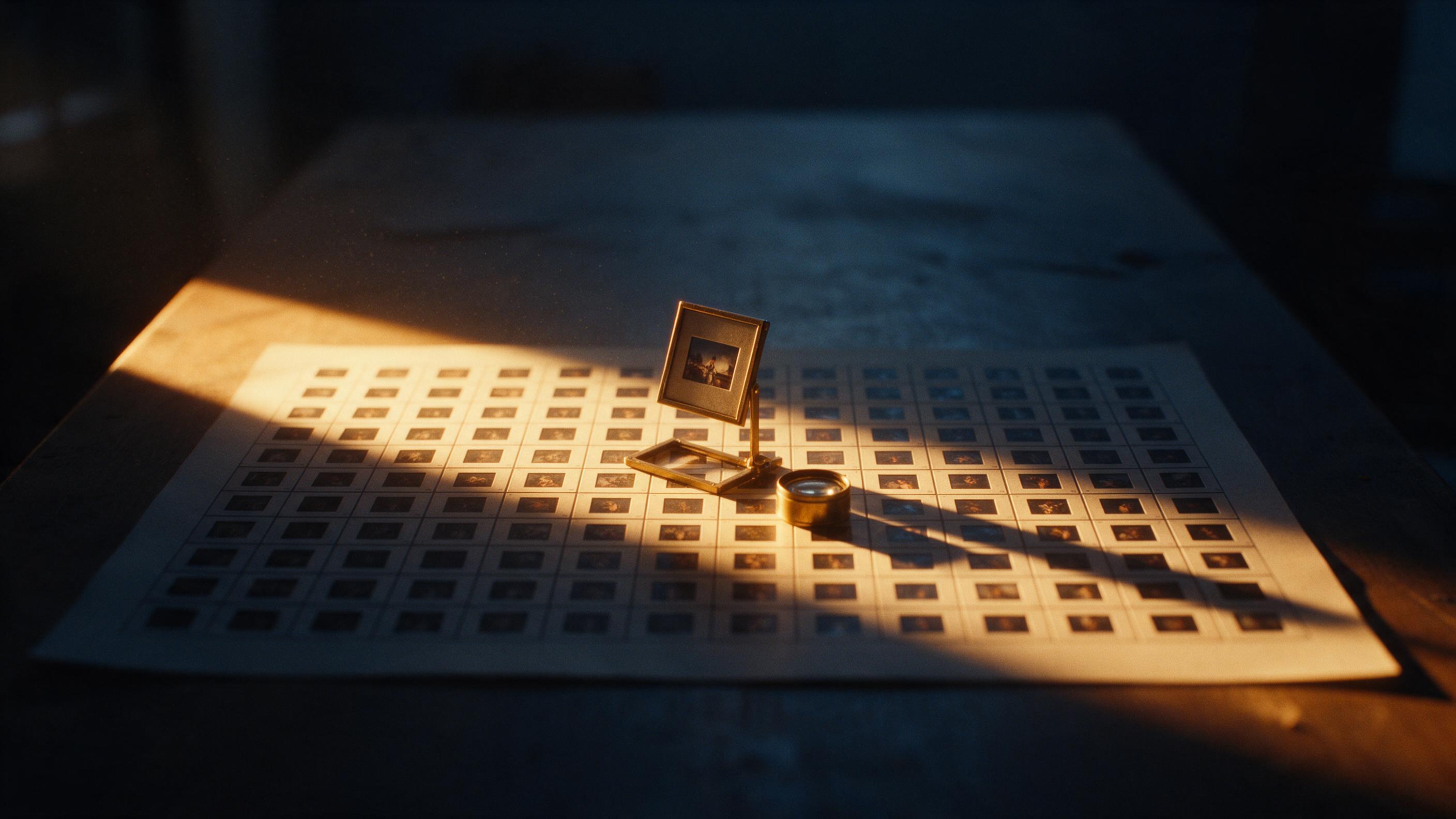
Start with 1 film in high resolution, 1 you actually want to look like. Not a moodboard, not a folder of stills pulled off a stock site. 1 film, 1080p or better, whose look, lighting and lens would be fine to live inside for the next 12 months. Then export about 400 frames from it. The full range, not the pretty ones. Close-ups, wide shots, lighting setups, moods, night exteriors, the flat interiors nobody would ever choose as a reference. 400 frames out of a 90 minute film is under 5 frames a minute, which is nothing. What it buys is everything. Fix them as much as you want. Crop, clean, rebalance, throw out the 60 that do not survive a second look. What you own at the end is a reference library with composition, colour and lens already baked in, and you did not pay a cinematographer for 1 frame of it.
Manipulate Beats Invent
Image to image beats generation from scratch. It is easier to change an image than to conjure one. This is the part people skip past. A generator asked for a shot starts from noise, so it has to invent the framing, the lens, the light and the palette in the same pass that it invents the subject. A re-master starts from a frame where 4 of those 5 things are already answered. So give it the frame. Whatever character, whatever lighting, feed the reference in and let the tool work on top of it. Every shot then arrives with the look already locked, and the only thing left to argue about is whether the moment is right. Same tool, 2 very different jobs. 1 is invention. The other is direction.
Three Things You Stop Paying For
Composition, colour and lens. 3 decisions, and a from-scratch generation pays for all 3 on every shot, whether the shot matters or not. They come free out of the 400 frames because they were decided on set, by people who were better at it than a prompt is. The library carries them. You carry the story. Now do the arithmetic on a 30 shot sequence. 30 generations from scratch is 30 chances for the colour to drift and 30 chances for the lens to change between cuts. 30 re-masters taken from 1 library is 1 look held across 30 shots, because the reference does not reset. That is also why the method is cheaper. Not cheaper per render. Cheaper per finished film, because the taste goes into story and performance instead of being spent re-inventing the same window light 30 times.
Four Layers, And Only One Is A Commodity
The stack has 4 layers and they are not equal. Story first. A full length narrative, the thing that decides whether any of the rest matters. Then performance and direction, the human layer and the only 1 that cannot be bought back later. Darker. Closer. Slower. That call is taste, and it is the whole reason to keep a person at the controls. Then the style library locked from the 400 frame export. Then rendering, the AI layer, sitting at the bottom as the commodity. The machine is the camera crew. Backgrounds are the solved layer. They are already good, already cheap, already everywhere, and nobody pays for them twice. The money sits 2 layers up. The taste, the references and the calls are the moat, and they move up the stack rather than away from it.
The AI is the brush. The reference is the skeleton.
Five Per Cent Is The Mouth
Acting is more than lip-sync. Lip-sync is the last and easiest 5 per cent, and it is the part everyone demos, because it is the part a model can be measured on. The other 95 per cent is what a character feels and what the light means while they feel it. A face that moves correctly tells the audience nothing. A face held 1 beat too long in the wrong light tells them the scene is over before the line arrives. That 95 per cent is a direction problem, not a rendering problem, which is why a better checkpoint never fixes it. A person watching the cut fixes it, with 4 words. No, darker, closer.
One Day Of Pipeline, And The Operator Directs Everything
The automation is 1 day of work. Frame extractor takes the film and pulls the 400 frames. Style pass normalises the library. Consistency check throws out the 60 that do not match. Then 1 prompt skill that takes a full story and renders it in the locked style. After that the whole thing runs as 1 command. Listen, tell this whole story. The style is already built in and the rendering is the machine's problem. Built companies across twelve countries. Restructured a industrial group. Deployed 210 energy systems across Africa and Asia. Took a company through a Frankfurt IPO. Entrade built 200 wood-gasification machines across the UK and Europe. 16 years of field work from rural Nigeria to Fukushima. 393 pages in paperback and Kindle, published 8 April 2026. Never generate a shot you can instead re-master. The probability that a shot generated from nothing matches a look locked by 400 references is close to 0. The probability that a re-mastered frame does is close to 1. Export the 400 frames, feed them as references, work image to image. The AI is the brush. The reference is the skeleton. The operator directs everything.
Never generate a shot you can instead re-master.
The map is dead. Nobody told you.
Bali State of Mind is the survival guide for the collapse of everything you were taught to believe.
Beyond this book
Building the same thing somewhere else.
Julien Uhlig is available for advisory work, board seats and media appearances. Write to media@exventure.co.
The academy that trains the operators, across every company in the group, is EX Epic Academy - 25,000 applications, 12 per cohort, 200+ alumni across 19 countries. academy.epicsolutiongroup.com
18-20 November. Online, Las Palmas, Bali.
Three days on what happens to work, capital and institutions when the map stops matching the ground. Seats are limited by cohort.
ex-aisummit.com →