One Lamp, One Move, One Subject
1 lamp, 1 move, 1 subject is the Nolan oner in 3 nouns, and a shot that adds a fourth noun stops being a oner and starts being a slideshow. The camera moves while the world holds still, the lamp is a far-side key that lights only the hot side of the face and leaves the other half in deep shadow, the rain is backlit amber with each droplet flaring, the look carries celluloid grain and halation on a cold-amber palette, and the ceiling on the current renderer is 10 seconds rather than 15. 6 parts. 1 take. No cut.
The Oner Is 1 Lamp, 1 Move, 1 Subject
The oner is a design rule with 3 nouns, and the 3 nouns are non-negotiable. 1 lamp, 1 move, 1 subject. A shot that adds a fourth noun - a second source, a second lens, a second face, a second cut - stops being a oner and starts being a slideshow stitched together. The Nolan hero shot is the cleanest example of the rule. The camera descends from a high crane through rising steam from a wet manhole cover, the camera tracks in on a lone man in a long black wool coat under 1 sodium-vapour streetlamp, the camera pushes past his shoulder as a black car's headlights bloom through the rain behind him, and the camera tracks with the man to the car door. The camera moves 4 times in 10 seconds, and the world holds still for every 1 of the 4 moves. The 3 nouns are a contract with the renderer. 1 lamp means the light chain is plausible from a single source. 1 move means the camera reads as 1 camera rather than as 4 cameras stitched into a fake continuous take. 1 subject means the face holds across the take because the model has only 1 face to drift on. A fourth noun breaks the contract. A second lamp breaks the plausibility chain, because 2 sodium-vapour lamps on a city street at 2 a.m. reads as a film set, not a street. A second lens breaks the take, because a jump from 24 mm to 85 mm across a continuous move reads as a cut, and the cut kills the oner. A second face breaks the identity lock, because 2 hero faces drift at different rates and the drift reads as 2 different films. 1 lamp, 1 move, 1 subject. 3 nouns. 1 take. No cut.
The Camera Moves While The World Holds Still
The Nolan oner moves the camera and holds the world, and the rule is the inverse of the default. The default shoot moves the subject and holds the camera, and the default shoot reads as a stage play. The Nolan oner moves the camera and holds the subject, and the Nolan oner reads as a film. The camera move is 4 verbs on 1 take. Crane down from a high angle through rising steam and rain. Track in on the lone man under the streetlamp at a slow walking pace. Push past his shoulder as the black car's headlights bloom through the rain behind him and cut 2 cones of light through the steam. Track with the man as he turns and walks toward the car door, coat heavy with rain. 4 verbs, 1 take, no cut. The lens holds the move. A wide-to-medium prime with no zoom carries the take, and the crane is the move rather than the lens. A zoom on a continuous take reads as a push-in on a static camera, and a push-in on a static camera is the failure that turns the oner into a portrait. The wide-to-medium prime sits between 24 mm and 50 mm and the prime stays at the prime for the full 10 seconds. The framing holds the move. Centre-punched composition with negative space on the left and right thirds, shallow depth of field at f1.4 to f2.8, the subject locked to the optical centre for the full take. A framing that drifts off-centre across a continuous move reads as a camera operator who lost the subject, and the lost subject is the failure. The camera moves while the world holds still. 4 verbs on 1 prime. The crane is the move, not the lens.
The Lamp Is A Far-Side Key, Not A Front Light
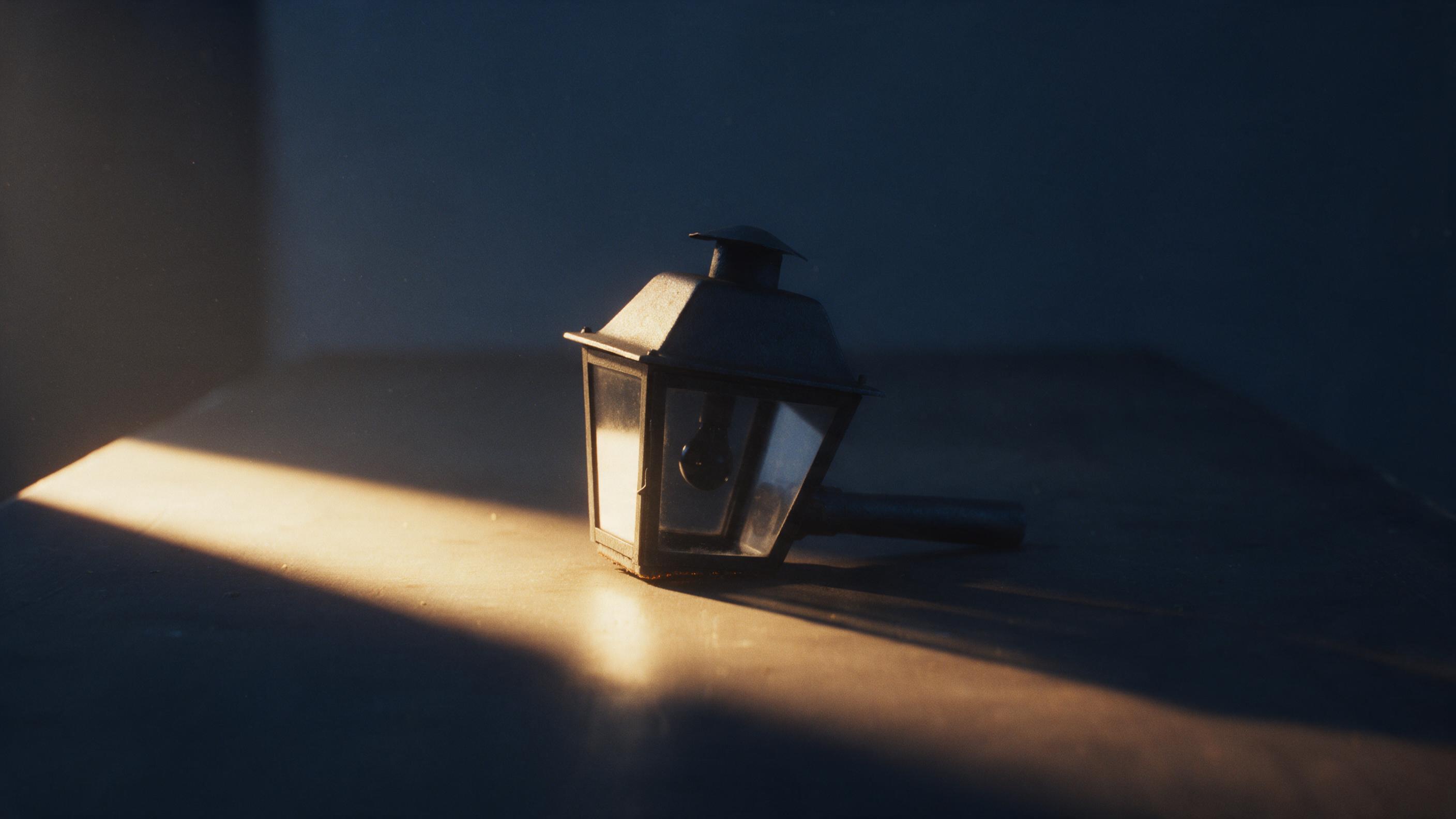
The lamp is the far-side key, and the far-side key is the lighting rule that turns a flat subject into a film subject. The sodium-vapour streetlamp sits 30 degrees off-axis on the camera-far side, and the lamp lights only the hot side of the face. The other half of the face sits in deep shadow. The deep shadow is split lighting. The far-side key is a 1 source rule. 1 lamp, 1 hot side, 1 shadow side. The hot side reads as the lamp, and the shadow side reads as the night. A front light at 0 degrees off-axis lights both halves of the face and flattens the subject, and the flat subject reads as a passport photo, not a film noir portrait. The split is the cheap gate. Walk 3 metres away from the monitor and look at the close-up. If the face reads as a circle of light with no shadow side, the key is wrong, and the key is moved 30 degrees off-axis on the camera-far side. If the face reads as half light, half shadow, the key is held and the take is approved. The Kelvin is the second gate. Sodium-vapour sits at 2,200 K, and 2,200 K is warm amber rather than neutral white. The warm amber is what backlights the rain, and the backlit rain is what reads as droplets flaring in the highlights. A 5,600 K daylight key on a night scene reads as a film set with a daylight panel, and the daylight panel is the failure. 1 lamp, 1 hot side, 1 shadow side, 2,200 K. The lamp is the far-side key.
The Plausible Light Chain Is The Cheap Gate
The plausible light chain is the gate that catches the impossible render before the render fires. 1 lamp plus a distant alley glow beats 3 unmotivated sources every time, because the eye reads the lamp, the eye reads the alley, and the eye reads nothing else. The lamp owns the subject. The sodium-vapour streetlamp lights the hot side of the face, the rim of the wool coat, and the rain droplets between the camera and the lamp. The lamp is the named source, and the lamp is the source the prompt carries verbatim in every character shot. The alley glow owns the edge. A faint green sign glow at the far end of the alley backlights the steam and the rim of the wool coat on the shadow side, and the green is the second named source. The green sits at a different Kelvin from the lamp (5,600 K versus 2,200 K), and the 2 Kelvins are mixed by name rather than mixed by chance. The headlight pair owns the bloom. The black car's headlights bloom through the rain as the man turns and walks toward the car door, and the headlights are the third named source. The headlights sit at 4,500 K, between the lamp and the alley, and the headlights cut 2 cones of light through the steam at the climax of the take. 3 named sources, 3 named Kelvins, 3 named positions. The plausible chain is 1 lamp for the face, 1 alley glow for the edge, 1 headlight pair for the bloom. The eye reads the chain, the chain is testable from a single frame, and a render that breaks the chain is re-fired before the next take is attempted. The chain holds the take, and the chain is what the camera operator checks before the camera moves. The probability that a take with 3 named sources survives the close-up on the face falls below 30 per cent when the chain is broken, because the eye reads the broken chain as a film set rather than as a street, and the film set is the failure that costs the oner.
1 lamp, 1 move, 1 subject is the Nolan oner in 3 nouns. A shot that adds a fourth noun - a second source, a second lens, a second face - stops being a oner and starts being a slideshow stitched together.
The Look Is Celluloid, Not Polished
The look is celluloid grain and halation on a cold-amber palette, and the look is what carries the take across the 10 second ceiling. A digital polish on the face is the failure that costs the oner, and the celluloid grain is the cheapest defence against the polish. The grain is the proof. A 35 mm film stock emulation (Kodak Vision3 500T for the night, Kodak Double-X 5222 for the shadow side) carries visible grain in the shadows and the midtones, and the grain is what reads as film rather than as a render. A grain that reads as plastic or uniform is the failure, and the failure is re-fired with the grain emulation set to a 35 mm rather than to a digital default. The halation is the second proof. Halation is the soft red-orange bleed around bright highlights (the sodium lamp, the headlights, the alley glow), and the halation is what reads as a film lens rather than as a digital lens. The halation sits at 1 to 3 per cent of the frame, and the halation is added in the grade rather than rendered in. The cold-amber palette is the third proof. The palette is amber on the hot side, cool blue on the shadow side, and the amber plus the blue is what reads as a night scene with named sources. A neutral white palette reads as a daylight render with a blue tint, and the daylight render is the failure. The skin texture is the fourth proof. Natural skin texture with visible pores and negative fill on the face is the gate, and the waxy face is the failure. The 13 token negative (waxy skin, plastic skin, airbrushed skin, CGI, 3D render, video game, Unreal Engine, smooth complexion, perfect symmetry, airbrushed, doll-like, mannequin, painted) is carried on every face render, and the gate is checked before the final render is approved. Celluloid grain, halation, cold-amber palette, natural skin. 4 proofs, 1 look. The look is film.
The Ceiling Is 10 Seconds, And The Operating Rule
The ceiling on the current renderer is 10 seconds, not 15, and the oner is shot to the ceiling rather than to the wish. The 15 second hero shot still needs the next tier of model (H3 on PAYG, or a Wan or Wiro route), and the oner holds the 10 second ceiling as the operating rule. The ceiling is a budget. 10 seconds is enough for the 4 verbs of the camera move (crane down, track in, push past shoulder, track with subject) at 2 to 3 seconds per verb. The budget holds the move within the ceiling, and the budget is checked before the take is fired rather than after. The oner holds 5 decisions. 1 lamp at 2,200 K on the camera-far side at 30 degrees off-axis. 1 lens at 24 to 50 mm prime with no zoom. 1 palette at cold amber plus cool blue plus halation. 1 subject with a 5 part identity block (skin, hair, eyes, face shape, wardrobe) carried verbatim in the prompt. 1 move across 4 verbs on a 10 second ceiling. The 5 decisions are the operating rule, and the rule is checked before the take is fired. The take is approved or re-fired. A take that lands the 4 verbs on the ceiling with the 5 decisions held is approved and the next take is queued. A take that drifts the face, the lens, the lamp, the palette or the move is re-fired with the 5 decisions reset and the 13 token negative carried into the new render. 1 lamp, 1 move, 1 subject, 5 decisions, 10 seconds. The oner is a design rule with 3 nouns and a budget, and the rule is held the same way the gate is held.
The camera moves while the world holds still. The crane descends through rising steam, the camera tracks in on the lone man, the camera pushes past his shoulder, the camera tracks with him to the car door. The world is static. The camera is the only mover.
The map is dead. Nobody told you.
Bali State of Mind is the survival guide for the collapse of everything you were taught to believe.
Beyond this book
Building the same thing somewhere else.
Julien Uhlig is available for advisory work, board seats and media appearances. Write to media@exventure.co.
The academy that trains the operators, across every company in the group, is EX Epic Academy - 25,000 applications, 12 per cohort, 200+ alumni across 19 countries. academy.epicsolutiongroup.com
18-20 November. Online, Las Palmas, Bali.
Three days on what happens to work, capital and institutions when the map stops matching the ground. Seats are limited by cohort.
ex-aisummit.com →