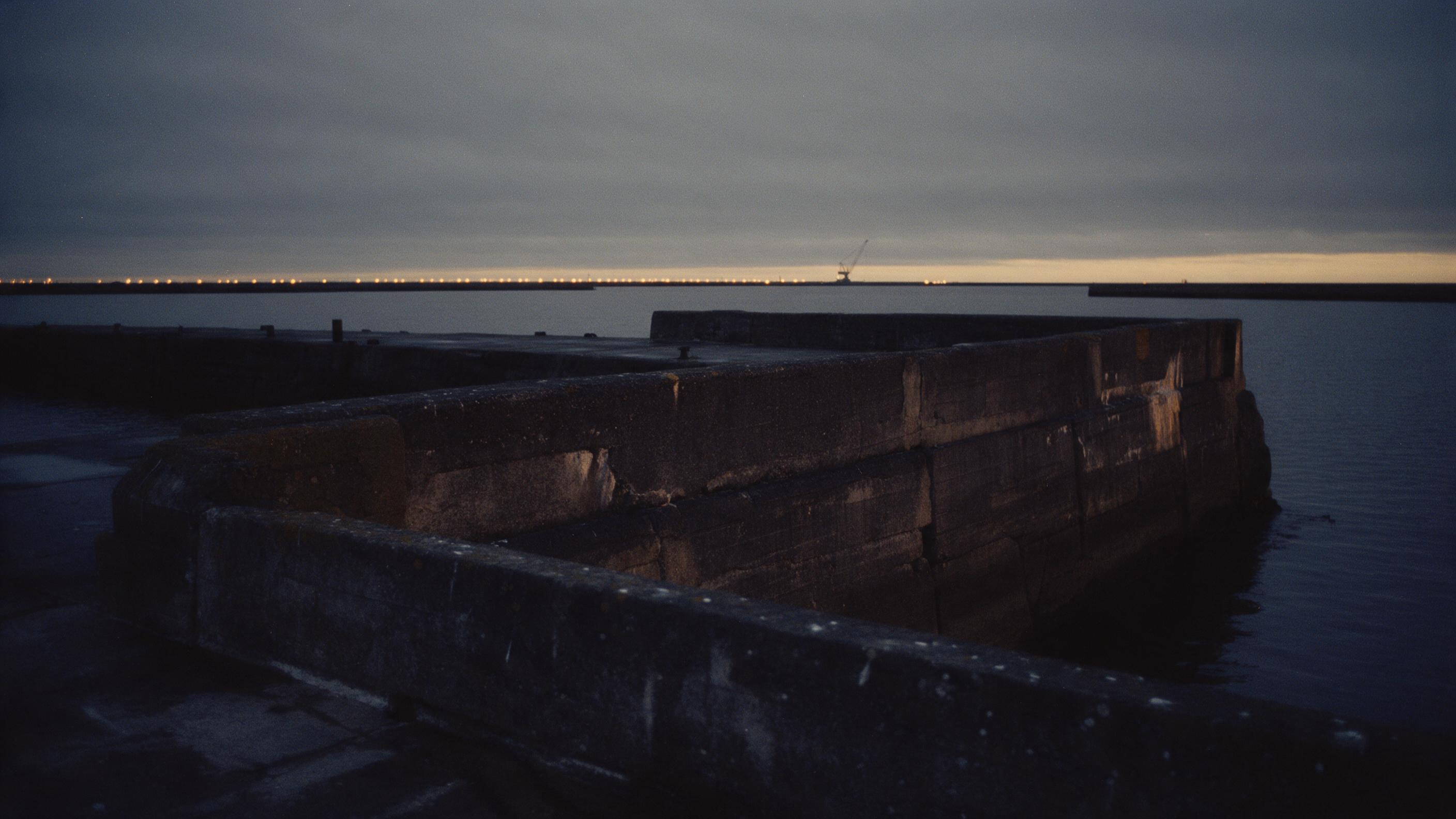
The Levees Were Assured To Hold
1989, Rostock. An old woman took hold of my arm to tell me something and the sound broke in the middle of it. I was 13 and I had nothing to offer her. No explanation, no framework, no useful fact. I have thought about that grip for 37 years. Here is why I think we are walking into the same night, and what actually holds when the ground you priced as permanent turns out not to be.
Rostock, 1989: The Grip On My Arm
Rostock, 1989. I was 13 years old, standing in a crowd, when an old woman took hold of my arm. She was in her 70s. Her entire life had been organised inside one reality. One border. One newspaper. One price list. One set of things you were allowed to say out loud. 40 years of it. Then, over a few months, the reality stopped being true. She could not finish her sentence. She started telling me something and the sound broke in the middle of it. Not crying exactly. Something underneath crying. And I stood there holding her arm, 13 years old, with nothing to offer. No explanation. No framework. No useful fact. Because there was nothing to explain. Her world had broken. That is not a problem that needs a solution. It is a fact that needs a witness. I have thought about that woman for 37 years. I am thinking about her now, at 49, because I think we are walking into the same night. Not one city. Everyone. The moment the certainties people built their whole lives around stop being certain, while the institutions that were supposed to warn them are still in committee. I want to show you what that night looks like from the inside, and what actually holds when it arrives.
In Awe, In Distance
My forefathers looked at nature the way we are about to look at AI. In awe. In distance. Accepting that knowledge does not grasp reality. A pre-industrial farmer looked at a hurricane and did not know what it was. No pressure systems. No radar. No forecast. He knew one thing: something far more powerful than him was here, he was small in front of it, and he had better build his life accordingly. That is not ignorance. That is an accurate reading of his own position. In 1755 an earthquake, a tsunami and fire took Lisbon in a single morning. Tens of thousands dead on a Sunday. Europe did not respond with engineering. It responded with theology, because there was no vocabulary for a force that size. Then we got clever. We industrialised. We built weather services and dams and levees. We put satellites in orbit and models on computers and we got genuinely good at predicting storms. We built cities below sea level and promised ourselves the water would be handled. We changed the climate itself and took 50 years to admit it. Somewhere in there we decided we had mastered nature. Nature had not been informed. You can understand the mechanics of a force and still be powerless before it. That sentence is the whole book. We understand storms now at a level our forefathers could not imagine, and a storm still takes a city apart in a weekend, and there is not one thing our understanding can do about it except move people out of the way. That is where we are with AI. We built it. We can point at the training data, the parameters, the maths. And we cannot say what it becomes, cannot hold what it does, cannot master it the way we assumed we master everything.
The Levees Were Assured To Hold
The levees were assured to hold. That was the phrase the engineers used. Assured. In 2005, Hurricane Katrina came ashore. The Army Corps of Engineers had a system that was supposed to protect New Orleans from a storm that size. Within 72 hours, 80% of the city was under water. The Superdome, a stadium built to hold 70,000 people for a football game, held 20,000 people with no power and no water. 1,800 people died in the Gulf. People drowned in their own attics. The richest country in human history could not deliver water to a city 100 miles from its own coast in under a week. That was weather. Not invasion. Not war. Weather. 2017. Hurricane Maria crossed Puerto Rico and knocked out power to 3.4 million US citizens. The power stayed out for close to a year in places. The official death count settled near 3,000, and it took 11 months of argument to get there. An island of Americans, hit by wind, left dark for a year. That is the output of the most capable civilisation that has ever existed, faced with a force it could model perfectly and could not stop. And the honest response afterwards was the old one. In awe. In distance. You can have every model and every satellite and still not control what happens when nature decides to move. You can plan. You can prepare. You can position yourself inside it. You cannot dominate it. You can only respect it, adapt, and hope. AI is the same kind of force. It is not a tool with a manual. It is a thing that is moving on its own logic now, faster than our ability to read it. That is not pessimism. That is the position report.
The Pattern: Pricing Permanence
There is a pattern I have watched repeat three times in one lifetime. People price something at permanent, build an entire life on the price, and break when the price is corrected. East Germany was permanent. The Wall went up in 1961 and stood 28 years. People made careers inside it. Raised children inside it. Planned 30 years ahead inside it. Nobody alive could remember anything else, so the assumption was never tested. In 1989 it was tested in a weekend. The border guards simply stopped. The Wall was a fact on Friday and scrap metal by the following spring, and everyone who had organised their life around it had to reorganise their life in real time, with no rehearsal. The economy was permanent. Interest rates moved slowly, property went up, currencies held. You could sign a 30-year mortgage and believe you understood the probabilities. Then 2008 arrived. I know that year from inside it: the blackout in 2003 in the Lehman building, then five years later a EUR 20 million personal guarantee, and a company that folded on Christmas Day 2008. I lost savings in the 2013 Cyprus bail-in as well, when a bank account stopped being a bank account overnight. None of that was unpredictable in hindsight. All of it was priced as permanent beforehand. A career was permanent. You chose a skill, got good at it, and the skill paid for 40 years. An engineer stayed an engineer. A lawyer stayed a lawyer. The skill was the identity. Now a specialism that took a decade to build can be commoditised in 18 months. Same mistake, three times. Not a failure of intelligence. A failure of pricing. We keep attaching a permanent value to a temporary condition, and we do it because the temporary condition has always held so far. A note on the fear, because people misread mine. The thing that frightens me is not a specific problem. I know how to handle a specific problem. I have been at zero more than once. What frightens me is uncertainty at the moment the technology moves faster than the system can process it. If you are not worried, you are either positioned in a way I do not understand, or you have priced the probability at zero. I do not think either of us can afford that second one.
Her world had broken. That is not a problem that needs a solution. It is a fact that needs a witness.
What Is Actually Yours
So here is what is actually yours, in the only sense that survives a repricing. Not a skill. There are no AI-resistant skills. If a piece of work is rule-based, complex, taught and examinable, it will eventually be done better by a machine that never sleeps and costs nothing per unit. That is arithmetic, not opinion. What remains is the part of you that was never rational to begin with. Trust. Presence. The fact that other humans want to work with you specifically. That is not a certificate. It is built out of decades of showing up when it was inconvenient, keeping commitments nobody was checking, and caring about another person's trajectory as much as your own. I have 220 interns a year passing through. They arrive holding a map that was already wrong when it was handed to them. They want to know what to learn. The honest answer is: learn to be someone people trust, and learn to price a probability instead of a prediction. That is the whole curriculum. The proof that this compounds is physical. 210 energy systems standing where there were none, across Africa and Asia. Companies built in 12 countries. A EUR 75 million industrial group restructured, which does not happen because a genius arrives by helicopter, it happens because hundreds of people decide the person next to them is worth carrying a corner for. I am 49. I turn 50 in June 2026. The book came out on 8 April 2026, 393 pages, and it exists for exactly one reason: so that the people walking into this transition are not walking in blind, pricing permanence, alone. Never work against the trend. Never be inside a depression or a recession if you can position outside it. Reduce your dependencies, because less debt buys more options and cheaper living buys more freedom. Build the kind of community where people actually turn up. Do the hard thing early, at 25 instead of 45. Go straight at the work instead of preparing to start, because planning paralysis is more expensive than any mistake you will make. And stay alive, stay healthy, stay flexible. Everything else is built on that floor.
Hold Their Arm
I cannot tell you it will be fine. I do not know that. I am afraid of what is coming, and I am building for the probability that what comes is better than what we have. Both sentences are true in me at the same time, and I have stopped trying to resolve them. The old woman in Rostock did not need me to explain the Cold War. She did not need geopolitics. She needed a 13-year-old boy to stand there and let her break without leaving. Presence. That her world had ended and someone was still standing in it with her. That is what I can offer my own children about the transition. Not a forecast. Not a hedge. Not a guarantee. To be the person standing in the room when the certainty goes, with nothing to explain and nowhere to be. The system will not tell you when to jump. It moves forward until it hits a wall. See the wall, position before the crash, keep moving while you are still frightened, and when somebody else's world comes apart in front of you, do the only thing that has ever worked. Hold their arm. Stay awake. Build toward the probability.
You can understand the mechanics of a force and still be powerless before it.
The map is dead. Nobody told you.
Bali State of Mind is the survival guide for the collapse of everything you were taught to believe.
Beyond this book
Building the same thing somewhere else.
Julien Uhlig is available for advisory work, board seats and media appearances. Write to media@exventure.co.
The academy that trains the operators, across every company in the group, is EX Epic Academy - 25,000 applications, 25 seats per cohort, 210 alumni across 19 countries. academy.epicsolutiongroup.com
18-20 November. Online, Las Palmas, Bali.
Three days on what happens to work, capital and institutions when the map stops matching the ground. Seats are limited by cohort.
ex-aisummit.com →