Four Thousand Sensors On One Body
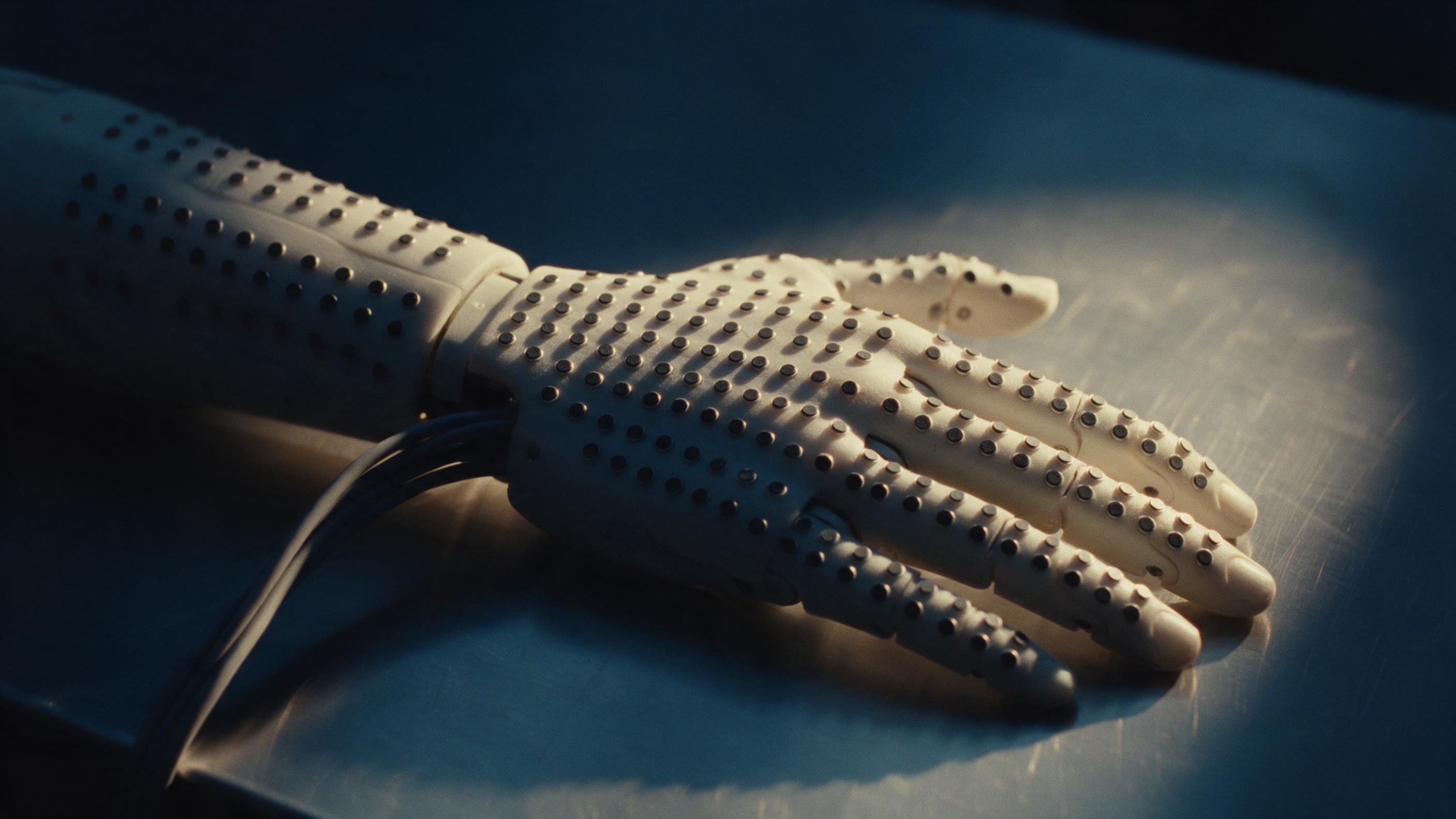
The first large-area flexible electronic skin was an 8 by 8 array, sixty-four points of touch. Seventeen years later the same lineage reached 256 by 256, sixty-five thousand. Coverage has been solved. The iCub humanoid wears roughly four thousand sensors across a child-sized body, and the part of the problem that is still open is not the one the datasheets describe.
Sixty-Four Points Of Touch
The density number is the one worth tracking, because it is the only figure in this field that compounds.\\n\\nThe first large-area flexible electronic skin arrived in 2003 as an 8 by 8 pixel array. Sixty-four points of contact, read once, on a surface that could bend. By 2020 the same lineage had produced a 256 by 256 active-matrix pressure sensor on a flexible substrate: 65,536 taxels, a thousand-fold increase in seventeen years. A pitch of one millimetre, a frame rate of 100 hertz, demonstrated on a robot hand.\\n\\nThat curve is faster than the sensor literature admits, and it is not an accident of one laboratory. The arrays are built on thin-film transistor backplanes borrowed wholesale from the display industry, which spent two decades learning to deposit transistors on plastic. A 16 by 16 array on amorphous silicon reads at 2 millimetre pitch and a kilohertz. An IGZO 32 by 32 runs at 1 millimetre and 500 hertz. An IGZO 100 by 100 reaches half a millimetre and 100 hertz. The infrastructure was already paid for.\\n\\nSixty-four to sixty-five thousand is the headline. The reason it happened is less romantic: somebody else's manufacturing problem had already been solved, and the skin inherited it.
Two Wires Per Row And A Ghost
A direct-wired array needs one conductor per sensor. A matrix needs two per row and column: N squared taxels become 2N wires. That is the trick that made large arrays possible, and it comes with a bill.\\n\\nThe bill is time. A passive matrix reads one row at a time, so every taxel is sampled for a fixed settling window, and the frame rate falls as the array grows. An 8 by 8 array at 100 microseconds per row scans at roughly 1,500 hertz, which catches almost every manipulation event. A 32 by 32 array lands near 100 hertz and starts missing fast slip onset. A 64 by 64 array sits at about 25 hertz. A 100 by 100 array manages 10 hertz, which is enough for static pressure and nothing else. Every taxel added buys resolution and spends speed.\\n\\nThe bill is also signal. Current does not respect the addressing scheme, so it sneaks through neighbouring paths and a single touch appears at its true position and again in the mirror position. That ghosting turns severe past 16 by 16 in resistive arrays and past 50 by 50 in capacitive ones, and signal-to-noise falls as one over the root of the taxel count, crossing below 10 decibels past 50 taxels on a column.\\n\\nThe published fix is a transistor at every taxel, which isolates the node and eliminates crosstalk outright. It costs a thin-film transistor on a substrate that cannot take the heat: process temperature caps near 300 degrees, threshold voltage varies by 30 per cent across a flexible panel, and mechanical strain shifts that threshold by 0.1 to 1 volt. You can have the density, and then you spend the density on calibration.
Four Thousand Sensors On A Child-Sized Body
The most sensorized robot platform in existence is not a hand. It is a whole child-sized humanoid.\\n\\nThe iCub carries roughly 4,000 tactile sensors distributed across its body, the product of an EU-wide collaboration spanning Genoa, the Italian Institute of Technology and CNRS. A separate programme, ROBOSKIN, ran from 2019 to 2024 on whole-body electronic skin for humanoids. Between them they answered the coverage question on a human-scale body, at human-ish scale, more than five years ago.\\n\\nThe group map behind that work is broader than any single number. Boston University works on fibre-optic tactile sensing for surgical robots, where the sensor has to be small, disposable and optically read. Glasgow prints tactile electronics and pairs them with machine learning. Genoa supplies both the capacitive skin and the algorithms for reading large arrays. Sorbonne works on the fundamentals of fingertip mechanics and tactile illusions, which is the part that explains why a hand is not a camera. Elsewhere there is haptic rendering for social interaction, stretchable liquid metal with variable stiffness, ultrathin breathable skin for prosthetics, and self-powered piezoelectric surfaces that harvest the energy of their own contact.\\n\\nFour thousand sensors on one body is not a demonstration of sensing. It is a demonstration of distribution, and distribution is the problem nobody photographs.
The Wire Is The Wall
Compare the two bodies directly and the gap stops being about sensitivity.\\n\\nA human hand holds about 17,000 mechanoreceptors and routes roughly 38,000 nerve fibres across the wrist through 15 to 20 joint crossings, at a failure rate on flex of zero. A typical robot hand in 2020 carried 10 to 50 taxels, moved about 10 kilobits per second and ran 10 to 100 wires. The advanced research hand of 2025 carries 100 to 500 taxels, up to 1,000 in the best cases, moves 1 to 10 megabits per second, and still fails on 1 to 5 per cent of a million flex cycles.\\n\\nThe mechanical arithmetic is the part that kills projects. 300 shielded wires crossing a wrist weigh 30 to 100 grams, and that mass sits at the end of a moving limb where inertia costs the most. The bundle is stiffer than the skin it feeds, so the wiring changes the contact mechanics it was installed to measure. Adjacent wires carry high-frequency signals and couple into each other. And the connector between a moving skin and stationary readout is the single most failure-prone point in the system.\\n\\nThe efficiency metric is bits per wire per second. A passive matrix delivers about 1 to 10. An active matrix delivers 100 to 1,000. An event-driven architecture, which transmits only when a reading changes, reaches 10,000 to a million under the sparse contact conditions that dominate real manipulation. That ratio, not the taxel count, is what tells you whether an architecture will scale.
Sixty-four points of touch in 2003. Sixty-five thousand by 2020. Coverage was never the hard part.
The Bottleneck Moved And Left The Sensors Behind
The constraint has migrated twice, and both moves are legible in retrospect.\\n\\nFrom 2000 to 2015 the limiting factor was the transducer: low sensitivity, high drift, and better materials as the answer. From 2015 to 2022 the limit was interconnect: too few taxels and a data rate to match, answered with matrix arrays and active backplanes. From 2022 the limit is interpretation. The visible evidence is that optical tactile sensors now produce over 100,000 effective taxels per fingertip and active-matrix skins reach past 10,000, while the algorithms that read them are still being fitted task by task.\\n\\nThe structural reason is a missing dataset. Computer vision has ImageNet, natural language processing has web-scale corpora, and tactile machine learning has a largest public dataset in the region of 100,000 samples against 10 to 100 million for vision. There is no shared benchmark. There is no cross-sensor transfer: a model trained on one optical sensor does not run on a capacitive array, because the two do not produce the same kind of number.\\n\\nSo the field has a thousand-fold density gain and no shared way to turn it into meaning. A body that can feel almost everything and understand very little is not a sensing problem. It is a reading problem, and reading problems do not get solved by adding sensors.
What The Density Record Actually Buys
The honest reading of the past two decades is that coverage is finished and comprehension is not.\\n\\nIf a team is choosing where to spend its engineering budget, the density number is the wrong place to look. The arrays are already dense. The backplanes already exist, borrowed from displays. What is unbuilt is the read path: event-driven front ends, local processing, and representations that survive a change of sensor. The probability that a whole-body skin works in practice is set far less by the transducer a team selects than by whether it solves the wiring and the reading before it solves the sensitivity.\\n\\nThe pattern generalises past touch. A capability curve climbs, somebody declares the problem solved, and the constraint quietly relocates to the layer nobody was measuring. The published record here is unusually clear: 64 taxels in 2003, 65,536 in 2020, 4,000 sensors on a humanoid body, and a largest public dataset of about 100,000 samples. One of those four numbers is two orders of magnitude behind the others, and it is the one that decides what the machine can actually do.\\n\\nThe sensor got a thousand times better. The meaning did not move at all.
Every taxel you add is one more wire that has to cross a joint that flexes a million times.
The map is dead. Nobody told you.
Bali State of Mind is the survival guide for the collapse of everything you were taught to believe.
Beyond this book
Building the same thing somewhere else.
Julien Uhlig is available for advisory work, board seats and media appearances. Write to media@exventure.co.
The academy that trains the operators, across every company in the group, is EX Epic Academy - 25,000 applications, 25 seats per cohort, 210 alumni across 19 countries. academy.epicsolutiongroup.com
18-20 November. Online, Las Palmas, Bali.
Three days on what happens to work, capital and institutions when the map stops matching the ground. Seats are limited by cohort.
ex-aisummit.com →