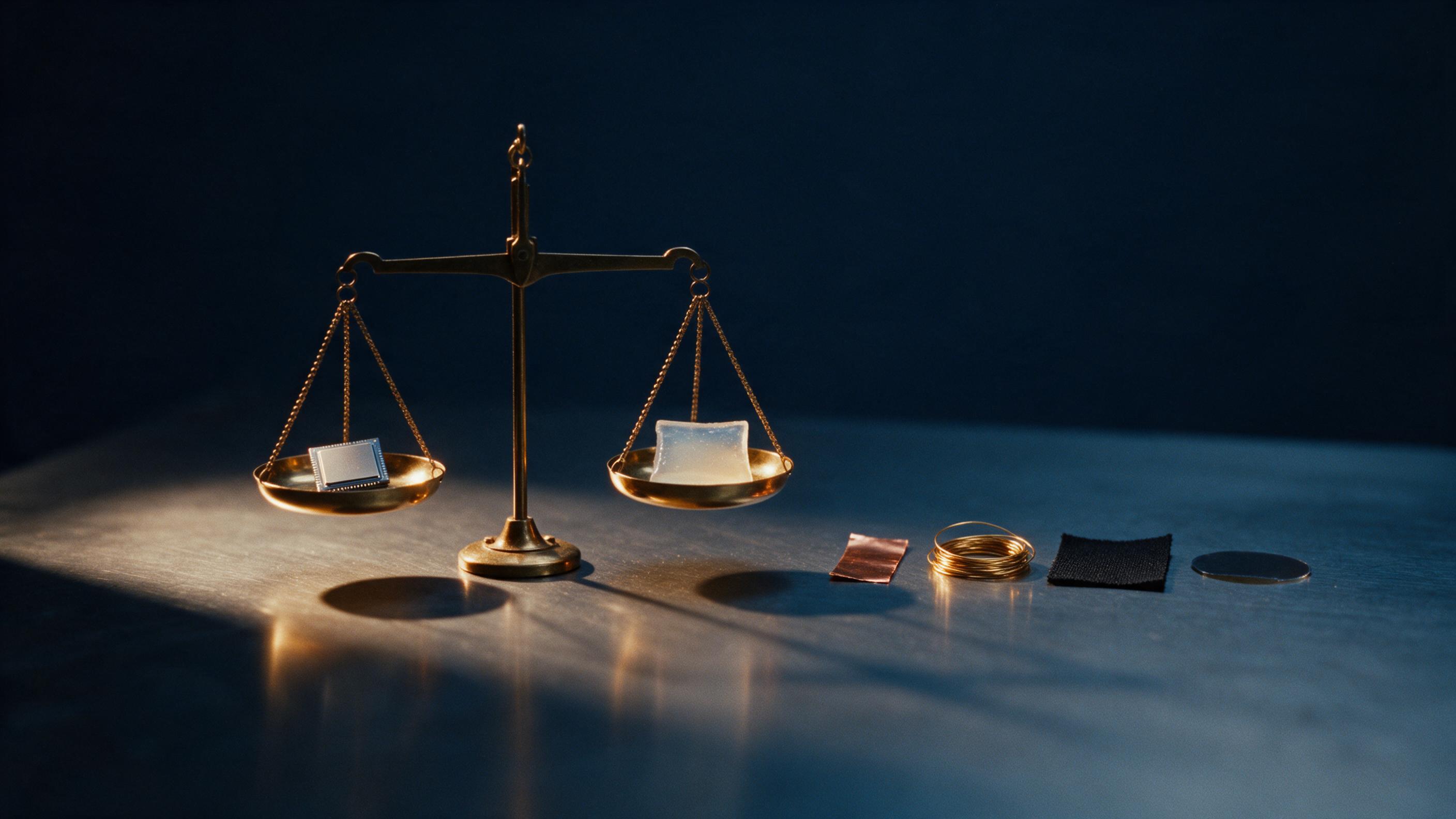
Every Sensor Is A Bargain
There is no best transducer for artificial touch. There are seven, and every one of them is a trade. Two splits decide almost everything: static against dynamic, which mirrors biology's slowly adapting and rapidly adapting receptors, and electrical against optical, which is a bet about where the hard problem lives. Read the datasheet and one number stands out. Name the bargain first and the same number tells you what you gave away.
The Question The Datasheet Cannot Answer
Every artificial skin needs a transducer, the part that turns contact into a signal. Ask which one is best and the honest answer is that the question has seven answers and no winner. The seven modalities do not compete on one axis. They compete on six at once: sensitivity, spatial resolution, bandwidth, drift, durability and cost. Each mechanism sits at a different point in that space, and moving toward one corner moves you away from another. One optical part alone returns more than 100,000 effective taxels from a single fingertip, with a force range from 0.01 to 20 newtons. A capacitive array covers the same fingertip at a taxel pitch of 0.5 to 5 millimetres. Those are not the same device described twice. This is the single most useful piece of literacy in the field, and it is the one most often missing in a procurement conversation. A supplier quotes sensitivity. The question that decides the deployment is which corner was traded away to get it, and whether that corner is the one your application stands in.
Static And Dynamic Is The First Split
The deepest division is not between materials. It is between what a sensor can measure at all. Biological skin answers this with four channels. Merkel cells and Ruffini endings hold a sustained pressure, so they report how hard you are gripping. Meissner corpuscles and Pacinian corpuscles report change and nothing else, tuned to texture and the 5 to 50 hertz band that carries the vibration before a dropped object. Engineered skins split the same way. Piezoresistive, capacitive, magnetic and optical parts hold a load. Piezoelectric and triboelectric parts measure change, and under a constant load their output decays to zero. The materials price the same way: PVDF sits at minus 33 picocoulombs per newton and PZT ceramic runs from 200 to 600, four times the signal and rigid enough to crack. Neither family covers the other's job. A static-only skin never notices the slip starting. A dynamic-only skin never knows how hard it is holding. So the best skins, like the best hands, run both at once: a sustained-pressure channel fused with a vibration channel. That fusion is not a refinement added at the end. It is the minimum specification.
The Second Split Is Where The Hard Problem Lives
The other fork is electrical against optical, and it is a wager about which part of the problem is cheaper to solve. An electrical array puts a sensing element at every taxel and reads resistance, capacitance, voltage or magnetic field. That means wires at a pitch of 1 to 5 millimetres, crosstalk between adjacent channels, and drift as soft materials creep. An active-matrix version of that array has passed 10,000 taxels. It covers a whole body, and the price is the wiring. An optical skin shares one camera behind one deformable medium. Markers move, the camera sees the movement, and effective resolution lands at 10 to 50 micrometres, far finer than any taxel grid. The trade is one camera cable instead of 10,000 wires. The price is bulk, a focal distance, a 30 to 60 hertz camera-limited bandwidth and a rigid lens that does not extend past a fingertip. That trade is the reason dexterous manipulation research moved so fast toward camera-based fingertips. It converts the hardest problem in tactile sensing, distributed signal interpretation, into one that computer vision solved years ago. The wager is that a rigid camera and a lump of gel are cheaper than 10,000 wires.
What The Bargain Actually Costs
Six charges appear on every one of these invoices, and they are worth naming before any number on a datasheet. Wiring comes first. One conductor per taxel is the clean case, and a matrix that turns 100 wires into 10 introduces crosstalk between neighbours. Readout circuitry comes second: some transducers need an amplifier, a filter and a converter on every channel, and that bill is paid in board area and power. Drift comes third. Soft materials creep, hysteresis accumulates, and a sensor calibrated in March is lying by September. 90 days is a generous estimate of that window, and the published specs rarely name it. The environment comes fourth, because humidity, temperature, abrasion and chemical exposure each remove a family of mechanisms from consideration. Durability comes fifth. The sixth charge is the one that decides deployments. If recalibration needs a laboratory, the sensor does not go into a field. It goes into a case, and the case goes into a cupboard.
No single mechanism covers both regimes well, and neither does a hand.
Six Questions Before Any Number
Run the same six questions against any transducer and the bargain surfaces in under 60 seconds. Is it static-capable or dynamic-only, and if it is dynamic-only, what is the complementary part doing the other half? What is the wiring cost per taxel, and does the matrix that reduces it create a crosstalk problem on the channel counts you need? Does it drift, and over what period? Then: can it survive the environment, what does the readout cost per channel, and can it be recalibrated where it is installed rather than where it was built? That is the whole literacy test. A sensitivity figure without those six answers is a claim about a laboratory, not about a product. And the reason this matters beyond engineering is that the same structure runs through almost every technical decision: the headline number is real, and it is never the whole specification.
What The Best Skins Do
The pattern at the top of the field is turning into a shape: camera-based fingertips for dexterity, a capacitive palm for sustained pressure, piezoelectric vibration sensing at the wrist to catch what the palm misses, and a materials stack chosen for the strain each part will actually see. That is a hybrid, and it is a hybrid because biology is one. Four channels, four jobs, no single mechanism asked to do all of them. The probability that one modality covers a whole hand well is not zero. It is small, and most of the field prices it as though it were large, which is why so many designs restart from a single sensing principle every 18 months. The comparison surveys have been running since 2010 and again in 2023, and the bargains have not collapsed into each other. Seven modalities, six axes, one question asked in the right order. Name the bargain first, because every number on the sheet is the price of the bargain you did not take.
One number, one price. The price is the bargain you did not take.
The map is dead. Nobody told you.
Bali State of Mind is the survival guide for the collapse of everything you were taught to believe.
Beyond this book
Building the same thing somewhere else.
Julien Uhlig is available for advisory work, board seats and media appearances. Write to media@exventure.co.
The academy that trains the operators, across every company in the group, is EX Epic Academy - 25,000 applications, 12 per cohort, 200+ alumni across 19 countries. academy.epicsolutiongroup.com
18-20 November. Online, Las Palmas, Bali.
Three days on what happens to work, capital and institutions when the map stops matching the ground. Seats are limited by cohort.
ex-aisummit.com →