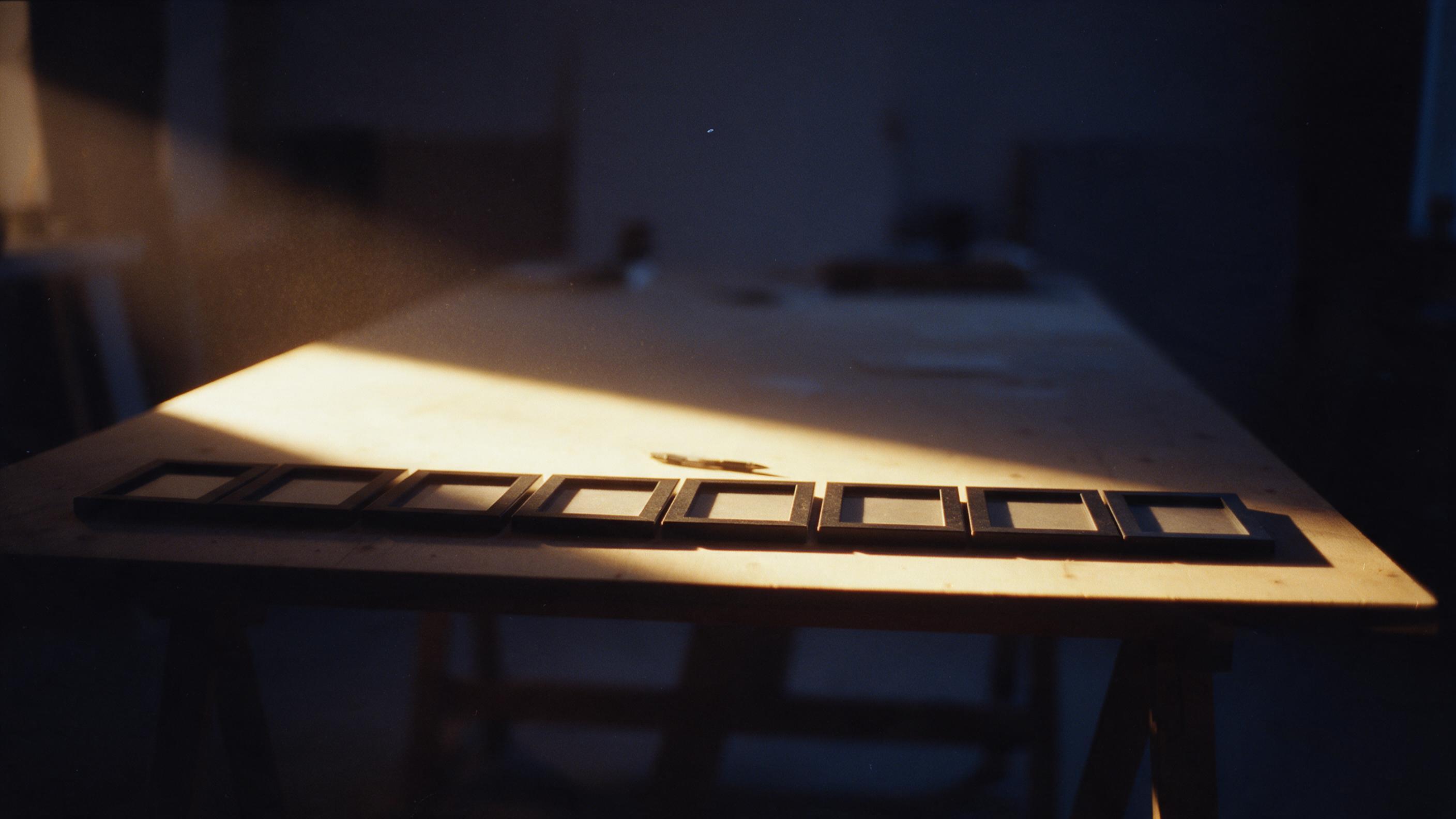
Every Bracket Is A Decision
The production tool is 8 stages with a gate between each 1. Nothing reaches the timeline until the gate is green. That 1 rule is the difference between a film made in order and a folder of 40 good clips.
8 Stages, 7 Gates, 3 Rules
Most advice about making a film with a model is about taste. The production tool is about sequence, and sequence is the part that can be checked. It runs 8 stages. Stage 0, the song. Stage 1, story, characters and the anticipation arc. Stage 2, the shot list, image by image. Stage 3, render every still. Stage 4, the benchmark gate. Stage 5, animate. Stage 6, grade. Stage 7, cut. 7 gates sit between them, and a gate is not a review. It is a refusal. The next stage does not open until this 1 is green, which means a weak link cannot travel downstream disguised as progress. 3 rules hold the whole thing up. Always start with a song, because the lyrics drive the story and with no song there is no film. Stills first and gate hard, because a broken still becomes a broken video and the still is the fix. Wan for every normal shot and Wiro for the nude and sexual scenes, because 1 renderer cannot do both jobs without lying about 1 of them. The reason a pipeline beats a folder of clips is arithmetic. If each of 7 stages is 90 percent right and nothing is checked, the finished film lands at about 48 percent, because 0.9 raised to the 7th power is 0.478. Stop the 10 percent that failed at every gate and all 7 stages are 90 percent right at the end instead. The gate is the only place that difference gets made, and it costs 1 look per still. The order is not a preference either. Stage 3 is the only expensive stage. Render 40 stills before the story is decided and 40 stills are wrong. Decide whose eyes the film is in first and the same 40 stills are a film.
Stage 0: The Song Is The Screenplay
The song comes first, always, and it is not background. It is the script. Pull the full lyrics and the structure, then build the lyric map: every line to a timestamp, an emotion and an image. Not a mood board. A table with 3 columns and 1 row per line, so the film has a countable spine before anyone opens a render tool. Each shot then answers a line, which is a smaller and far more answerable question than what does this scene feel like. The chorus is the thesis. Every return of the chorus should look like a return: the same subject, closer, more revealed. That is not repetition, it is accumulation, and an audience reads it as a film that knows where it is going. Stage 1 asks 2 questions and the first 1 governs everything. Whose eyes. Objective and static buys geography and distance. Subjective, inside 1 head, buys intimacy and costs you the right to show anything that character would not see. Get that wrong and 40 stills become 40 pieces of evidence for the wrong thesis. Then the anticipation arc, charted as tension from 1 to 10 across the beats. Every shot is either raising, withholding or approaching, or releasing, a payoff. The arc rises without resolving, and the longer the withhold the harder the release lands. Name the 1 feeling the whole piece serves, in 1 sentence, before any image exists.
Stage 1 And 2: The Bible And The 2 Locks
Stage 1 also builds the character bible. A character is not a label, it is a person: first the body, its build and proportions, then the wish, the insecurity, the motivation, the inner struggle and the voice. Those 4 inner fields are the difference between a performance and a placeholder. A character with a label has no film. A character with a wish and an insecurity has somewhere to go. Stage 2 is the pre-edit, and it is built 1 image at a time rather than as a batch. 2 locks hold across the entire list. The identity lock is 1 verbatim block per character: face, ethnicity, skin, hair, wardrobe and body, byte-identical in every shot, so the person in shot 14 is the same person as in shot 1. The lens lock is 1 focal length per beat group, held for the whole group, because the eye reports a lens change as a scene change. 24 mm shows the world. 35 mm shows the world with a subject standing in it. 50 mm is the natural frame. 85 mm isolates 1 face and compresses everything behind it. The 180 degree line is set per scene and never crossed. Cross it and 2 people in conversation appear to be talking in the same direction, which reads as an error long before an audience can name the rule that was broken. The output is a numbered shot card per image, and every card carries the same fields: the lyric it answers, the image, the prompt, the negative, the impact, the 1 detail that carries it, framing, lens, lighting, place, whether the light could actually exist there, the character block, what the character is thinking, what they want, what they are fighting, how they relate, the emotional carry, the body, the hands and face rule, the cut and why, the camera move, the continuity. It sounds like a form. It is an interview with yourself. No field blank, and no image without a purpose, which is exactly why the detail field exists: name the 1 in-frame thing that carries the beat, and if you cannot name it, the shot is decoration.
Stage 3 And 4: Stills First, Then 9 Benchmarks
Render every shot as a still before any video exists. The still is the quality ceiling and the video's first frame, so a still that drifted survives into every second that follows it. Stills are built by subtraction rather than addition: shallow depth of field, a center-punch composition, natural light with a far-side key, handheld truth, celluloid texture, and an anti-AI negative prompt that is part of the prompt rather than an optional extra. 2 rules cut drift before it starts. No hands in close-up, ever. Few face close-ups, and when 1 is necessary, partially occluded, by shadow or a strand of hair. Then the gate. 9 benchmarks, run twice: once as a checklist, because the agent can confirm the right things were named, and once as a vision read over the actual pixels, because only an eye can see that the key light moved between 2 adjacent frames. B1 identity and body. B2 lens. B3 light and plausibility, meaning whether the source could exist in that room at all. B4 location. B5 the look. B6 anti-AI, hands and faces. B7 continuity. B8 impact. B9 grade. 1 FAIL blocks the whole delivery. Not a deduction and not a note for later: the still goes back, is re-rendered and is re-gated. Nothing reaches the timeline until the gate is green, and the gate is not a formality, because a film is never judged by its best frame.
A gate is not a review. It is a refusal.
Stage 5 And 6: Animate, Then 1 Palette
Animation starts after the gate, and the routing is decided by content rather than convenience. Normal shots move through Wan. Nude and sexual scenes go through Wiro for the still and the video both, and explicit content never passes through the other renderer. Each shot's still is its first frame, so the image-to-video prompt names only 3 things: the action, the expression and the camera move. It never re-describes appearance, because re-describing appearance is how identity drifts back in through the prompt after 4 hours spent keeping it out of the frame. Shots stay short, 3 to 8 seconds. Once or twice, early in the film, 1 signature 15 second hero move: a crane, a fly-around, a push-in or a track, with no held face and a still world behind it. 15 seconds is enough to establish a place and far too long to hide a flaw. Grade comes next and it happens once. Balance in the lift, mood in the gamma, warmth in the gain, skin protected through all 3. 1 palette for the whole film and no drift between cuts. The gate here is consistency rather than beauty, because the eye compares every frame to the frame it saw 4 seconds ago, and 2 shots of the same scene 2 stops apart read as a mistake even to someone who has never heard the word grade.
Stage 7, And The 1 Question Under All 8
The cut is where the anticipation arc gets paid off, and it runs on 2 tracks: continuity and style. Continuity is numbered R1 to R13 and it is a checklist rather than a philosophy. The 30 degree ladder between 2 shots of the same subject. The 180 degree line, direction and eyelines preserved. Cutting on action so motion carries the seam. J-cuts and L-cuts so sound leads the picture into the next scene. And R13, which is that every single cut has a named reason in 1 clause. If the reason will not fit in 1 clause, it is not a cut. It is a gap. The style is 7 moves drawn from Nolan's cutting: cross-cutting, the Shepard-tone edit in which each scene out is more intense than its scene in, the match cut from shape to shape, subjective editing that cuts only when the character would look away, withhold-then-reveal, the recurring insert that says the theme with an object, and the split between invisible cuts and contrast cuts. Pace is emotion, so linger on the release and move fast on the raise, and cut sooner than feels comfortable, because in a generated sequence the longer a shot runs the more it reads as generated. Built companies across twelve countries. Restructured a industrial group. Deployed 210 energy systems across Africa and Asia. Took a company through a Frankfurt IPO. Entrade built 200 wood-gasification machines across the UK and Europe. 16 years of field work from rural Nigeria to Fukushima. 393 pages in paperback and Kindle, published 8 April 2026. The probability that a film built through 8 gated stages fails to communicate is close to 0, and the probability that a film built backwards does is close to 1, not because the tools are weak but because an empty bracket is a decision you asked somebody else to make for you. Under all 8 stages there is 1 question, and it is the same question at every stage: whose eyes, and what should they feel. Answer it and the other decisions inherit an order. Leave it blank and you have built a folder of 40 good clips, which is not a film, and which will not survive the first gate it meets.
The song is the screenplay. Every shot answers a line, not a mood.
The map is dead. Nobody told you.
Bali State of Mind is the survival guide for the collapse of everything you were taught to believe.
Beyond this book
Building the same thing somewhere else.
Julien Uhlig is available for advisory work, board seats and media appearances. Write to media@exventure.co.
The academy that trains the operators, across every company in the group, is EX Epic Academy - 25,000 applications, 12 per cohort, 200+ alumni across 19 countries. academy.epicsolutiongroup.com
18-20 November. Online, Las Palmas, Bali.
Three days on what happens to work, capital and institutions when the map stops matching the ground. Seats are limited by cohort.
ex-aisummit.com →