Europe Bought The Long Clock
In 2003 the first large-area flexible electronic skin was 64 sensors on a sheet of plastic. By 2020 the same research lineage carried 65,536 of them on a substrate that bends. No quarterly budget pays for the seventeen years between those two numbers, and the way that gap was actually funded says more about the field than any datasheet.
Sixty-Four Sensors On Plastic
The first large-area flexible electronic skin was demonstrated in 2003 as an 8 by 8 array, 64 sensors on a plastic sheet. The count is not the interesting part. The substrate is.\n\nSilicon sits about six orders of magnitude away from living tissue in stiffness: roughly 150 gigapascals against the 10 to 100 kilopascals of human skin. Rigid electronics on soft tissue behaves like a steel plate bolted to a marshmallow. Polyimide brings that down to about 2.5 gigapascals and silicone to roughly 1 megapascal, and the price of the softness is thermal. Flexible plastic tolerates about 300 degrees Celsius. High-performance polycrystalline silicon wants closer to 500. Every step of progress since 2003 has been a negotiation with that ceiling.\n\nThe ceiling set the pace of the first decade, not the imagination.
The Record Sits On A Sheet That Bends
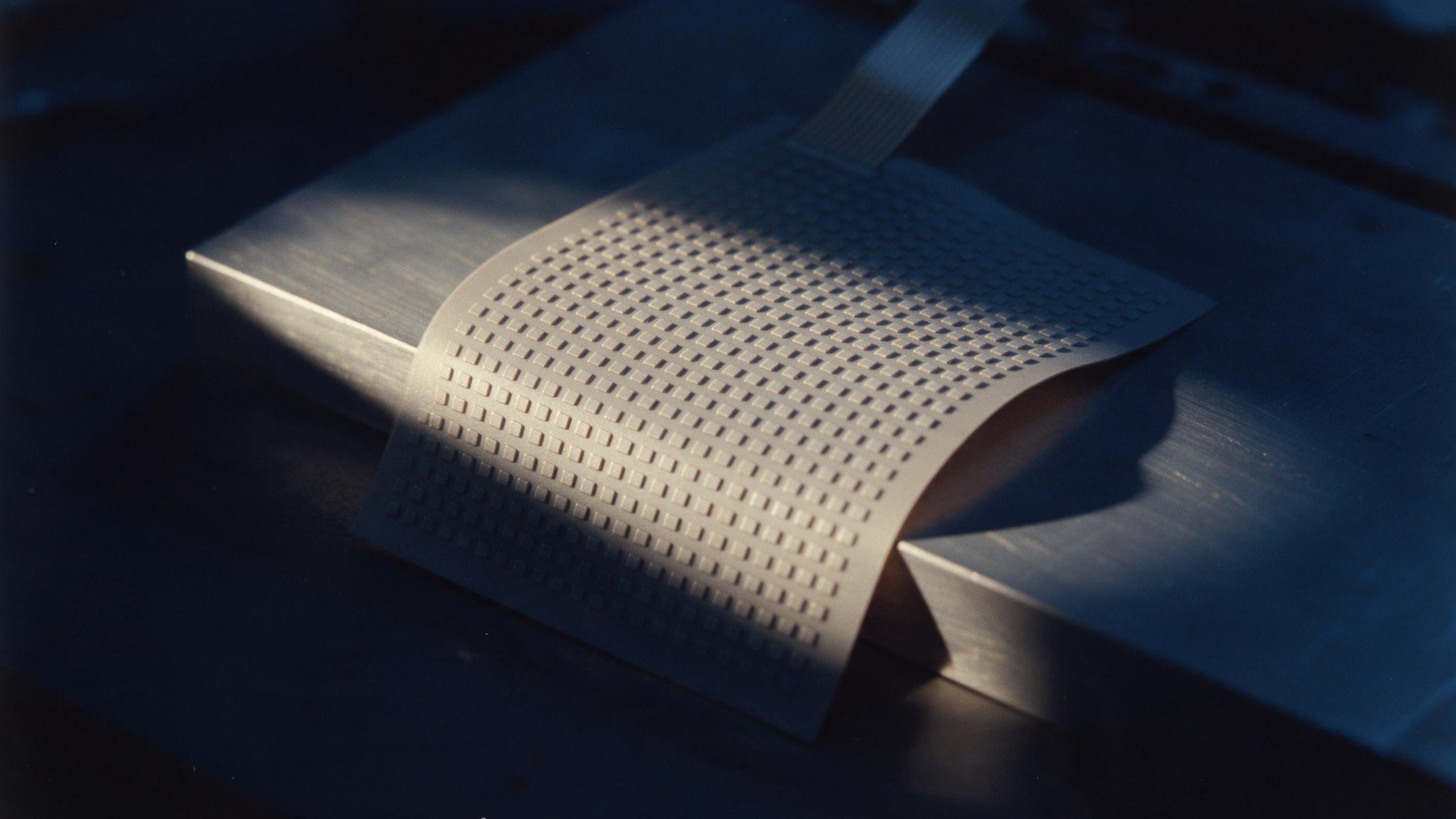
By 2020 the same research lineage had produced a 256 by 256 active-matrix pressure sensor on a flexible substrate: 65,536 taxels at roughly 1 millimetre pitch and 100 hertz. A 2023 demonstration put that class of array on a robotic hand. A 2024 result drove a 64 by 64 oxide array to 0.5 millimetre pitch and 400 hertz on a PEN film.\n\nActive matrix is why the count could go up. One thin-film transistor at every taxel lets each element be addressed on its own, so no neighbour leaks into the reading. A passive grid, driven by external multiplexing, holds to about 50 by 50 before crosstalk and signal-to-noise eat the measurement. The active route has been shown past 256 by 256.\n\nThe transistor that made it manufacturable is indium-gallium-zinc-oxide, with mobility between 10 and 50 square centimetres per volt-second and uniformity inside about plus or minus 5 per cent across a panel. Low-temperature polycrystalline silicon runs five to ten times faster and pays for it with laser-anneal variability that no one has fully tamed.
Three Projects, Three Five-Year Clocks
The funded answer to that problem was not a company. It was a set of consortia with fixed horizons. SORI ran 2020 to 2025 on soft tactile skins for human-robot interaction, coordinated from Stuttgart. TOUCHLESS runs 2022 to 2026 on tactile sensing for surgery, coordinated from Munich. ROBOSKIN ran 2019 to 2024 on whole-body electronic skin for humanoids, led from the Italian Institute of Technology.\n\nThree projects. Three five-year clocks. Three completely different end uses. Not one of them a product.\n\nThat is the mechanism. A five-year horizon lets a group spend eighteen months on a backplane and publish nothing anybody can buy. A quarterly horizon cannot. The intermediate results are the deliverable, and the density record is one of them.
Who Signs For The Long Bet
European Research Council grants and the framework programme, with a policy emphasis on human-robot collaboration, are what underwrite a horizon no quarterly budget would carry. The horizon then shows up in the hardware.\n\nThe fast budget builds an organic transistor array on PET: processed below 150 degrees Celsius, cheap, quick to make, mobility anywhere from 0.1 to 10 square centimetres per volt-second, and uniformity that wanders by 30 per cent across the panel. The long budget builds oxide transistors on polyimide: about 300 degrees, mobility 10 to 50, uniformity inside 5 per cent. Same field, same sensor, two risk appetites. The appetite is set by whoever signs, and for how long.\n\nSo the 256 by 256 record is not proof that one lab out-engineered another. It is proof that somebody agreed to fund a decade of unglamorous intermediate work.
Sixty-four sensors in 2003. Sixty-five thousand in 2020. Somebody paid for the seventeen years between them, and it was not a customer.
The Bill Arrives At The Bend
None of the funding removes the physics. Bending strain shifts a transistor threshold voltage by 0.1 to 1 volt. Registering successive layers on a substrate that expands and contracts with temperature leaves alignment errors of 5 to 50 micrometres, and that caps resolution. Threshold voltage varies by up to 30 per cent across a single flexible panel, so every taxel needs its own calibration.\n\nThe workarounds are the current state of the art. Island-bridge layouts put rigid oxide islands on stretchable interconnects: 32 by 32 arrays holding up to 50 per cent stretch, reported in 2025. Self-healing polymers re-knit after a cut and restore about 93 per cent of mechanical continuity.\n\nThe money bought the clock. The clock bought the numbers. The substrate still sends the bill.
The Record Is Not The Roadmap
Follow the deployment line instead of the density line. GelSight was invented at MIT in 2009. GelSlim squeezed it into a fingertip by 2014. DIGIT and its contemporaries arrived open-sourced in 2019 and 2020. Commercial sensors were on sale by 2022, inside humanoid hands through 2023 and 2024, and in a first industrial deployment on an assembly line in 2025.\n\nHands carrying those sensors finish contact-rich tasks at around 90 to 95 per cent success, against 60 to 75 per cent for hands without touch. The tolerance trade runs the same way in different units: a vision-guided cell has to position tighter than the tolerance it targets, so a 0.01 millimetre fit demands fixtures, calibration and a repeatable arm, while a hand that can feel only has to arrive within about 0.5 millimetre and then search.\n\nThe probability that a five-year research programme yields a shipping product is not zero. It is also not the point. These consortia are funded to produce public knowledge, and the density record, the process window and the calibration methods are exactly that. The error is reading a record as a roadmap.\n\nSixty-four sensors in 2003. Sixty-five thousand in 2020. Someone paid for the seventeen years in between, and it was not a customer.
The substrate sets the temperature ceiling, and the temperature ceiling sets the ambition.
The map is dead. Nobody told you.
Bali State of Mind is the survival guide for the collapse of everything you were taught to believe.
Beyond this book
Building the same thing somewhere else.
Julien Uhlig is available for advisory work, board seats and media appearances. Write to media@exventure.co.
The academy that trains the operators, across every company in the group, is EX Epic Academy - 25,000 applications, 25 seats per cohort, 210 alumni across 19 countries. academy.epicsolutiongroup.com
18-20 November. Online, Las Palmas, Bali.
Three days on what happens to work, capital and institutions when the map stops matching the ground. Seats are limited by cohort.
ex-aisummit.com →