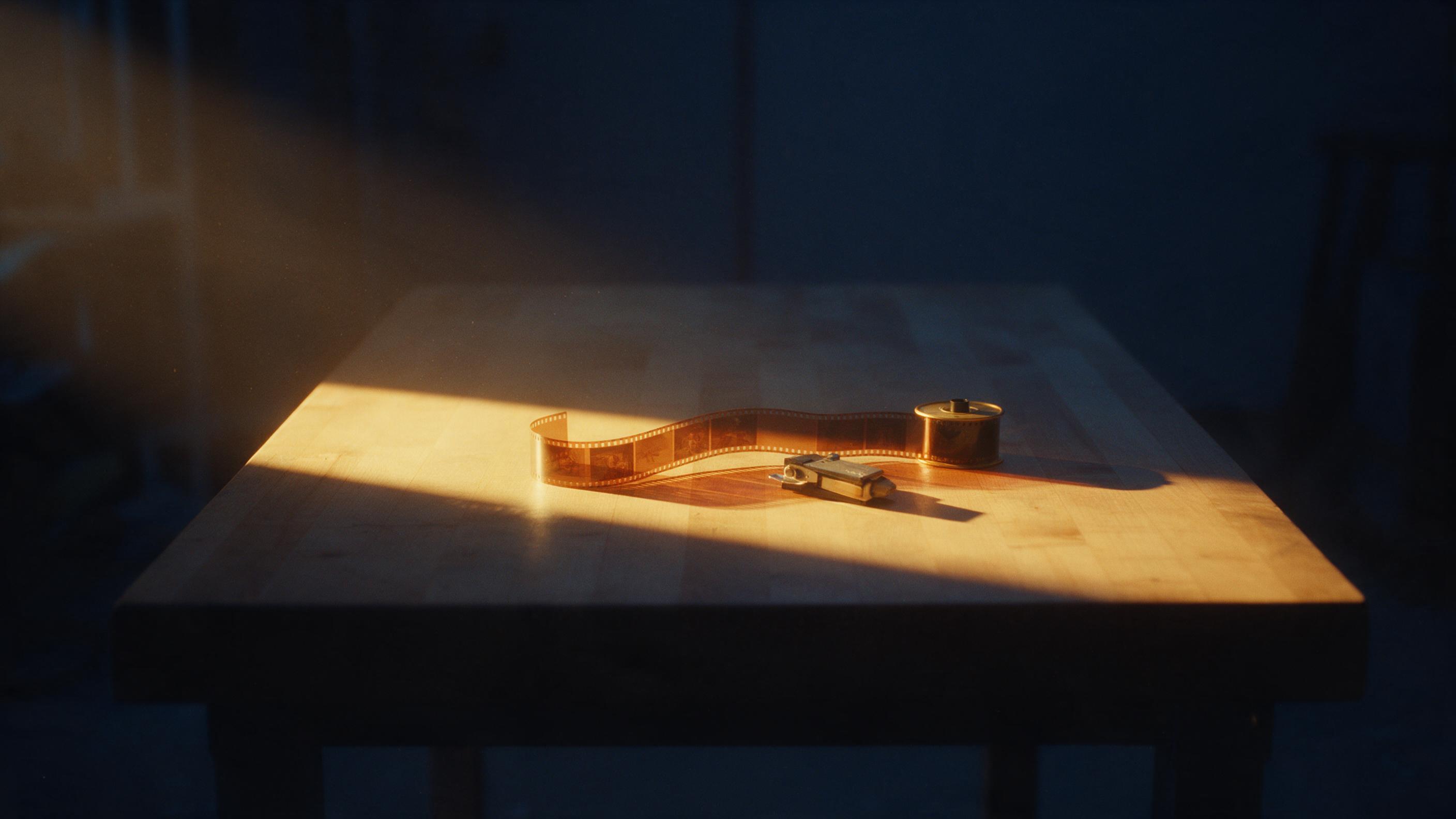
Cut To Withhold, Cut To Reveal
An edit is not a way to get from one shot to the next. It is a machine for withholding and releasing, and every cut either advances the action, changes the scale of the information, or lands a new idea. 7 tricks carry a cutting style. 1 rule carries all 7: never cut without a named reason.
The Cut Is Not A Connector
Take a 90 minute film with an average shot length of 4 seconds and you are making about 1,350 cuts. That is 1,350 decisions about what the audience knows, and most of them are made in seconds and never revisited. Nobody in the room will ever see the seam. Everybody in the room will feel the pace. The mistake is treating the cut as plumbing. Shot 1 is finished, shot 2 is waiting, so something has to join them and the join is housekeeping. Cut like that 1,350 times and the film has a rhythm but no argument, and the audience sits through 90 minutes of information that never once changes shape. The other reading is the one that matters. The cut is where anticipation becomes physical. Every edit either raises a question or answers one, and if it does neither, it is 1 of the 1,350 that could have been removed without anyone noticing. The film is not built in the shots. It is built in the gaps between them, and the gaps are the only place the audience is ever asked to do any work. So the working test is 1 sentence long. Name what the audience gains in the gap. If you can name it, cut. If you cannot, hold.
Seven Tricks, One Machine
The tricks are all versions of the same instrument, and they are worth learning together because they only work together. Cross-cutting, or parallel action. 2 or 3 storylines are intercut at different intensity phases, 1 peaking, 1 building, 1 just starting, and the cut lands on each thread at its peak. The audience is never given the whole of any 1 line, so it keeps assembling the film in its own head. The Shepard-tone edit. Structure the piece so that each scene out is slightly more intense than its in. The rise is continuous and the release is withheld by choice, not by accident. This is the anticipation arc made physical in the cut rather than described in the script. The match cut, shape to shape. A top to a city. A plane to a sea. A wave to a bookcase. The visual rhyme makes the cut feel designed instead of convenient, and it carries the theme across the seam without 1 line of dialogue explaining it. Subjective editing. Cut only when the character would look away. If the character does not see it, the audience does not see it, and the film stays inside 1 head. The objective cut is not forbidden. It is a tool for distance, and it loses its power the moment you use it by habit. Withhold, then reveal. Delay the payoff. Show what leads up to the thing rather than the thing, and let the audience hold the want for longer than is comfortable. The longer the withholding runs, the harder the release lands, and the release is the only part the audience will remember. The insert that carries the theme. 1 object recurs, and the object holds the meaning. A top. A token. A watch. Said in an insert, the theme needs no speech, and an audience that has been quietly shown the same object 4 or 5 times will do the interpretation work for you. And last, the split that holds the whole style together. Invisible cuts keep the audience inside the story. Contrast cuts make the audience feel the gap. Match on action and the sound lead are invisible. A smash cut, a hard match and a montage are visible on purpose. Knowing which 1 you are making is the entire craft.
The Cut Is Where The Rise Lives
The Shepard tone is the trick worth understanding properly, because it is the 1 worth understanding best. In sound, it is a stack of tones an octave apart in which the top fades out as the bottom rises, so the pitch appears to climb forever and never arrives. In an edit, it is a structure in which no scene is allowed to end lower than it began. Build it with 2 or 3 threads and the cut becomes the engine. Each time you leave a thread, you leave it at its highest point so far. Each time you return, that thread is still climbing. The audience reads a rise that never resolves, and the tension is not in any 1 scene. It is in the difference between where the thread was and where it now is. Then release, once, deliberately, at the place you chose before you started cutting. That release is the only drop in the film, which is exactly why it lands. A film that releases every 10 minutes is a film with no release at all, because the audience has learned the interval and can see the machinery through it. This is the difference between pace and rise. Pace is how fast the cuts come. Rise is what the cuts are doing. You can cut 1,350 times in 90 minutes and never rise once, and that is the most common failure in a fast edit: energy on the surface and no accumulating pressure underneath it.
The Grammar Underneath
The style sits on a grammar, and the grammar is short. These are the rules that decide whether a cut reads as invisible or as a mistake. Cut on action so the motion bridges the seam. The eye is tracking a hand, a turn or a step at 24 frames per second, and a cut placed inside that motion is carried across it. A cut placed 12 frames before or 12 frames after the motion is a jump, and the audience sees the edit instead of the film. Shoot 12 frames of handle either side of the action and the cut point stays a choice rather than a constraint. Lead the sound across the cut. A J-cut brings the next scene's audio in before its picture, an L-cut lets the outgoing audio run over the incoming image. Hard-cutting every line turns a conversation into ping-pong, and ping-pong reads as 2 people taking turns rather than 1 conversation happening. Hold the 180 degree line and hold the eyelines across the edit. Break the line and the audience loses the geography in 1 cut, and once the geography is gone it does not come back cheaply. Change size or angle by at least 30 degrees between 2 shots of the same subject, and keep both eyelines inside 180 degrees of each other. A jump between 2 frames of the same subject at the same size and the same angle is the clearest amateur tell there is, and no amount of grade fixes it. Cut on action to stay invisible. Cut on contrast to make meaning. A smash cut, a shape match or a short montage is a visible cut, and a visible cut is a statement. Use the invisible 1 when the audience should forget it is watching. Use the visible 1 when the audience should feel the gap, and be certain which 1 you meant before the timeline is locked. The continuity rules behind all of this sit in R1 to R13, and the cutting stage is Stage 7 of the production path. Both exist so that no 1 is arbitrating the grammar at the moment of the cut, which is the worst possible moment to be deciding anything.
The cut is a machine for withholding and release, not a way to move from one shot to the next.
Cut Shorter Than Feels Comfortable
The single most useful habit in an AI stitch is to cut sooner than feels right. A generated shot tends to run past its own information, and a shot that has finished saying what it came to say keeps holding the frame while the audience waits. A long static run does not read as patience. It reads as generated. A held frame that delivers nothing for 15 seconds is 15 seconds the audience spends outside the film. The audience has no way to say why, but it can feel the shape of a shot that has no reason to still be on screen, and that feeling is the opposite of the immersion the shot was bought for. So cut on information rather than on comfort. Ask what the shot is delivering, and the moment it has delivered it, leave. If the audience needs the extra 1 second to catch up, they will catch up in the next shot, because the next shot is already carrying the motion across the seam at 24 frames per second. Holding the outgoing frame for 10 seconds to make sure everybody understood is 1 of the most expensive things an editor can do, and it costs nothing to do wrong. The other half of the habit is naming the cut. Write the reason in 1 clause, on the timeline, where you can read it. Advances the action. Changes the scale of the information. Lands a new idea. If the clause will not come, the cut has no reason, and a cut with no reason is the 1 the audience feels as a stumble.
Never Cut Without A Named Reason
Put the whole style in 1 line. Cut to withhold, cut to reveal, cut to rise, and never cut without a named reason. The cut is where the anticipation arc stops being a plan and starts being physical, and every edit either raises the question or answers it. That is why the audience can follow a film that tells them almost nothing. It always knows where it is, even when it knows nothing else. Geography first, then information, then meaning, and the withholding happens inside that structure rather than in place of it. The same discipline shows up outside a timeline. Building companies across twelve countries, restructured a industrial group, deployed 210 energy systems across Africa and Asia, took a company through a Frankfurt IPO, and shipped 200 wood-gasification machines across the UK and Europe are all the same instruction repeated: decide the reason first, then hold the decision when it gets uncomfortable. A book of 393 pages in paperback and Kindle is 393 pages of the same discipline applied to sentences. The cuts that survive are the ones with a reason that can be said out loud. The probability that an edit reads as intentional is not a property of the footage and it is not a property of the model. It is a property of how many of the cuts were given a reason before they were made, and most timelines are still pricing that at zero. Keep the line above the monitor, where the timeline is. Cut to withhold, cut to reveal, cut to rise, and never cut without a named reason.
Cut to withhold, cut to reveal, cut to rise, and never cut without a named reason.
The map is dead. Nobody told you.
Bali State of Mind is the survival guide for the collapse of everything you were taught to believe.
Beyond this book
Building the same thing somewhere else.
Julien Uhlig is available for advisory work, board seats and media appearances. Write to media@exventure.co.
The academy that trains the operators, across every company in the group, is EX Epic Academy - 25,000 applications, 12 per cohort, 200+ alumni across 19 countries. academy.epicsolutiongroup.com
18-20 November. Online, Las Palmas, Bali.
Three days on what happens to work, capital and institutions when the map stops matching the ground. Seats are limited by cohort.
ex-aisummit.com →