Coalification In Four Hours
Wet waste had no process for a century. The missing step was water, and it was already in the feedstock.
The Tonne That Is Mostly Water
Entrade put two hundred wood-gasification machines into buildings across the UK and Europe, and every one of them wanted dry fuel. Below about 15 per cent moisture a gasifier behaves. Above it, you are burning part of your own product to dry the rest of it, and the meter runs backwards. Sewage sludge arrives at 80 per cent water. Food waste arrives wetter. Digestate, the residue a biogas plant leaves behind after it has taken its cut, comes out at 90 per cent or more. For a century the answer was to dry it. Press it, belt it, stack it under a roof, pay for every joule removed. That is not a process. That is a bill with a schedule attached. The probability that wet feedstock is the binding constraint on your project is not zero. Most operators price it at zero, right up until the dryer becomes the largest energy consumer on site.
Inkohlung, Compressed
Nature has been running this reaction for a very long time. Peat to lignite to bituminous coal takes somewhere between 50,000 and 50 million years, depending on the basin. Friedrich Bergius described the compressed version in 1913. He took the Nobel Prize in Chemistry in 1931 for high-pressure chemistry, sold the patent to BASF, and by the Second World War Germany was running 18 direct liquefaction plants turning out roughly 4 million tonnes a year. The same principle sits under hydrothermal carbonisation: wet organic matter, hot compressed water, and time compressed into hours. Four reactions run in sequence. Hydrolysis breaks cellulose, hemicellulose, lignin and proteins into water-soluble monomers. Dehydration strips hydroxyl groups out as water and drags the oxygen-to-carbon ratio down. Decarboxylation releases carbon dioxide and densifies what is left. Polymerisation and aromatisation then build the reactive intermediates, principally 5-hydroxymethylfurfural, into aromatic clusters and eventually carbon spheres. Water is not the obstacle in that sequence. It is the solvent, the catalyst and the reaction medium, and its ionic product climbs under subcritical conditions, so the acid-base chemistry accelerates without anyone adding acid.
Four Hours, Not Fifty Million Years
The operating window is narrower than the pitch deck and wider than most engineers assume. Temperature runs 180 to 280 degrees Celsius, with most commercial work done between 200 and 250. Pressure is autogenous, 10 to 50 bar, generated by the steam table rather than by a compressor you have to buy and feed. Time in the reactor runs from 30 minutes to 24 hours, with 1 to 8 hours covering the commercial cases. Subcritical water is the medium throughout and pH lands acidic, usually 3 to 7. Temperature is the lever that matters. Raise it and carbon content climbs, yield falls, energy density improves. Hold time past 4 to 6 hours and the returns thin out, which is why the 4-hour plant exists as a product. The reaction is mildly exothermic. It releases 25 to 38 per cent of the dry biomass energy value while it runs. That is not a rounding error. It is the reason a plant can hold temperature at 91 per cent feedstock moisture without importing heat.
What Comes Out, And What Comes Out With It
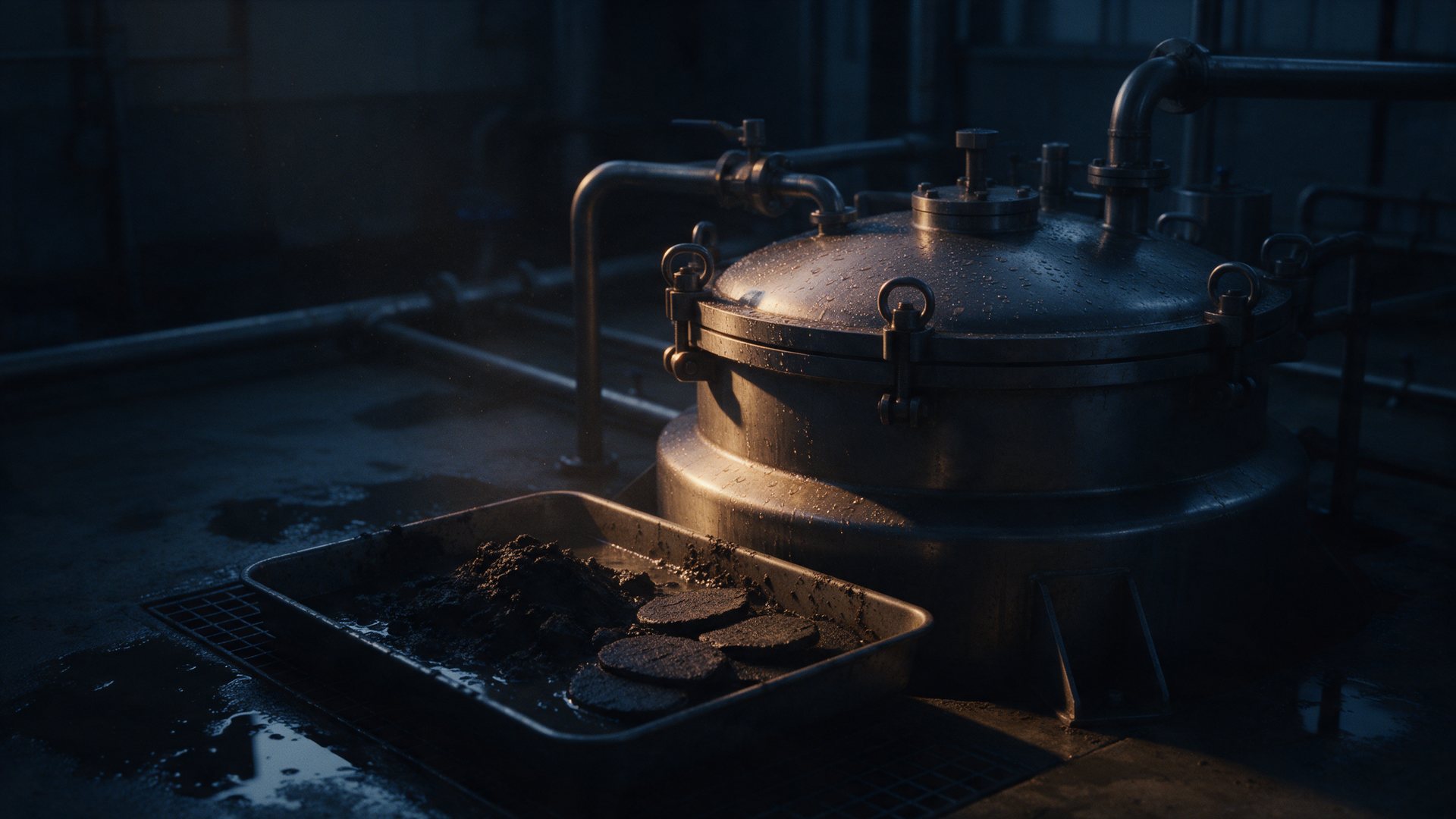
Three streams leave the reactor and only one of them is the product people talk about. Hydrochar is the solid, 50 to 70 per cent of the input by weight in a good run, carrying 45 to 70 per cent carbon against 35 to 50 in the feedstock. Higher heating value lands between 20 and 30 megajoules per kilogram. The oxygen-to-carbon ratio falls to 0.1 to 0.4, which is lignite territory, and surface area sits at 10 to 100 square metres per gram before any activation. Process water is 20 to 40 per cent of the mass and it is the stream that decides whether the site is a treatment works or a liability. Chemical oxygen demand runs 30 to 50 grams per litre. Total organic carbon reaches 4,000 to 31,700 milligrams per litre, ammonium nitrogen 4,400, potassium between 5,870 and 6,330. Gas is 5 to 10 per cent of the mass and it is 95 per cent carbon dioxide or better, which is the chemistry telling you where the carbon went. Then the number that decides the argument. Carbon retention across solid and liquid runs above 90 per cent. Pyrolysis biochar keeps 30 to 50. Anaerobic digestion keeps about 50. Alcoholic fermentation keeps about 67. And biochar needs feedstock under 20 per cent moisture, so the wet tonne has to be dried first. Hydrochar runs at 90 per cent water and does not care.
Water is not the obstacle. It is the reagent.
The Plant That Already Works
This is not a laboratory curiosity. Ingelia reached technology readiness level 9 in 2010 and has held it. First commercial plant at Naquera in Valencia, two reactors running from 2016 at about 14,000 tonnes a year, a UK unit at Immingham from 2018 with CPL Industries at 0.6 tonnes an hour, Ostend in Belgium from 2022 at 6,000 tonnes a year, and a planned Tuscan plant with ACEA at 80,000 tonnes a year, the largest designed so far. Its continuous reactor patent ES2768236T3 carries a 2012 priority and was granted in 2020. The process runs at 210 degrees Celsius and 20 bar with 4 to 8 hours in the reactor, and the hydrochar is certified to ISO 17225/8 at 20 to 24 megajoules per kilogram. C-Green Technology in Solna bolted wet oxidation onto the back end, which is exothermic, so once the unit is started it needs no external heat at all. That removes the largest operating cost on the sheet. The reactor runs 180 to 250 degrees, then oxidation at 220 to 260, up to 30,000 tonnes of wet sludge a year per plant. First installation at Heinola in Finland with Stora Enso in January 2020 at about 20,000 tonnes a year, patent US11724952B2 granted in August 2023 on a 2018 priority, modules shipped in 20 and 40 foot ISO containers, and in June 2026 a raise of SEK 40 million, about EUR 3.7 million, for European expansion. TerraNova Energy in Germany pairs carbonisation at 180 to 200 degrees and 20 to 35 bar with thermal hydrolysis at 160 to 170, and reports the pair lifting total biomethane yield 50 per cent and hydrolysis alone 35 per cent. Its Mexico City installation is the largest plant treating organic waste anywhere. HTCycle, formerly AVA-CO2 Schweiz, ran the first industrial-scale demonstration unit at Karlsruhe in 2010 and its first industrial plant at Relzow in 2012 at 8,400 tonnes a year with reactors of 14,400 litres. SunCoal Industries, bought by UPM Biochemicals in August 2023, holds more than 47 patents and has already walked the output away from fuel and into materials. More than 200 companies and organisations are filing in the space, patent growth went exponential from about 2005, filings peaked between 2010 and 2020, and the move from batch reactors to continuous ones dates from 2012.
The Water Is The Waste Stream
Read the failure list and it is one subject. The first bottleneck named in the literature is process water management, and it is not a footnote. A chemical oxygen demand of 30 to 50 grams per litre is a treatment obligation with a price attached, and the cheapest treatment is to put the water back into the front of the reactor. Recirculation buys 5 to 8 per cent more energy recovery and concentrates the organics until chemical oxygen demand doubles after three cycles, acetic acid accumulates to 20 grams per litre, and hydrochar quality starts to degrade past the third pass. Pair it with anaerobic digestion instead and the arithmetic changes. The digester removes 75 per cent of the chemical oxygen demand and produces 225 to 302 normal millilitres of methane per gram of it. Recirculation plus digestion takes total energy recovery to 90 per cent against 84 for a conventional plant, and TerraNova reports the same route lifting biogas yield about 15 per cent. Capital sits at EUR 300 to 600 per tonne of annual input, operating cost at EUR 50 to 120, and a gate fee can swing feedstock from a cost of EUR 50 a tonne to an income of EUR 30. Solid fuel grade hydrochar sells at EUR 80 to 150 a tonne. Break-even is 10,000 to 20,000 tonnes of input a year, payback 4 to 8 years, internal rate of return 8 to 15 per cent with gate fees counted. A 2025 comparison put the floor price of hydrochar at USD 0.0063 per megajoule against USD 0.0082 for slow pyrolysis, 23.2 per cent cheaper. The market was USD 966 million in 2024 and is projected at USD 2,513 million by 2034 at 10.5 per cent compound growth. In 2024 there were 58 active plants in Europe, 41 in Asia-Pacific and 23 in North America. In 2023, 3.4 million tonnes of wet waste were diverted from landfill through the process. Three companies hold more than 57 per cent of installed capacity. And roughly 35 per cent of small facilities still fail to clear a five-year return.
The Step That Was Missing Was Already In The Feedstock
I spent years building hardware that wanted dry fuel, and the drying cost was always a line in the budget that belonged to somebody else. That is the whole mistake. A tonne of wet waste is mostly water. The industry treated the water as an obstacle and paid, decade after decade, to take it out. The process that took over instead treats the water as the reagent, holds it at pressure, and finishes in 4 hours what a geological basin takes 50 million years to do. I have built companies across twelve countries, restructured a EUR 75 million industrial group, taken a company through a Frankfurt IPO, deployed 210 energy systems across Africa and Asia, and signed a EUR 20 million personal guarantee on an operation that folded on Christmas Day 2008. In every one of those, the binding constraint was the step everyone had already priced as solved. Drying the feed was that step, and the cost sat inside the plant for a century because nobody went back to the assumption. The probability that your cheapest feedstock is the wet tonne you are currently paying to dewater is not zero. Most operators price it at zero. Water was never the problem.
The reaction releases 25 to 38 per cent of the feedstock energy while it runs. That is not a rounding error.
The map is dead. Nobody told you.
Bali State of Mind is the survival guide for the collapse of everything you were taught to believe.
Beyond this book
Building the same thing somewhere else.
Julien Uhlig is available for advisory work, board seats and media appearances. Write to media@exventure.co.
The academy that trains the operators, across every company in the group, is EX Epic Academy - 25,000 applications, 25 seats per cohort, 210 alumni across 19 countries. academy.epicsolutiongroup.com
18-20 November. Online, Las Palmas, Bali.
Three days on what happens to work, capital and institutions when the map stops matching the ground. Seats are limited by cohort.
ex-aisummit.com →