Cheap Is A Specification
Piezoresistive sensing is the workhorse: a filler-loaded elastomer whose resistance falls under load, with gauge factors of 5 to 20 for carbon black and 20 to 100 for graphene foam, a response time of 1 to 10 milliseconds and a spatial resolution of 1 to 10 millimetres - against 5 to 20 per cent hysteresis, 5 to 30 per cent drift over hours and a 10 to the 3 to 10 to the 5 cycle life. It answers presence, coarse force and spatial pattern. It cannot hold a calibration.
A Filler Network Above Its Percolation Threshold
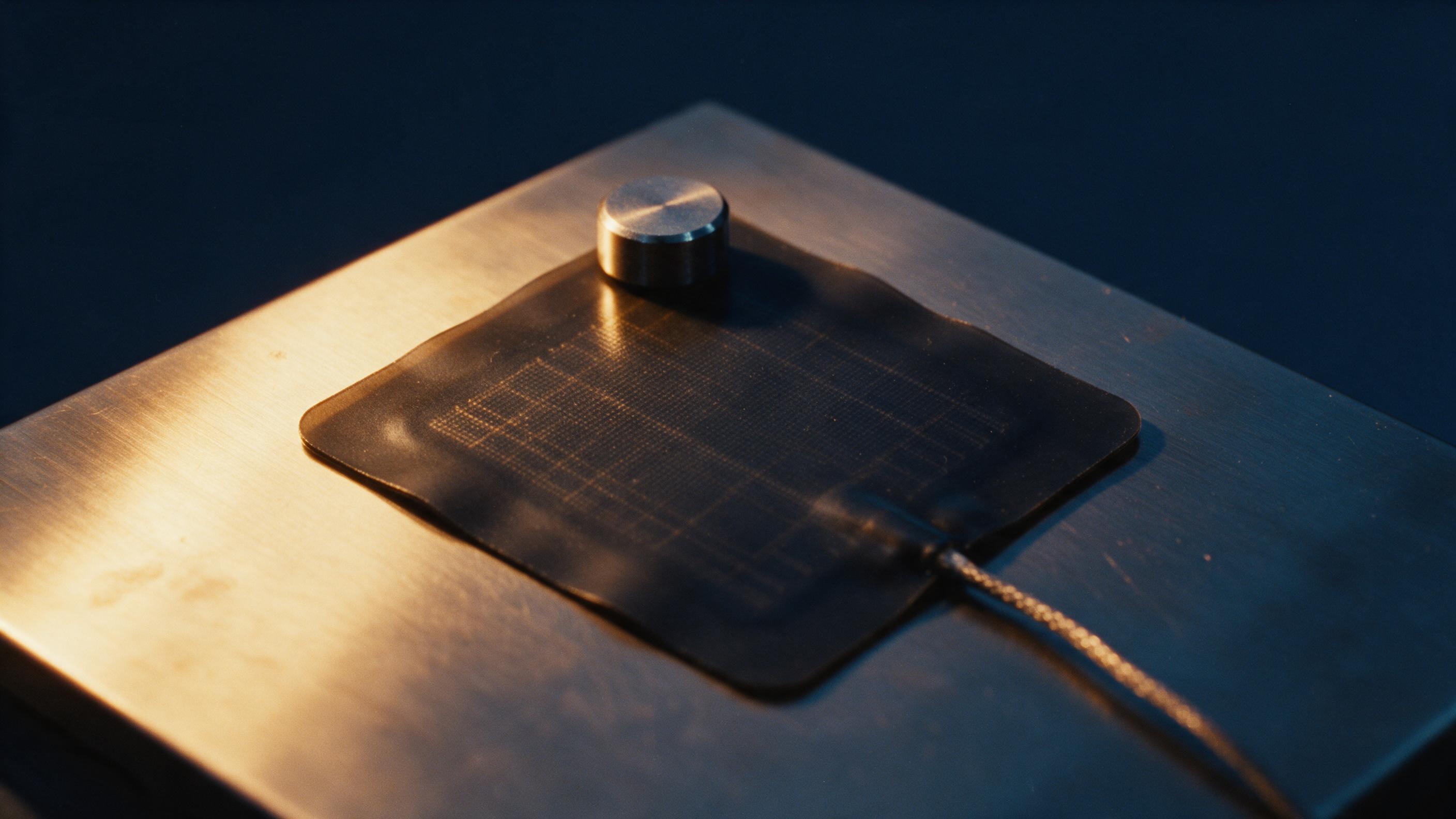
A piezoresistive sensor is an elastomer loaded with conductive filler above its percolation threshold. Squeeze it and the particles move closer, the conductive pathways multiply, the resistance falls. Release it and the resistance climbs back along a different curve. That is the whole mechanism. A voltage divider reads it. No charge amplifier, no carrier frequency, no shielded cable. One force-sensing resistor and one microcontroller pin will report contact, and they will do it for years without a recalibration step in the firmware. The cost of that simplicity sits on the same datasheet, in the same font. Loading and unloading do not retrace the same path, so the reading depends on history rather than on force. The number a piezoresistive pad reports is not a measurement of pressure. It is a measurement of its own history. Decades of use in grippers and pressure mats come from exactly that trade, taken deliberately.
Five Materials, Four Orders Of Drift
Five filler systems cover the whole useful range. Carbon black in PDMS lands at a gauge factor of 5 to 20 across 0 to 100 kilopascals. Carbon nanotubes lift that to 10 to 50 over 0 to 50 kilopascals, and the nanotube route pays for the sensitivity in agglomeration and in price. Graphene foam reaches 20 to 100, the highest gauge factor of the five, across the narrowest range at 0 to 10 kilopascals, and it is also the most fragile of them. Velostat, the conductive fabric inside every hobbyist pressure mat, sits at about 5 across 0 to 500 kilopascals. PEDOT:PSS on fabric runs 10 to 30 over 0 to 50 kilopascals and drifts with humidity. The gauge factor is the headline column and the weakest one to shop on. Response time is 1 to 10 milliseconds and spatial resolution is 1 to 10 millimetres, and both of those numbers are set as much by the electrode pattern and the readout as by the chemistry. The stability numbers decide the application. Hysteresis is 5 to 20 per cent of full scale. Drift is 5 to 30 per cent over hours under sustained load. The temperature coefficient is 0.1 to 1 per cent per degree Celsius, which across a 40-degree swing is the same order of magnitude as the signal. Cycling life runs 10 to the 3 up to 10 to the 5 cycles.
Four Failure Modes, Read As A Specification
Read the four weaknesses as the specification rather than as a complaint, and the material becomes easy to place. A pad that creeps 30 per cent over four hours cannot hold a calibration, so any product built on it re-zeroes on every grasp or measures something other than absolute force. Temperature is the second trap. Resistance moves with temperature at 0.1 to 1 per cent per degree, and a gripper pad sitting beside a motor has no way to separate the two effects unless a reference element sits next to the sensing one. The honest architecture is differential: two identical elements, one loaded and one not, with the readout taking the difference and the temperature cancelling. Hysteresis is the third. The gap between the loading path and the return path is 5 to 20 per cent of full scale, which is small inside a pressure mat and enormous inside a force-controlled gripper. The fourth is life. Ten to the 5 cycles sounds like a lot until the application runs at 1 hertz, where it is 27 hours.
The Cheap Version Is A Statement About The Product
I signed a EUR 20 million personal guarantee on an industrial roll-up and watched the company fold on Christmas Day 2008. What I took from that was not a lesson about risk appetite. It was that choosing the cheap version of a component is never a compromise on the component. It is a statement about what the product is allowed to be. A piezoresistive array cannot measure past about 5 per cent accuracy, and no better amplifier fixes that. The filler network restructures under load. Sheet resistance creeps. The baseline walks. What the material can do is report presence, coarse force and spatial pattern, and pattern at 1 to 10 millimetres is exactly what a pressure floor or a gripper skin needs. One distinction carries the whole decision. A gripper pad answers whether something is held. An instrument answers with what force, traceable, the same number tomorrow. Only one of those questions is worth 10 times the cost per taxel.
The number a piezoresistive pad reports is not a measurement of pressure. It is a measurement of its own history.
Where It Wins, Every Day
Three applications pay for piezoresistive sensing without apology. A gripper pad detects the presence and absence of a grasped object and gives a coarse force reading that tells the controller whether the grasp is holding. A pressure-sensitive floor does gait analysis, fall detection and occupancy sensing across square metres, where cost per taxel decides whether the project exists at all. A wearable joint reads bending angle and contact pressure inside an exoskeleton. Every one of those wants pattern rather than precision. None of them needs a traceable force measurement, and none of them will ever be audited by a calibration laboratory. The applications that fail here are the ones that need a number somebody will sign. Torque verification, dose delivery, force feedback thin enough that a human feels the error. Those want capacitance, a strain gauge or an optical sensor, at 10 to 50 times the cost per taxel and with their own electronics attached. Scale decides as well. Matrix addressing keeps the wiring count down, so a mat with 1,000 taxels is a manufacturing question rather than a wiring question.
Write The Accuracy Down Before You Choose
The purchasing decision is normally framed as a budget question and it is a specification question. A piezoresistive mat and a capacitive array are not the same instrument at two prices. They are two different instruments that happen to report the same variable, and only one of them will survive an accuracy audit. So write down the accuracy the product actually needs before the sensor is chosen. If the answer is 5 per cent and pattern, the cheap material is the correct engineering choice and nobody should apologise for it. If the answer is 1 per cent and a calibration that survives a service interval, the cheap material is the wrong one, and no amount of signal processing makes it right. Cheap is a specification. It says coarse, absolute-free, pattern-first and re-zeroed every cycle. That is a strong specification for a pressure floor and a fatal one for a scale. The probability that a piezoresistive array, read with a better amplifier and a smarter calibration model, ever reports force to instrument accuracy is low, because the drift lives in the material and not in the electronics.
Gauge factor is the headline column and the weakest one to shop on.
The map is dead. Nobody told you.
Bali State of Mind is the survival guide for the collapse of everything you were taught to believe.
Beyond this book
Building the same thing somewhere else.
Julien Uhlig is available for advisory work, board seats and media appearances. Write to media@exventure.co.
The academy that trains the operators, across every company in the group, is EX Epic Academy - 25,000 applications, 25 seats per cohort, 210 alumni across 19 countries. academy.epicsolutiongroup.com
18-20 November. Online, Las Palmas, Bali.
Three days on what happens to work, capital and institutions when the map stops matching the ground. Seats are limited by cohort.
ex-aisummit.com →