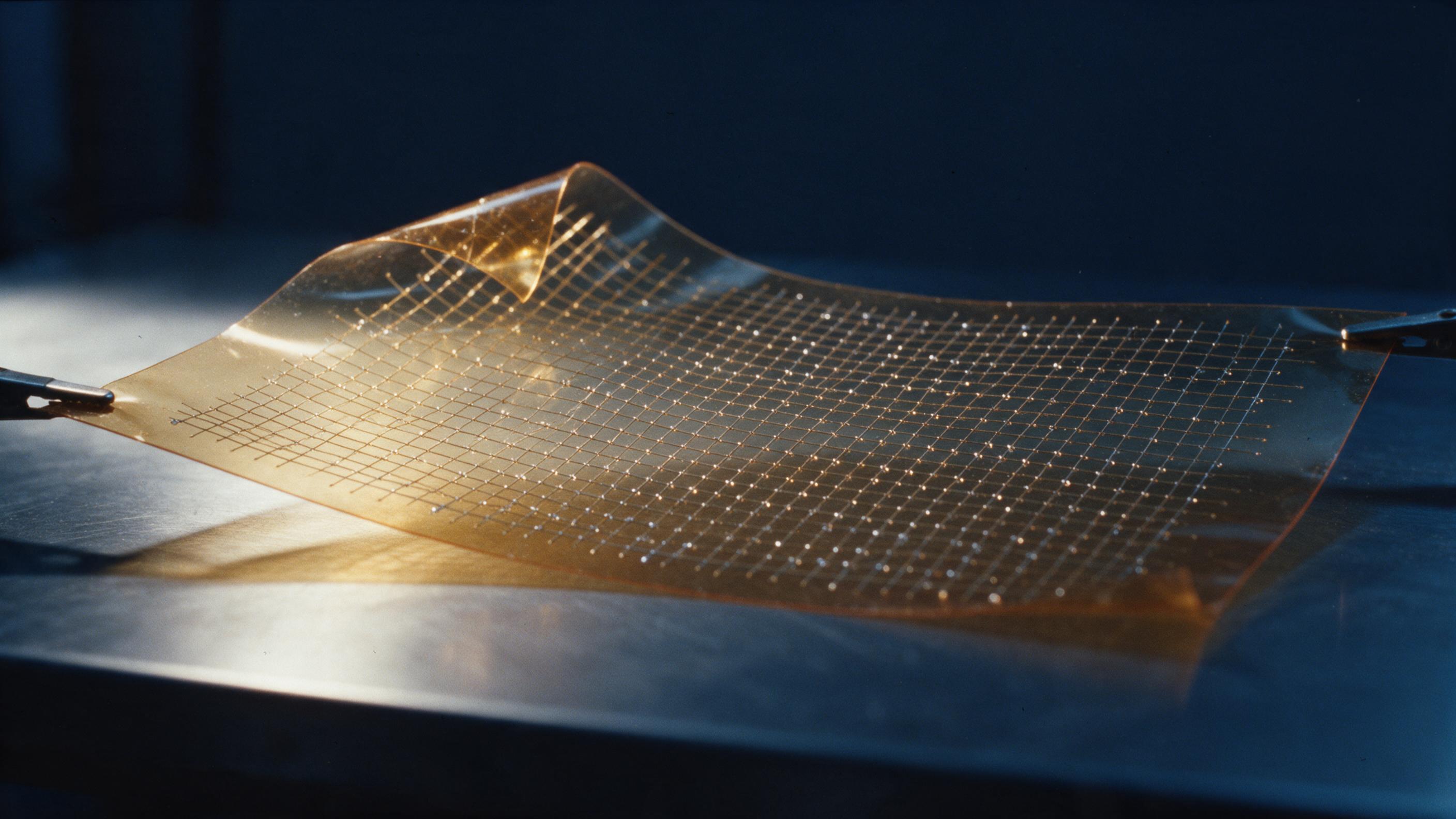
A Switch Behind Every Taxel
A passive matrix is the cheapest way to read a sheet of sensors and it stops being practical near 50 by 50, where crosstalk, frame rate and signal to noise all turn against you. Put a thin-film transistor at every taxel and the crosstalk path is switched open: 256 by 256 at 1 millimetre pitch and 100 hertz has been built. The bill is a 300 degree process ceiling, 5 to 50 micrometre registration, threshold voltages that vary 30 per cent across a panel, and a calibration for every point on the sheet.
Fifty By Fifty Is The Wall
Wire a sheet of pressure sensors as a grid. Row lines one way, column lines the other, a sensing element at each crossing, one readout circuit at the foot of every column. Drive a row, measure the columns, move to the next row. That is a passive matrix, and for a small array it is the cheapest thing that works. It does not scale, and the reason is not the sensor. With no switch at the crossing, every element shares an electrical node with everything else in its row and everything else in its column. Apply a voltage to read one point and the current finds neighbouring paths. A press in one corner appears, faintly, in the reading from a different corner. Ghosting is the polite word for it. Three numbers describe the ceiling. Frame rate falls away past about 32 rows. Signal to noise degrades with every row added. Passive arrays stop being practical somewhere near 50 by 50, which is 2,500 points on the sheet. Fifty by fifty is a patch. It is not a limb, and it is not a body. The sensor material was never the constraint here. The addressing was.
A Transistor At Every Point
An active-matrix backplane puts a thin-film transistor at every single taxel. One switch per sensing element, fabricated into the substrate underneath it. The rows and columns stay. What changes is where they land. The gate of the transistor connects to the row select line. Its source and drain sit between the taxel and the column readout line. Drive a row and every transistor in that row turns on, connecting each taxel to its own column. The rows you are not driving have their transistors off. Those taxels are floating, isolated, and invisible to the measurement in progress. Crosstalk is not reduced by this. The parasitic path it travelled through is switched open, so the path does not exist while you are reading. Frame rate stops depending on how large the array is. Signal to noise stops degrading with size. The ninth row and the two hundredth row measure the same way. For a capacitive sensor, one transistor per point is not enough. A two-transistor cell adds a reset transistor that pulls the taxel to a known state before the read. A three-transistor cell adds an amplifier so the signal leaves the taxel already strong, before it crosses the column line. Both are standard cells. Both cost area, and area is pixel pitch, and pixel pitch is resolution. That is the trade in one sentence. Large-area sensing with no interference, bought by building a transistor array underneath it.
The Table The Display Industry Already Paid For
None of this is new physics. Every flat panel display ships an active matrix, and the display industry spent thirty years and a great deal of capital learning to make thin-film transistors on glass, then on plastic. Five families are on the table. Amorphous silicon, a-Si:H, mobility of 0.5 to 1 square centimetres per volt second, mature to the point of being unremarkable. Indium gallium zinc oxide, IGZO, mobility 10 to 50, mature in flexible OLED production. Low-temperature polysilicon, LTPS, mobility 50 to 200, and it needs roughly 500 degrees Celsius for the crystallisation step. Organic transistors, OTFT, mobility 0.1 to 10, processable below 150 degrees. Carbon nanotube transistors, mobility 10 to 100, still research. IGZO is the sweet spot. Between 10 and 50 for mobility, good uniformity, a process that fits under 300 degrees, and an established manufacturing base because commercial flexible OLED displays already run it. LTPS is the fastest practical option and it is five times quicker than IGZO. It also wants a substrate that survives 500 degrees, which polyimide does not. That single number decides the flexible list before any sensor design starts. The uniformity column matters more than the mobility column, and the tables usually put mobility first. A transistor with mobility of 100 and a threshold that varies 30 per cent across the panel gives you an array where every point needs its own correction. A slower transistor that behaves the same everywhere gives you an array you can read with one equation.
Three Hundred Degrees
The fabrication problem is not the transistor. It is everything the transistor sits on. Flexible substrates — polyimide, polyethylene naphthalate — put a ceiling of about 300 degrees Celsius on the whole process. That number alone deletes LTPS from the flexible list. It also constrains the dielectrics, the contact metals and every anneal step in the flow. Registration is the second constraint. A thin-film transistor is built from successive lithography layers, and a flexible substrate expands and contracts with each thermal step, so layer two does not land perfectly on layer one. Alignment errors of 5 to 50 micrometres are common, and that figure sets the floor on pixel pitch before the sensor is considered at all. Threshold voltage is the third, and it is the one that reaches the product. Across a flexible panel the threshold voltage of the transistors varies by plus or minus 30 per cent. Each taxel then has a different on-resistance, which is a different gain, which means the same pressure reads as a different number depending on where it landed. Bend the sheet and it gets worse: strain shifts each threshold voltage by 0.1 to 1 volt, so the correction that was right flat is wrong at the radius you are actually holding. Three things follow, and they are all cost. Every point on the sheet gets its own calibration. That calibration is a function of curvature, not a constant. And the calibration has to live somewhere, which means a chip, a bus and an extra step in software for every taxel on the substrate.
A passive array is a party line. Every point hears every other point.
What The Switch Buys
Numbers, from arrays that have actually been built. An amorphous silicon 16 by 16: 2 millimetre pitch, 1 kilohertz frame rate, no crosstalk, uniformity plus or minus 15 per cent, bend radius 10 millimetres. An IGZO 32 by 32: 1 millimetre pitch, 500 hertz, uniformity plus or minus 5 per cent, bend radius 5 millimetres. An IGZO 100 by 100: half a millimetre pitch, 100 hertz, uniformity plus or minus 8 per cent, bend radius 3 millimetres. An organic 16 by 16: 3 millimetre pitch, 200 hertz, uniformity plus or minus 30 per cent, and it bends to 1 millimetre radius because the process stays under 150 degrees. The frontier sits where you would expect it to. A 256 by 256 active-matrix array on polyimide at 1 millimetre pitch and 100 hertz, demonstrated on a robot hand. An IGZO 64 by 64 on PEN at half a millimetre pitch and 400 hertz, integrated with capacitive tactile sensors. And an island-bridge layout that places rigid IGZO islands on stretchable interconnects, 32 by 32, holding 50 per cent stretch without losing the addressing. Set that against the passive column. A practical ceiling near 50 by 50, frame rate collapsing past 32 rows, signal to noise falling with every row added, and ghosting waiting to confuse whatever reads the output. The active matrix costs a transistor array and a calibration pipeline. It buys back the array size, the frame rate and the trustworthiness of every individual number the sheet reports.
Read The Uniformity, Not The Resolution
The comparison tables all lead with array size, because array size is the number that gets quoted back in a meeting. It is also the number most likely to survive the trip from a rigid reference design into a product that ships. Here is the order to read it in. First, does the sheet have to bend? An active matrix on a rigid substrate is a solved manufacturing problem, and if the answer is no, the calibration question collapses into one factory step. Say yes and you have bought the flexible substrate, the 300 degree ceiling, the 5 to 50 micrometre registration tolerance and a threshold voltage that moves with strain. Second, how many points, and does anyone need them to agree? Under 16 by 16 taxels a passive array is cheaper, and its crosstalk sits inside an error bar you were going to accept anyway. Above 32 by 32, or above 100 hertz, or anywhere a ghost reading would be believed by the software downstream, a switch at every point stops being an option. Third, is the stream sparse? A sensor that reports change instead of state throws most of the frame away, and a fixed scan that reads every point every cycle is the wrong instrument for it. And on a square metre of skin, over a whole body, a fabric-based matrix is more practical than a transistor array on a flexible substrate, however good the array is. I have built companies across 12 countries and restructured a 75 million euro industrial group, and the lesson from the fabrication floor repeats. The array size is the promise made in the abstract. The calibration file is the work, and the work arrives after the funding. The probability that a flexible active matrix holds its numbers through a million bends is neither zero nor one. It is a curve, and the curve is what the project actually buys.
Crosstalk is not noise you filter out. It is a number that grows with the array.
The map is dead. Nobody told you.
Bali State of Mind is the survival guide for the collapse of everything you were taught to believe.
Beyond this book
Building the same thing somewhere else.
Julien Uhlig is available for advisory work, board seats and media appearances. Write to media@exventure.co.
The academy that trains the operators, across every company in the group, is EX Epic Academy - 25,000 applications, 25 seats per cohort, 210 alumni across 19 countries. academy.epicsolutiongroup.com
18-20 November. Online, Las Palmas, Bali.
Three days on what happens to work, capital and institutions when the map stops matching the ground. Seats are limited by cohort.
ex-aisummit.com →