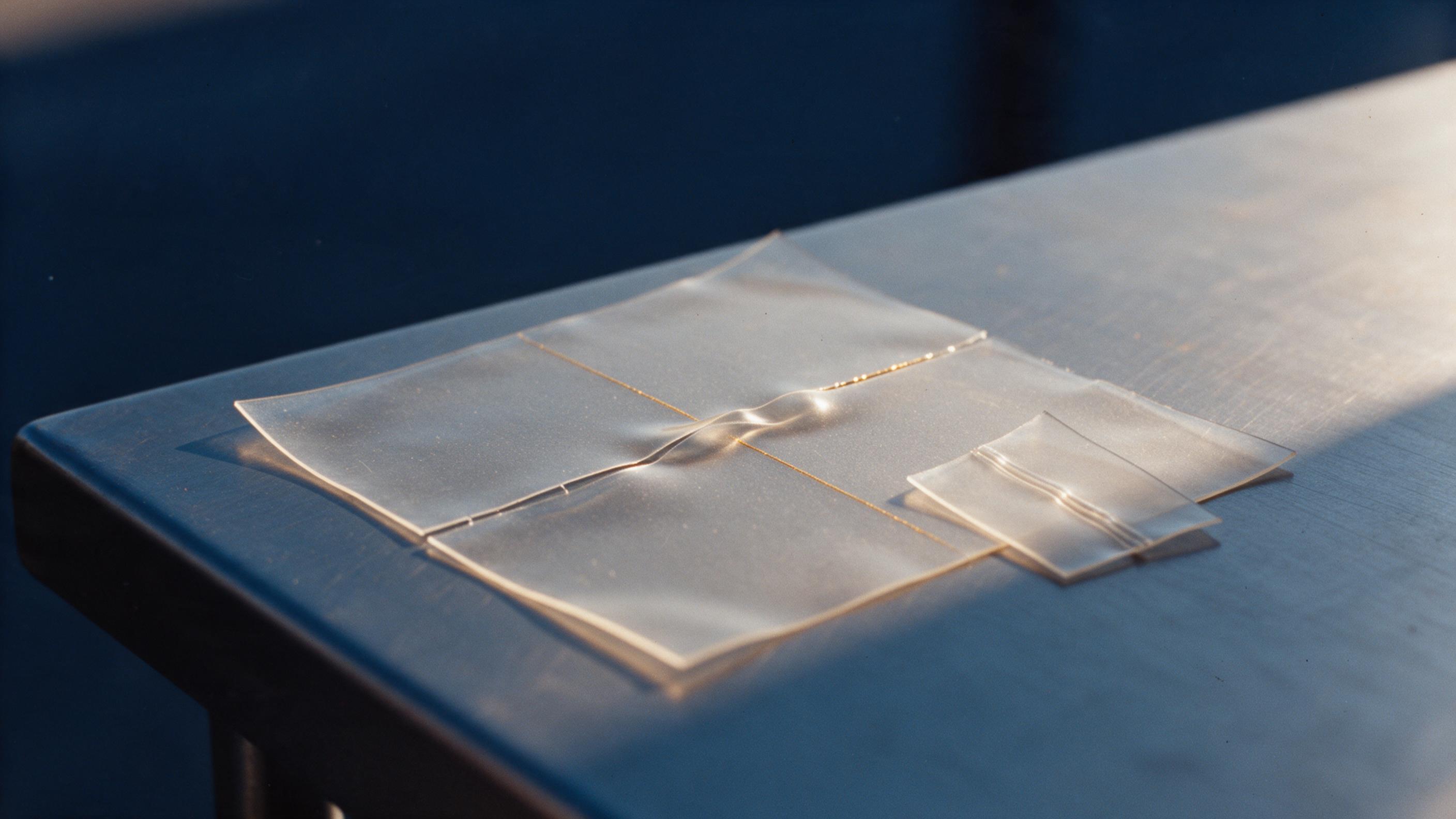
A Strain Record And A Self-Healing Cut
Two numbers define where skin-like electronics actually stands. One is an organic transistor that keeps its performance past 100 per cent strain. The other is a polymer that closes a cut at room temperature and restores its electrical path. Both are real and neither one is a device, which is exactly why they belong in the same decision.
The Two Numbers On The Record
Two numbers define where skin-like electronics actually stands.\n\nThe first is a transistor. In 2023 a set of organic thin-film transistors held their performance past 100 per cent strain, a record for intrinsically stretchable electronics. The device is stretched to twice its resting length and still switches.\n\nThe second is a cut. Polymers published between 2012 and 2018 close a slice or a scratch at room temperature and restore both the mechanical and the electrical properties of the film. No oven, no clamp, no operator. The material repairs itself where it was damaged.\n\nOne is a performance record. The other is a repair promise. Both came out of the same bet: that the material should behave like tissue rather than be protected from it.\n\nThere is a rival route on the table. Keep the silicon rigid, shrink it into islands and let the wiring absorb the movement. That route already ships in medical patches and needs no new chemistry.\n\nSo the honest question is not which one is better. It is what each route charges, in a currency you can count.
What Stretch Does To A Conductive Polymer
Conduction in a conductive polymer runs through connected PEDOT-rich domains. Pull the film and the domains separate, the percolating path thins, and resistance climbs.\n\nThe published numbers show the price. PEDOT:PSS reaches 100 to 1,000 siemens per centimetre, and its best conductivity sits at 20 to 50 per cent stretch. Polyaniline gives 10 to 100 at 10 to 30 per cent. Polypyrrole gives 10 to 100 at 10 to 20 per cent and cracks early.\n\nBlend the polymer with an elastomer such as SEBS and the composite passes 100 per cent strain at around 100 siemens per centimetre, holding through 1,000 cycles. Conductivity falls by an order of magnitude and the film survives.\n\nFilled elastomers follow the same rule with different constants. Carbon black at 10 to 30 per cent by weight gives 0.1 to 10 siemens per centimetre and 20 to 50 per cent stretch. Silver nanowires give 100 to 1,000 at 50 to 100 per cent with moderate fatigue. Silver flakes reach 1,000 to 10,000 siemens per centimetre and then give up at 5 to 20 per cent stretch.\n\nThe table has one direction. Conductivity and stretch trade against each other, because dense connected pathways are exactly what stretching disconnects.\n\nThe 2023 transistor record moved that line. It did not erase it.
The Cut Is The Test Nobody Runs
Every electronic skin has a structural problem. The sensor is the contact surface, so it is the part that gets abraded, punctured, soaked and fatigued. The most fragile component sits in the most punishing location.\n\nSelf-healing chemistry answers that with repair. The mechanisms differ mostly in what they charge for it. Hydrogen-bonded networks heal at room temperature in seconds to minutes, recover 50 to 80 per cent of mechanical strength, and survive 50 to 100 or more cycles. Diels-Alder bonds recover 80 to 95 per cent but need 60 to 120 degrees Celsius for 5 to 60 minutes and hold for 5 to 20 cycles. Disulfide exchange heals at room temperature with a catalyst, at 60 to 90 per cent and 10 to 50 cycles. Boronic ester exchange needs only water, recovering 70 to 95 per cent across 50 cycles and more.\n\nElectrical recovery is a second problem. Liquid metal reconnects almost perfectly. Conductive polymers re-entangle their chains and recover well. Percolation composites reconnect only partially, because the filler particles find new neighbours and the resistance settles higher.\n\nThe demonstrations are recent and specific. A hydrogel and carbon nanotube capacitive skin published in 2024 held 85 per cent of its capacitance after 100 cuts. An electro-optical skin published in 2025 reported about 93 per cent mechanical healing efficiency while sensing touch and proximity at once.\n\nRead the two columns together. Recovery percentage is high. Cycle count is not.\n\nA material that heals fifty times is a maintenance schedule, not a miracle.
Four Devices That Left The Bench
The device record matters as much as the material record, and it arrived in four steps.\n\nIn 2010 the first active-matrix electronic skin on organic transistors was published, with signal amplification at every pixel. It was a pressure-sensing array that could be bent and stretched, and it is the point where the material became a system.\n\nIn 2013 the first digital tactile sensor with spiking output followed, a skin-inspired organic mechanoreceptor that produced nerve-like pulses rather than an analogue voltage. The signal format changed, not just the substrate.\n\nIn 2018 a physically transient form of silicon electronics was demonstrated. The device dissolves after its working life instead of entering a waste stream.\n\nBy 2023 the stretchable organic transistor reached 100 per cent strain retention, and biodegradable electronic skin appeared in the same period. The film is expected to disappear once the measurement is finished.\n\nThe order is the interesting part. Every device arrived after the material that made it possible. None of them was a new architecture.\n\nMaterials records and device records are different achievements. The field keeps scoring the first as though it were the second.
One is a performance record. The other is a repair promise.
A Cut That Heals Against A Skin That Cannot Be Cut
Compare the two routes on their own numbers. A rigid-island system keeps commercial silicon performance, sustains 30 to 50 per cent global stretch across 1,000 cycles, and reaches 400 per cent at a much shorter life. Its minimum bend radius is about one millimetre. It has no repair mechanism at all, because the brittle part never touches the world.\n\nAn intrinsically stretchable system heals itself at room temperature and conducts at around 100 siemens per centimetre instead of the thousands of a metal trace. It loses some of that when cut, and it gets most of it back.\n\nRead the record honestly and the two routes stop competing for the same slot. The probability that healing chemistry closes the full electrical gap against a rigid island inside the same footprint is low, well under 20 per cent, because the healing chemistry and the conduction chemistry pull on the same polymer backbone. Soften the network enough to re-knit and you have already slowed the electrons.\n\nThat is not an argument against self-healing. It is an argument about where to use it. Healing is what you buy when the surface is exposed, when the damage is certain, and when reaching the damaged panel costs more than the panel.\n\nThe surface decides the material. The signal decides the geometry.
Price The Repair, Not The Material
The decision rule is arithmetic, and it takes about ten minutes.\n\nCount the damage events a surface will take in a year. Then price the act of reaching it: the downtime, the access, the labour, the risk of the intervention doing new damage. If the second number is large, a material that heals 50 to 100 times at 70 to 90 per cent recovery is cheaper than a rigid panel that has to be replaced.\n\nThen write the maintenance model, because a healable skin has one. It needs a service interval, a trigger the chemistry actually accepts, which may be heat between 60 and 120 degrees Celsius, a catalyst, or simply water. It needs a health check on the healed path, because a healed conductor is not the conductor you tested.\n\nIf the surface can be swapped cheaply and the signal is the point, the rigid island wins and it wins on performance. That is a real result, not a compromise.\n\nThe 100 per cent strain record and the room-temperature heal answer one question between them: how much electronic performance are you willing to give up to make a surface soft.\n\nAnswer it in numbers before you order a batch. The chemistry is not going to answer it for you.
The table has one direction. Conductivity and stretch trade against each other.
The map is dead. Nobody told you.
Bali State of Mind is the survival guide for the collapse of everything you were taught to believe.
Beyond this book
Building the same thing somewhere else.
Julien Uhlig is available for advisory work, board seats and media appearances. Write to media@exventure.co.
The academy that trains the operators, across every company in the group, is EX Epic Academy - 25,000 applications, 25 seats per cohort, 210 alumni across 19 countries. academy.epicsolutiongroup.com
18-20 November. Online, Las Palmas, Bali.
Three days on what happens to work, capital and institutions when the map stops matching the ground. Seats are limited by cohort.
ex-aisummit.com →